
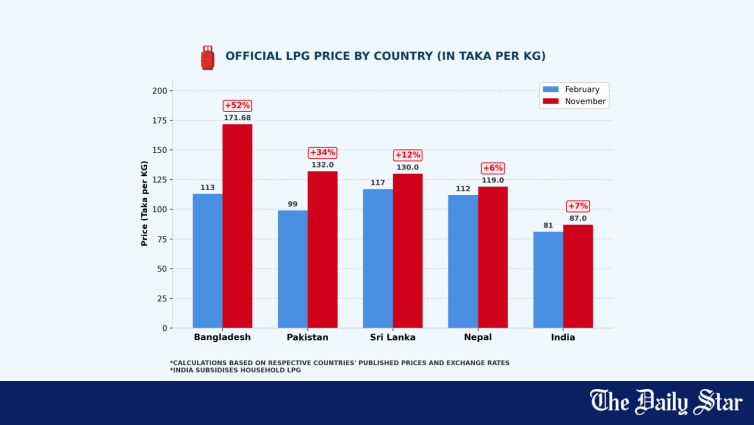
Consumers in Bangladesh are paying around 30 to 45 percent more for liquefied petroleum gas (LPG) than the official or published retail rates in Pakistan, Sri Lanka and Nepal.
The official retail price of LPG in Bangladesh has risen by nearly 52 percent since February, just before the outbreak of the Iran war, as the disruption of Middle Eastern supplies forced importers to turn to more distant sources, pushing up freight costs and premiums for securing cargoes.
The price increased from Tk 113 per kilogram in February to Tk 171.68 in November.
Over the same period, the converted official retail price rose by around 34 percent in Pakistan, 12 percent in Sri Lanka and 7 percent in India, while Nepal’s latest available rate was about 6 percent higher than its February price.
At the November rate, LPG cost around Tk 132 per kg in Pakistan, Tk 130 in Sri Lanka and Tk 119 in Nepal, according to calculations based on the respective countries’ published prices and exchange rates.
These comparisons, however, do not necessarily reflect actual market prices in Pakistan, as local newspapers report that the market price is nearly double the official rate.
In India, household consumers pay the equivalent of around Tk 87 per kg, but the rate is not directly comparable with Bangladesh’s because the Indian government subsidises domestic LPG.
Commercial LPG in Delhi costs around Tk 194 per kg, which is higher than Bangladesh’s regulated retail price.
Comparisons with India often overlook the difference between household and commercial LPG prices, said Jalal Ahmed, chairman of the Bangladesh Energy Regulatory Commission (BERC).
India’s household consumers pay less because the government absorbs a substantial part of the cost, while commercial users pay a market-linked rate.
Pakistan’s official notified price is far below what some consumers pay in the open market, and Nepal depends on supplies from India, he said.
The prices nevertheless show that Bangladesh’s regulated retail rate has risen more sharply than those in several neighbouring markets.
Pakistan and Sri Lanka, unlike landlocked Nepal, have deep sea ports that allow them to receive larger LPG vessels, Jalal said.
He identified three structural disadvantages for Bangladesh: its relatively small purchasing volume, dependence on spot market purchases and the additional cost of transferring LPG from mother vessels to smaller vessels.
“Bangladesh is a much smaller buyer than India,” he said.
Indian buyers can purchase around 1 lakh tonnes in a single vessel, while Bangladeshi companies typically buy much smaller quantities.
When both countries approach suppliers in the same international market, sellers naturally prioritise larger buyers, giving them stronger bargaining power.
India also has three state-owned oil marketing companies with long-term supply arrangements. In Bangladesh, only a few companies maintain such contracts, while many depend on spot purchases.
Spot purchases expose importers to price volatility and make it harder to secure cargoes at competitive rates, particularly when global supply is tight.
Long-term contracts provide greater certainty over volumes and supply schedules, although they do not necessarily protect buyers from changes in international prices.
Besides, Bangladesh often has to transfer LPG from large mother vessels to smaller vessels before bringing it ashore, involving an additional stage of handling and freight.
The disruption of Middle Eastern supplies has made these disadvantages more pronounced.
Before the war began on February 28, Bangladesh sourced much of its LPG from the Gulf.
But the conflict and the resultant restrictions on shipping through the Strait of Hormuz and the US–Bangladesh Agreement on Reciprocal Trade have compelled importers to seek alternative supplies from the US.
BERC’s country-of-origin data show that the US share of Bangladesh’s LPG imports rose from 27.4 percent in September 2025 to 85 percent in September this year.
The share recorded as coming from Oman fell from 41 percent to zero over the same period.
The shift towards US supplies has increased voyage times.
Shipments from the US Gulf take around 40 to 45 days to reach the Bay of Bengal, compared with roughly two weeks from Middle Eastern suppliers, according to industry sources.
Freight costs for US-origin cargoes had risen sharply, said Azam J Chowdhury, director of Omera Petroleum and former president of the LPG Operators Association of Bangladesh.
He cited an increase from around $82 per tonne before the conflict to as much as $250 per tonne under current conditions.
The pressure is not confined to Bangladesh.
US propane exports reached a record 2.2 million barrels a day in September, with Asian markets receiving 38 million barrels of US propane and 10.4 million barrels of butane during the month, according to S&P Global.
As buyers compete for supplies, international prices have risen.
S&P Global assessed North Asian propane cargoes at $977 per tonne and butane at $1,057 in October.
Butane commanded a higher price as demand for winter-grade gasoline blending increased in Western markets and disruptions to Middle Eastern supplies tightened availability, it said.
The higher butane price is particularly significant for Bangladesh, as BERC calculates local LPG prices using a blend of 35 percent propane and 65 percent butane.
On this basis, the North Asian prices translate into a weighted average of around $1,029 per tonne.
This compares with a weighted average of $759 per tonne under the Saudi Aramco Contract Price (CP), which BERC continues to use as its principal benchmark despite the shift in Bangladesh’s import sources.
For November, Saudi Aramco set the CP at $720 per tonne for propane and $780 for butane. The North Asian weighted price was therefore around 36 percent higher.
The commission’s formula provides a benchmark for retail prices, but it does not necessarily capture the actual procurement cost of every importer.
Prices paid by companies can vary according to source, contract terms, cargo size, freight, insurance and supplier premiums.
The country was still using the Saudi CP benchmark while companies were paying prices based on other international market rates, Azam said.
“It’s becoming more dangerous nowadays,” he said.
Domestic charges have also increased, which has also impacted local prices.
Under the BERC’s November revision, storage and bottling charges rose by 40 percent to Tk 23.48 per kg from Tk 16.74.
Distributors’ charges increased by 70 percent to Tk 7.08 from Tk 4.17, while retailers’ charges rose by 55 percent to Tk 5.83 from Tk 3.75.
For a 12kg cylinder, the storage and bottling charge has increased to Tk 282 from Tk 201, while the distributor’s charge rose to Tk 85 from Tk 50 and the retailer’s charge to Tk 70 from Tk 45.
The increases came amid demands from traders for higher commissions and changes to the distribution system, announcing a two-day strike in selling LPG countrywide.
Market concentration adds another layer to the problem.
Bangladesh has around 33 licensed LPG operators, but only 16 companies imported 17.4 lakh tonnes of fuel in fiscal 2025-26, according to figures presented by the BERC technical committee. Seven companies accounted for 86 percent of imports.
The country’s licensed companies have a combined annual bottling capacity of 6.38 million tonnes, while private storage capacity stands at around 1,41,635 tonnes.
Imports in fiscal 2025-26 represented only around 27 percent of annual bottling capacity, indicating that much of the licensed capacity remains unused.
The government has also struggled to establish a direct presence in the market.
Bangladesh Petroleum Corporation (BPC) initiated a plan to import LPG by itself to reduce dependence on private operators and provide an alternative source during shortages.
After failing to secure an acceptable offer through its tender process, BPC is now exploring alternative arrangements, Jalal said.
The state-owned BPC is now in discussions with private companies about using their storage facilities and finding a marketing partner.
“However, no arrangement had been finalised,” he added.








Leave a Reply