
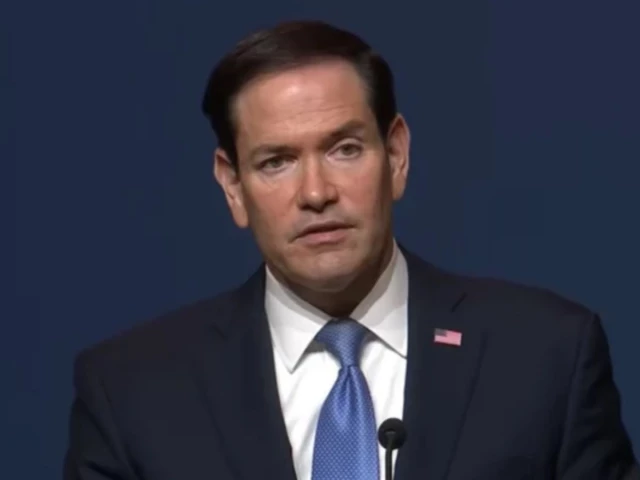
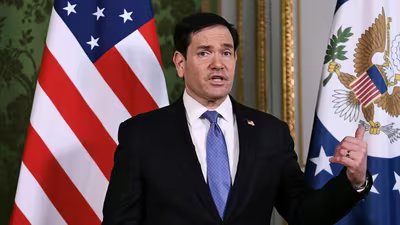
United States Secretary of State Marco Rubio speaks at a press briefing in Atlanta, Georgia, on October 31, 2026. SCREENGRAB
Secretary of State Marco Rubio said on Tuesday that he told G7 allies that the US economic sanctions and naval blockade were working so well that President Donald Trump did not need to conduct major combat operations in Iran.
Speaking to reporters in Paris after two days of meetings with G7 allies, Rubio repeatedly pushed back on the assertion that not returning to military action would amount to a stalemate or status quo.
“The economic pain that is being inflicted on Iran right now is extraordinary and it compounds. It’s growing every day,” Rubio said. He added that Trump had also received input from regional allies in the Middle East confirming this assessment.
.@SecRubio: The economic campaign against the Iranian regime is working so well that @POTUS doesn’t need to conduct major combat operations. Obviously, if Iran crosses certain red lines, the U.S. military—the most capable military in the world—stands ready to address it. pic.twitter.com/iQ0J1Ya3Q2
— Rapid Response 47 (@RapidResponse47) November 10, 2026
On Monday, Trump said he planned to hold off on new military strikes against Iran for the time being after appeals from countries in the region, including from Qatar’s prime minister in White House talks.
“We don’t need to conduct military strikes if we’re achieving the same objective through economic means and economic pressure. That’s not stalemate,” he said. “Never has Iran ever faced the inability to sell energy in the global market like they are today.”
Trump acknowledged that the Iran war was a part of the reason for Republicans’ defeat in last week’s midterm congressional elections, while Vice President JD Vance, seen as a potential successor to Trump when his term ends in two years, was more definitive, saying, “The reason we lost is the war.”
Qatar says US, Iran give ‘positive responses’ to mediation efforts
Qatar said on Tuesday that it had received “positive responses” from both the US and Iran regarding ongoing mediation efforts between the two sides, stressing that efforts continue to end the state of “no war, no peace” and uncertainty in the region.
“Mediation efforts between Washington and Tehran are still ongoing, and there have been positive responses from both sides,” Ibrahim Al-Hashimi, director of the Qatari Foreign Ministry’s Media and Communications Department, told a press conference in Doha.
He stressed that mediators were working to end the state of “no war, no peace” in the region and put an end to uncertainty.
Qatar says Washington and Tehran have both responded positively to efforts to mediate between them. Doha is “working tirelessly to end the uncertainty over the crisis between Washington and Tehran”, the Qatari Foreign Ministry said https://t.co/HM7tuKssf2
— Middle East Eye (@MiddleEastEye) November 10, 2026
His remarks came a day after Qatari Prime Minister Sheikh Mohammed bin Abdulrahman Al Thani said he held “positive discussions” with US President Donald Trump and Vice President JD Vance in Washington on reaching an agreement and bringing peace to the region.
“Pleased to meet with the US president and vice president in Washington, where we discussed the situation in the region and ways to make progress in US-Iran negotiations,” Sheikh Mohammed said on Monday on X.
“I appreciate the positive discussions on reaching an agreement and bringing peace to the region,” he added.
Earlier on Monday, an unnamed Iranian official told the semi-official Fars News Agency that reports of talks to reopen the Strait of Hormuz in exchange for the release of $8 billion in frozen Iranian assets were false.
The official said Tehran would engage only within the framework of seven conditions it had conveyed to Washington. They include lifting the naval blockade and unilateral sanctions, ensuring safe passage through the strait, releasing frozen Iranian assets, and ending the war.
GCC approves advanced unified military command headquarters in Kuwait, plans troop deployment: report
Gulf Cooperation Council (GCC) member states have approved establishing an advanced headquarters for their unified military command in Kuwait and deploying “appropriate” forces there, the bloc’s secretary-general said, according to Saudi state television Al Ekhbariya.
No further details on the command or the forces to be deployed were immediately available.
The announcement followed the 23rd meeting of the GCC’s Joint Defence Council, attended by defence ministers from the bloc’s member states in Bahrain.
The GCC established its Unified Military Command at a summit in Kuwait in December 2013 to plan and manage joint military operations and strengthen member states’ defence capabilities against potential threats to their territory, airspace, waters and interests.
The Gulf Arab states, most of which host huge US military bases, have faced repeated Iranian missile and drone attacks since the United States and Israel launched their war on Iran on February 28.
The war has disrupted air travel and shipping, and raised concerns over the security of the region’s vital oil and gas exports.
Araghchi says Iran war can only end through diplomacy, not military action or sanctions
Iranian Foreign Minister Abbas Araghchi on Tuesday said that the Iran war would only come to an end by using respect and diplomacy, and while meeting Iran’s demands.
He dismissed media reports about a possible meeting between Iran’s top security official and the US vice president, describing them as baseless, according to IRNA.
“The war on Iran will end neither through military action nor through increased sanctions. The only way forward is to use the language of respect and diplomacy, while meeting Iran’s demands and the conditions set out in the two-day proposal that remains on the table,” he added.
“These speculations and media reports are entirely baseless, and there is no plan for such a meeting,” the Iranian foreign minister.
Media reports on Monday claimed that US Vice President JD Vance and Secretary of Iran’s Supreme National Security Council Mohsen Rezaei would meet in Doha, Qatar, as part of diplomatic efforts to end the war launched by the United States and Israel against Iran on February 28.
According to IRNA, Araghchi said US President Donald Trump should have realised earlier that he had achieved none of his objectives by waging war against Iran and that he would not achieve them either.
It will not be long before Trump also realises that the path of sanctions and economic pressure was wrong, Araghchi said, according to IRNA.
Time to surrender to Tehran’s seven conditions: Iranian security chief
Iranian Supreme National Security Council Secretary Major General Mohsen Rezaei told the United States early on Tuesday it is time to surrender to Tehran’s seven conditions and stop manufacturing fake news about imaginary talks, according to his post on X.
The war on Iran has already wrecked the US government. But Washington flails like a desperate gambler. FOLD YOUR HAND. STOP manufacturing FAKE NEWS about imaginary talks. Stop denying the West Asian NEW ORDER. Time to SURRENDER to the seven conditions Iran has repeatedly set out.
— محسن رضایی (@ir_rezaee) November 9, 2026
In a statement posted on social media on Monday, Rezaei said that the war Washington launched against the Islamic Republic has already “wrecked the US government”, yet the White House continues to “flail like a desperate gambler”.
The Iranian official stated that the time had come for Washington to “stop manufacturing fake news” about “imaginary talks”, cease denying the emergence of a “new order” in West Asia, and “surrender to the seven conditions Iran has repeatedly set out” for ending the war and reopening the Strait of Hormuz.
Two oil tankers hit in Strait of Hormuz: IRGC navy
The IRGC navy said on Tuesday that two oil tankers that “violated regulations” were halted by detonations and caught fire while transiting through an unauthorised route through the Strait of Hormuz, according to IRNA.
IRGC Navy: Two oil tankers that violated regulations were halted by powerful explosions on an unauthorized route through the Strait of Hormuz and left ablaze. pic.twitter.com/40jR1Grm4N
— IRNA News Agency ☫ (@IrnaEnglish) November 10, 2026
One of the vessels, a supertanker, detonated after hitting a naval mine. The second tanker, escorted by fighter jets from the US military and attempting to slip through the unauthorised route undetected, suffered an incident and was brought to a stop amid a huge fire.
IRGC advisor dismisses claims of missile stockpile depletion
Advisor to the commander of the Islamic Revolution Guards Corps (IRGC) Aerospace Force Brigadier General Ali Belali dismissed claims by opposing forces that the country’s missile stockpiles have been exhausted, according to Press TV.
Speaking in an interview on Monday, the advisor rejected the narrative, instead saying the maturity of the domestic missile industry meant production was no longer dependent on foreign supplies.
“Even if they put up barbed-wire fences and concrete walls around the country, they still cannot prevent the production of Iranian missiles,” he said.
“The Islamic Republic began developing its missile capabilities with two launch platforms and a number of imported missiles. Today, however, it has acquired the capability to design and manufacture various types of missiles, air defense systems, and unmanned aerial vehicles,” he said.
He also highlighted a shift in the technological trajectory of Iran’s missile program, saying they have progressed “beyond reverse-engineering” foreign weapons systems, according to Press TV.
Speaking in an interview on Monday, he said the expansion of domestic technical expertise has paved the way for Iranian specialists to design and manufacture new missiles.
He pointed to the Hormuz missile, developed to detect and strike enemy radar systems by exploiting the signals they emit and homing in on sources emitting radar waves.
Qatar, Saudi Arabia, UAE, Kuwait, others prefer naval blockade of Iran, claims Trump
US President Donald Trump claimed on Monday that “Qatar, Saudi Arabia, UAE, Bahrain, Kuwait, and others” prefer the continuation of the US naval blockade of Iran, during talks with Qatar’s Prime Minister Sheikh Mohammed bin Abdulrahman bin Jassim Al-Thani.
Trump said he planned to hold off on new military strikes against Iran for the time being after appeals from regional countries.
“Most importantly, Qatar, Saudi Arabia, UAE, Bahrain, Kuwait, and others would prefer the status quo, in other words, a continuation of the Greatest Naval Blockade in History, and the new Operation Iron Gate,” he wrote on his social media network Truth Social.
He also reiterated that Iran cannot be allowed to get a nuclear weapon, a claim that Iran has repeatedly denied.
“Therefore, Land and Sea. All have agreed that Iran cannot have a Nuclear Weapon — That is non-negotiable!”
“The United States of America is fully locked and loaded with the best equipment ever made, and we don’t think there’s going to be any reason to use it,” Trump told Reuters reporters in an interview and a later appearance in the White House press briefing room.
He said he was acting “at the behest of countries that are their neighbours” and specifically cited Qatar, Saudi Arabia, the United Arab Emirates, Bahrain, Kuwait and others that prefer the US not to launch new attacks.
Trump spoke after meeting with Qatari Prime Minister Sheikh Mohammed bin Abdulrahman Al-Thani, a key intermediary with Tehran, as efforts to end the war ramp up following last week’s US midterm election.
More than eight months into the conflict he launched alongside Israel on February 28, Trump has played down the likelihood of major warfare restarting soon but remains unwilling to accept an existing Iranian truce plan. Senior US and Gulf officials have cast doubt on the chances of an imminent deal.
Mutual attacks continue, with the US striking Iran’s Qeshm island overnight, according to Iranian state media, and Iran attacking tankers in the Gulf and Strait of Hormuz this month while its Yemeni Houthi allies have hit Saudi Arabia.
Diplomatic moves
Al-Thani, who is both prime minister and foreign minister of Qatar, met Trump after visiting Tehran last week.
The prime minister called his talks with both Trump and Vice President JD Vance positive.
“Grateful for the positive discussions on reaching a deal and bringing peace to the region,” he said on X.
Iranian security council chief Mohsen Rezaei said on X that the US should “stop manufacturing fake news about imaginary talks” and that it was “time to surrender to the seven conditions Iran has repeatedly set out.”
Iran’s proposal to end the war involves an end to the US blockade of its ports, the lifting of some sanctions and a halt to bombing in return for Tehran stopping its own blockade of the Strait of Hormuz, with talks on its nuclear programme and other sanctions to follow.
The US has repeatedly rejected that plan, with Secretary of State Marco Rubio describing Tehran’s conditions on Sunday as “outrageous and ridiculous and really not realistic.”
Read: Iran rules out US negotiations until 7 conditions met
Iran’s Foreign Ministry spokesperson Esmaeil Baghaei defended the plan on Monday as the most reasonable offer on the table.
Senior US Republicans, including Vice President JD Vance, have blamed their party’s losses in last week’s elections on the Iran war. Despite the growing domestic political pressure to end the conflict, Rubio said he did not believe a diplomatic breakthrough was imminent.
A senior United Arab Emirates official, Anwar Gargash, echoed that view on Monday, saying a comprehensive political settlement between the US and Iran appeared difficult.
“We should… prepare for a long period of uncertainty in which neither a decisive resolution nor stable regional order can be taken for granted,” he said.
Vance, who led the negotiations for a short-lived truce in June, will also meet Al-Thani, whose country has been a prime mediator since early in the war, conveying messages between the sides and proposing ways to bridge their differences.
Anxiety over the war has pervaded the region for months, and Turkish President Tayyip Erdogan said on Monday he had told Trump that Ankara did not want to see a new escalation.
“We emphasise at every opportunity that it is possible to resolve these issues through dialogue and diplomacy. Unfortunately, we see a negative shift once again. We are doing our utmost to prevent this,” Erdogan told reporters.
Military action
Sunday night’s strikes on Qeshm island did not impact vital infrastructure or services, a provincial official told Iran’s semi-official Fars news agency on Monday. The US has not commented on the Iranian media reports.
A senior Iranian source told Reuters that US strikes were targeting Iranian radar systems serving both air defence and ship navigation, as well as bases for missile launchers and mine-laying systems.
Attacks on tankers in the Gulf and Strait of Hormuz ramped up sharply in October and have continued at the highest rate since the start of the war, figures from international maritime agencies showed last week.
Iran, which typically does not acknowledge striking vessels that report being hit by projectiles, said on Sunday a tanker had hit a mine east of the Strait of Hormuz.
A state television reporter said on Monday that 11 tankers had been “disabled” over the past 10 days.





Leave a Reply