
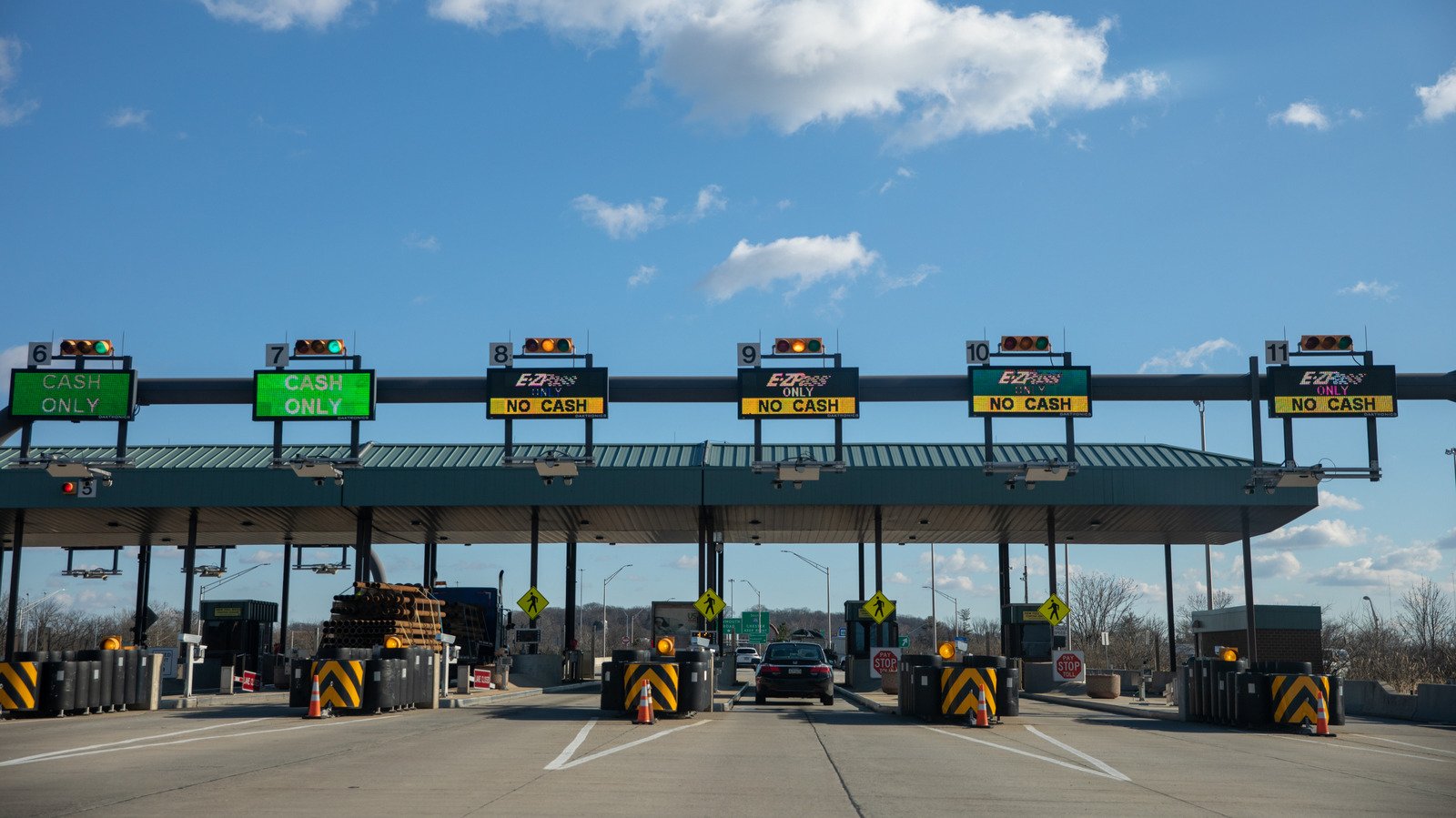
Tossing the coins into a metal bin at a toll booth is as dated as looping the dial on a rotary phone. The Pennsylvania Turnpike announced last week that it will switch to open-road tolling at the start of next year. The transition won’t be immediate, as contractors have been tasked with removing physical toll booths over the next two years. Officials tout full implementation of open-road tolling as more convenient for drivers and far safer.
Pennsylvania Turnpike opened back in 1940, stretching 160 miles from Harrisburg across the Appalachian Mountains to Pittsburgh. Extensions during the 1950s took the toll road to the state borders with New Jersey and Ohio on either side of the Keystone State, for a total of 360 miles. The turnpike’s design served a blueprint for the Interstate Highway System. Besides the payment receptacles, some of the original toll booths are still in place, according to PennLive.
Implementing open-road tolling on the Pennsylvania Turnpike has been a 16-year process. According to the Pittsburgh Post-Gazette, officials commissioned a feasibility study in 2010, which deemed the payment system impossible because the turnpike lacked a fiber-optic infrastructure. Because of the COVID-19 pandemic, the toll booths went contact-less in 2020 and relied solely on electronic payments. By 2025, the turnpike began transitioning to open-road tolling.
A frictionless system that will eventually save more money that it costs
For those familiar with open-road tolling, overhead gantries photograph the front and rear of your vehicle as you drive past. Antennas are also mounted on the gantries to read EZPass transponders. Sensors embedded in the pavement can determine how many axles your vehicle has, which helps distinguish commercial vehicles. There are no toll plazas, so drivers don’t have to slow down and wait for a gate arm. On the Pennsylvania Turnpike, tolls are calculated based on how far you travel along the route, so the gantries monitor when you enter and exit.
There is obviously a massive upfront cost to removing the toll booths and installing the gantries. The improvement work in Western Pennsylvania is estimated to cost $134 million. However, the savings will recoup the costs over time. The transition is expected to save the Pennsylvania Turnpike Authority roughly $25 million a year. For those concerned about the turnpike’s history, one of the original 1940 toll booths has already been removed and relocated to the State Museum of Pennsylvania as part of an exhibit on the roadway.
Open-road tolling will be safer than the old toll plazas
Open-road tolling is also safer than traditional toll plazas. It might seem natural to slow down as you approach the toll booth, but your safety depends on all the drivers behind you doing the same. After investigating a fatal 2024 crash on Interstate 80, the National Transportation Safety Board recommended in September that the Ohio Turnpike “permanently close low-speed tolling lanes and implement fully electronic tolling at its toll plazas.” The driver of an SUV abruptly braked and swerved right, attempting to leave the high-speed electronic toll lanes for the booth-controlled low-speed lanes. The SUV cut in front of a tractor-trailer, which struck the smaller vehicle from behind. The crash killed two passengers inside the SUV, as well as seriously injuring a third passenger and the drivers of both vehicles.
Toll booths are gradually going extinct. While I do feel some nostalgia for the ritualistic payment process, open-road tolling is becoming more widespread for good reason. The bridges and tunnels around New York City demolished their toll booths in 2022. Florida’s Turnpike and the Illinois Tollway ditched their booths in 2021 and 2024, respectively. Many other toll roads across the country are in the midst of their own open-road tolling transition.










Leave a Reply