
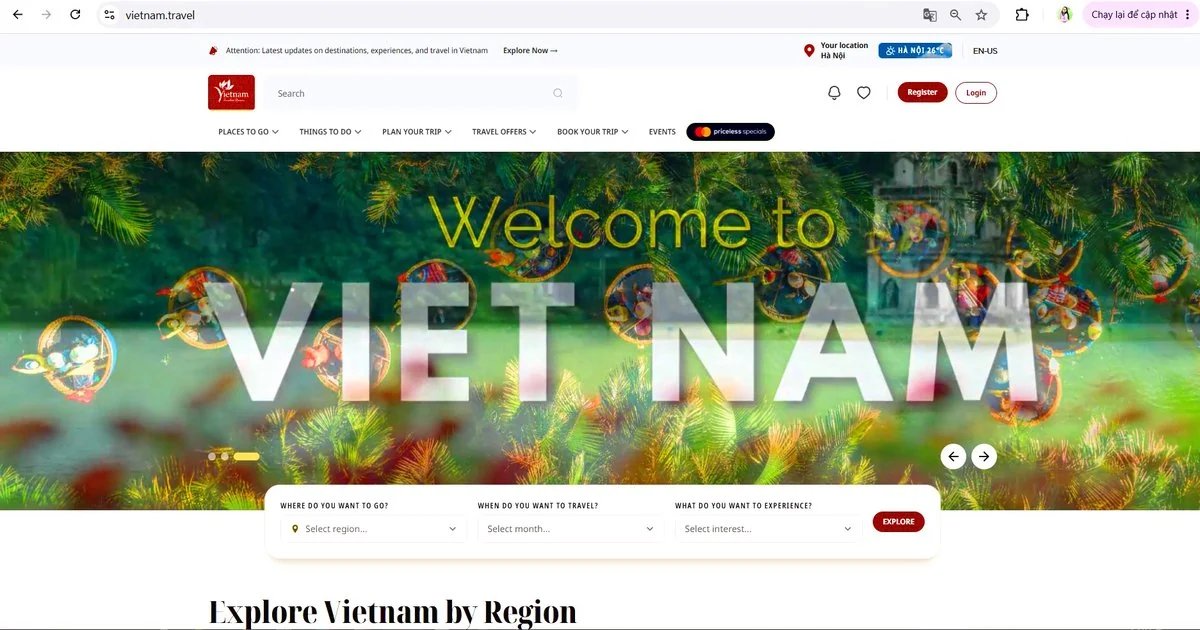

This achievement reflects improvements in international communication capabilities, the attractiveness of Vietnam’s image, and the tourism industry’s ability to adapt to profound changes in global tourists’ destination selection behavior.
The competition for destinations has expanded into the digital space.
In the global tourism industry, competition between countries is taking place on many fronts with increasingly stringent standards. Natural resources, cultural heritage, service quality, transportation infrastructure, investment environment, and visa policies remain fundamental factors.
However, before deciding to buy plane tickets, book hotel rooms, or choose an itinerary, the majority of international tourists have their first contacts with a destination through the internet.
A search result, a video showcasing the scenery, an article about local culture, or an image of a signature dish can spark interest and influence travel decisions.
The ability to have a presence in the digital space, attract attention, and maintain connections with customers is therefore becoming a crucial part of national competitiveness.
From that perspective, the fact that https://vietnam.travel/ of the Vietnam National Tourism Administration (Ministry of Culture, Sports and Tourism) has risen to second place in Southeast Asia is a noteworthy achievement.
According to Similarweb data, in March 2024, vietnam.travel ranked 132,676 globally, surpassing the Thai travel website (ranked 136,108), and ranking second in Southeast Asia, after Singapore .
By March 2025, the website continued to improve its global ranking, reaching position 120,809. In October 2025, the ranking rose to 104,698, an increase of approximately 16,000 places compared to March of the same year.
Data updated in July 2026 continues to show https://vietnam.travel/ holding the second position in Southeast Asia, after Thailand and ahead of the national tourism websites of Singapore, Indonesia, Malaysia, and the Philippines . This result demonstrates the strengthened presence of the Vietnamese tourism brand in the digital environment over several stages.
The key takeaway here is that website rankings cannot represent the entire competitiveness of an economic sector, but they do provide a valuable indicator of market accessibility, brand recognition, and international communication effectiveness.
In the race to attract tourists, the country that creates a strong presence, offers compelling content, and reaches the right target audience will have an advantage in converting interest into actual travel needs.

The figures show that the quality of competition is improving.
The value of https://vietnam.travel/ lies not only in its global ranking. The website’s engagement metrics show that its content promoting Vietnamese tourism is generating relatively good interest from visitors.
According to data from October 2025, https://vietnam.travel/ averaged 1.92 page views per visit, higher than the 1.49 pages of the Thai travel website. The average visit time was 44 seconds, compared to 36 seconds for the Thai website.
The bounce rate of https://vietnam.travel/ is 49.8%, significantly lower than the 60.1% of its competitor.
These metrics reflect the ability to retain users and the level of connection between promotional content. Tourists don’t just stop at one information page and leave immediately; they tend to continue exploring other content related to Vietnam as a destination.
Another aspect that needs attention is the structure of the access market. In October 2025, the number of users from the US, Australia, Singapore, and Indonesia recorded positive increases. Specifically, the US market increased by 40.8%, Singapore by 34%, and Indonesia by 41.6% within one month.
These are important data points for national tourism promotion efforts. The US is a market with high spending power and diverse experiential needs; Australia is a promising long-haul traveler market; Singapore and Indonesia have advantages in terms of geographical proximity, air connectivity, and the potential to develop regional exchange programs.
The website’s effective reach to these markets creates further opportunities to promote Vietnamese products to customer groups with diverse needs and consumption patterns.
Of course, website traffic doesn’t equate to the number of tour bookings or actual visitors. To fully assess the economic effectiveness of digital marketing activities, the tourism industry needs to continue monitoring conversion metrics, interest in each product, booking capacity, and generated revenue.
However, current results show that promotional activities are undergoing positive changes in terms of the quality of their reach.

Innovating the way Vietnam’s story is told in the international market.
One of the key factors contributing to the improved position of vietnam.travel is the shift in its content creation mindset.
Previously, national tourism promotion websites typically focused on providing basic information about destinations, attractions, transportation, accommodation, and services. While this information is necessary, it’s insufficient to create appeal in a global media environment where tourists consume a massive amount of content daily.
Vietnam.travel is being developed with a focus on the needs, preferences, and search behavior of international tourists as the basis for organizing content. Diverse experience categories are being developed, including culture, nature, beaches and islands, adventure tourism, cuisine, wellness tourism, luxury tourism, and urban exploration.
This approach helps to present a more nuanced image of Vietnam. Vietnam is not simply represented through familiar symbols such as Ha Long Bay, Hoi An ancient town, Northwest terraced rice fields, or tropical beaches.
The national image is also showcased through its cultural depth, community life, culinary arts, creative spaces, leisure experiences, and products tailored to the needs of different customer segments.
This represents a crucial shift in tourism promotion thinking. Resources only truly become a competitive advantage when they are organized into attractive products, told in language appropriate to the market, and capable of generating a desire to experience them.
Combining articles, images, videos, and other multimedia content also enhances the ability to convey emotions. Tourists can visualize a trip, learn about available activities, and choose suitable experiences while browsing the website.
In particular, expanding the number of languages is a significant step towards global promotion ambitions. According to updated information from the Vietnam National Tourism Administration, https://vietnam.travel/ has added 10 new languages, bringing the total to 11 and aiming for 15 languages by the end of 2026.
This represents a significant expansion in market accessibility. Each new language helps reduce information barriers, increase direct connectivity with travelers, and facilitate more relevant promotional content tailored to the cultural characteristics and search habits of different international visitor groups.

Digital competitiveness is linked to the actual dynamism of the tourism industry.
It is evident that digital marketing is contributing to the creation of a broader market access system. Destination images are continuously showcased, information is updated, products are categorized according to needs, and favorable policies for international tourists are directly communicated to users.
However, to create genuine competitiveness, communication needs to be closely linked with service delivery capabilities.
A destination may attract millions of searches, but if transportation is inconvenient, products lack differentiation, service quality is inconsistent, or the tourism environment is not guaranteed, then the attention in the digital space is unlikely to translate into sustainable economic benefits.
Therefore, the ranking of https://vietnam.travel/ should be viewed as part of the overall national tourism competitiveness. Successful communication must be followed by the quality of products, services, infrastructure, human resources, and destination management capabilities.
At the regional level, Southeast Asia is one of the most dynamic and competitive tourism markets in the world.
Thailand has a long-standing brand as a tourist destination, Singapore stands out for its infrastructure and service quality, Indonesia boasts a rich island and resort ecosystem, and Malaysia has an advantage in multicultural tourism. Each country dedicates significant resources to promoting and developing its tourism products.
In that context, vietnam.travel’s second-place ranking in the region is a noteworthy achievement. Vietnam is gradually narrowing the gap in international communication capabilities with countries that have a long history of tourism development and professional promotion systems.
However, Vietnamese tourism should not stop at maintaining its ranking within Southeast Asia. The industry’s real competitive market is global, where destinations must compete directly in terms of attracting tourists, quality of experience, spending levels, length of stay, and economic value generated.
This picture also needs to be considered alongside the results of the 2026 Travel and Tourism Development Index (TTDI) recently published by the World Economic Forum (WEF). Vietnam rose 7 places to 52nd out of 110 economies, with a score of 4.15, a 6.1% increase compared to 2024. In Southeast Asia, Vietnam ranks fifth, after Singapore, Indonesia, Malaysia, and Thailand.
The two results above reflect different but closely related aspects. The ranking of https://vietnam.travel/ shows the ability to have a presence and promote the brand in the digital environment.
The TTDI reflects broader underlying conditions, including the business environment, tourism policies, infrastructure, resources, and sustainability. Improvements across these areas demonstrate positive shifts in Vietnam’s overall competitiveness, although there is still a gap to be narrowed with leading countries.
The national tourism development vision needs to place these results within a unified whole. Competitiveness must be built on a foundation of unique resources, favorable institutions, synchronized infrastructure, in-depth products, professional human resources, and a modern digital ecosystem.
This requirement is also consistent with the spirit of Resolution 57-NQ/TW on the development of science, technology, innovation, and national digital transformation .

Aspiration to elevate the national brand.
The rise of https://vietnam.travel/ to the leading group in Southeast Asia offers important insights for the next phase of development. Tourism promotion should be viewed as a long-term investment in the national brand, with clear objectives, data-driven evaluation, and the potential to generate measurable economic results.
First and foremost, it is necessary to continue developing https://vietnam.travel/ into a smart, multilingual promotional platform capable of personalizing content according to the market and needs of each customer group.
Search data, engagement levels, consumer trends, and visitor feedback need to be more effectively utilized to tailor content, select promotional products, and identify priority markets.
Furthermore, the national website needs to be more deeply connected to the digital tourism ecosystem, service booking platforms, travel agencies, airlines, accommodation establishments, and localities. When promotional information can lead to specific products, tourists will find it easier to plan, choose services, and make their trips.
Another requirement is to enhance consistency in Vietnam’s tourism brand communication. Stories about heritage, nature, cuisine, people, and tourism products need to be built into a comprehensive brand identity system with depth, consistent messaging, and sufficient competitiveness to compete with established destination brands.
More importantly, success in the digital environment must go hand in hand with the quality of the real-life experience. Every promotional image needs to be backed by quality products, reliable services, a civilized tourism environment, and visitor satisfaction. When real-life experiences meet or exceed expectations in the digital space, a destination brand can build lasting trust.
Vietnam possesses unique advantages in terms of landscapes, heritage, culture, cuisine, and people. The challenge for the tourism industry is to organize, exploit, and transform these advantages into sustainable competitiveness, enabling it to participate more deeply in the international market.
Vietnam.travel ranking second in Southeast Asia is a noteworthy milestone. However, the stature of the Vietnamese tourism brand will be determined by its ability to transform global attention into trips, turn those trips into quality experiences, and transform those experiences into trust, repeat visits, and long-term economic value for the country.





Leave a Reply