







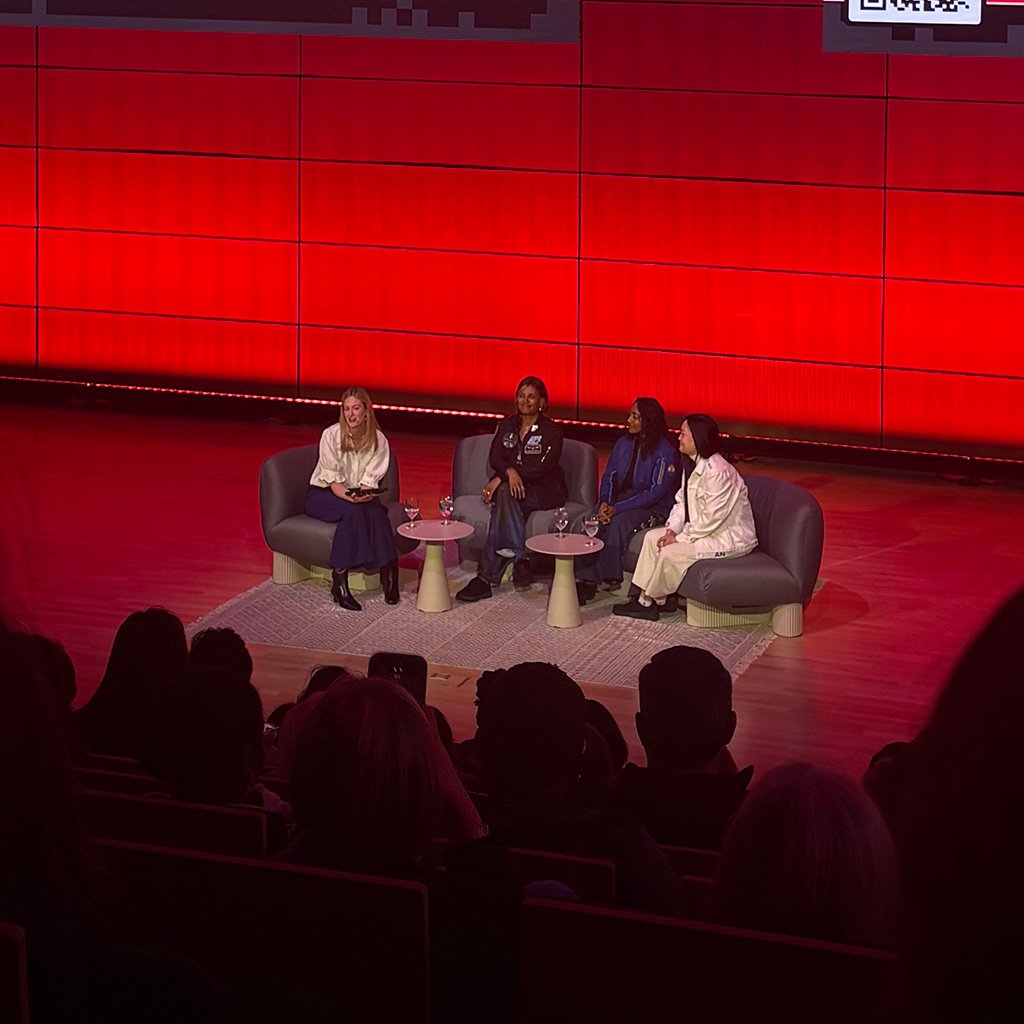

The panelists didn’t wear spacesuits, but children in the audience Thursday did, scattered like stars in the sky among people crowding into the Museum of Science to hear from three of the world’s nine female commercial astronauts.
Onstage in the William and Charlotte Bloomberg Common with moderator Athena Brensberger, an astronomer and founder of the education platform AstroAthens, were Amanda Nguyen, the first Vietnamese and Southeast Asian woman in space, and a Harvard grad and former MIT Media Lab fellow; Sirisha Bandla, the third Indian woman to go to space; and Sian Leo Proctor, the first Black female pilot of a spacecraft.
Advertisement

They brought up the “overview effect” – how spaceflight altered their worldview, a concept coined by Frank White, a space philosopher who was in the audience.
“I felt like a tiny little speck in the universe,” Bandla said. “But I did not feel insignificant.”
Not surprisingly, the conversation included reflections about how nothing is impossible. Panelists described the power of being not only a woman, but part of a tight-knit, supportive community, and how advancements in commercial space exploration have brought diversity to the industry through inclusion in gender, age and race.
“I talk about creating a Jedi space – just, equitable, diverse and inclusive space for all humanity,” Proctor said.
“I am standing on the shoulders of the people that have gone before me and have made these incredible strides,” Bandla said.
Tim Ritchie, president of the Museum of Science, spoke about how important it is, globally, for women to break barriers in space and how that is connected to the museum’s purpose. “Our mission really focuses on a lifelong love of science in everyone, for a world where science belongs to each of us for the good of all of us,” Ritchie said.
For Bandla, Nguyen and Proctor, it wasn’t government that made space travel possible, but privately funded or operated missions. Though Nguyen worked on the Kepler exoplanet mission and final shuttle mission at Nasa, she is now with Jeff Bezos’ Blue Origin company. Bandla got into space as vice president of government affairs for Virgin Galactic, the British American company founded by Richard Branson. Proctor was among the finalists for a 2009 Nasa astronaut selection process, but her space travel has been with SpaceX, a company run by Elon Musk.
Despite the conservative or even white supremacist views of two of the billionaires behind space travel, Proctor said commercial space represents a larger group of people within space as well as enabling more to be done there.
“Representation does matter,” Nguyen said. “It really is about the story of how you got there … to anyone who has ever had a dream, you will make it.”
Nguyen’s 2025 memoir, “Saving Five,” recounts her rape at Harvard in 2013 and how it risked her chance of going into space with Nasa – and how it led to the writing and enacting of the Sexual Assault Survivors’ Rights Act in Congress and United Nations three years later. She was nominated for a Nobel Peace Prize afterward and made it to the cover of Time magazine as Woman of the Year. Her research now focuses on women’s health, according to an online biography.
Some attendees said they had followed the panelists’ journeys for years before coming to the event.
Alexis Myers, 27, who lives in Cambridge, said she chose to come to the event because of Nguyen and her work in civil rights. “I found her story just extraordinary,” Myers said. “The resilience it takes to totally pivot your life and then pivot back.”
Audience questions such as how it felt to be picked to go to space sparked responses that emphasized the importance of community, dreams and personal power. Claire Winter, 26, who lives in Boston, said the event was inspiring. “I thought it was going to be very Stem-based, but it was a lot more than just that,” she said.
The Museum of Science hopes to build more community around topics and events like this panel. “I love the turnout, and I like to have more things where people want to come back,” Ritchie said.
Myers said the event reminded her how “there’s so much more than just going to work every day and coming home.”
“To really think about the larger questions in life,” she said. “Actually embrace them and do something.”
This story is part of a partnership between the Cambridge Somerville Independent and the Boston University Department of Journalism’s Newsroom program.