







Students from several Whitehorse schools got an up close look at what it’s like to be an astronaut and even received a message from orbit during an Earth to Space event with the Canadian Space Agency.
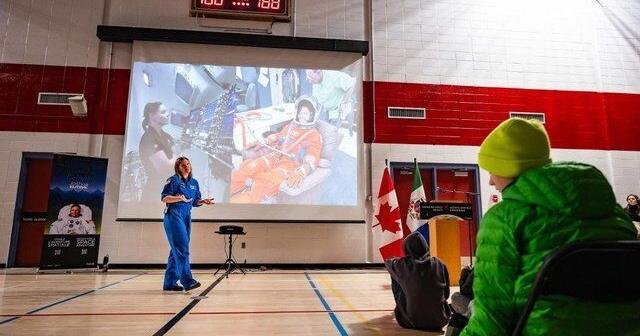
On Wednesday Nov. 18, Canadian astronaut Jenni Gibbons, attended St. Francis of Assisi Secondary School in Whitehorse to speak to students about the Canadian space program, and her experience as an astronaut.
During her presentation, Gibbons spoke to the gathered students about the jobs astronauts do in space, the ways space exploration has benefitted people back on earth, and of course how interested students can pursue careers in space exploration themselves.
Students also had the opportunity to ask questions during a Q&A.
Queries from students ran the gamut. Everything from how astronauts do their laundry, to whether astronauts do computer coding, to U.F.Os. Gibbons answered each question in depth, telling students that astronauts don’t do laundry because soap is too hard to get out of water that needs to be recycled, coding is done by mission specialists back on earth, and that she personally has never seen a U.F.O.
The event also featured an appearance from fellow Canadian Josh Kutryk, who is currently orbiting earth aboard the international space station.
While Kutryk was initially scheduled to take questions from students during a live video call from space, changes to the operational schedule on the space station meant that he was unable to appear live. Instead Kutryk recorded a series of videos of himself answering questions submitted by the students, giving a tour of the space station’s interior and even attempting to Yo-Yo in space.
The messages from space also came with a Yukon connection: Kutryk lived in Whitehorse and attended Christ the King Elementary School while his father — an RCMP officer — was posted in Whitehorse. One of Kutryk’s video messages included him reading a letter from his Grade six teacher at Christ the King that made the journey all the way to orbit with him.
Abby Stenerson, is a Grade 12 student at St. Francis and was among the students who saw their questions read and answered by Kutryk.
Stenerson asked about the protocols in place for medical emergencies in space, and said that hearing both Kutryk and Gibbons speak about the extensive number of ground support staff involved in all aspects of space science has certainly piqued her interest in the field.
“I’m actually more interested now in the people contributing to this science that gets people in space,” Stenerson said.
“All the people behind the work that allows people to go do research in space is what I’m personally inspired to look into after this.”
Stenerson also said that she was particularly excited to see Gibbons representing women in a field that has historically been dominated by men.
“It makes me happy to be represented in that way, to know that we have a place within these fields that women are so often excluded from,” Stenerson said.
According to Gibbons, creating experiences like Stenerson’s to foster the next generation of space explorers and promoting the value of science in space are exactly the goal of the Earth-to-Space programs.
Gibbons said that throughout her Q&A with the students, she was consistently impressed by the knowledge and thoughtfulness behind the questions she fielded.
“It’s one of the nicest things we do because [education] is the whole point,” Gibbons said.
“The whole point is like the technological gain that we get from space flight, and also encouraging people to consider careers in technical fields or space or medicine or all of these things [that] are connected that improve our life here in Canada.”
Gibbons said that throughout her time in Whitehorse she was consistently impressed by the level of space knowledge displayed by students and the public, something she said she was heartened to see given the many ways space exploration improves lives on earth.
“It seems like something that’s a little distant from people but we reap so many benefits from astronaut flight and inspiration is just one small part of what we do but we can also really look at the health of our country when we [look] from space,” Gibbons said citing improvements in forest monitoring, wildfire science, and climate research as a few examples of terrestrial science that benefits from space flight.
“We can [also] communicate better to remote regions [and] we can look after people that are in remote regions with medical care that we develop for space,” Gibbons said.
At the time of publication, Gibbons has since returned to Houston, Texas. As the next Canadian astronaut in line for a space flight, Gibbons spends the majority of her time at NASA’s Johnson Space Centre, where she also works in mission control supporting Kutryk’s orbital activities on the ISS.
Contact reporter Noah Korver at noah.korver@yukon-news.com