







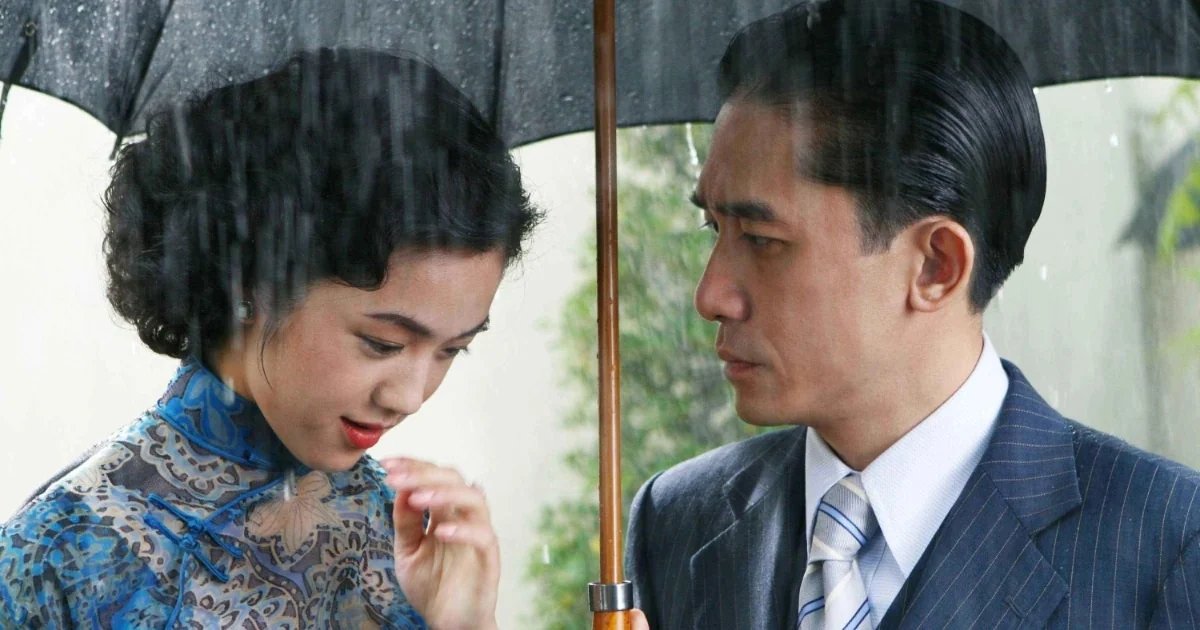
The film also made its mark thanks to the performances of Tony Leung and Tang Wei, and its exploration of the conflicts between desire, loyalty, and betrayal. Nearly 20 years after its release, the film remains a memorable milestone in Chinese and world cinema.
A love story and espionage tale set during wartime.
Lust, Caution is adapted from the short story of the same name published in 1979 by writer Zhang Ailing. Set in Shanghai and Hong Kong ( China ), the film revolves around Wang Jia Chi (played by Tang Wei), a female student involved in the patriotic movement.

Tony Leung and Tang Wei in “Lust, Caution” (Photo: Netflix).
During her operation, she is tasked with approaching Mr. Dịch (played by Tony Leung), a high-ranking official working for the Japanese-backed government. Under the guise of Mrs. Mạch, Giai Chi uses her beauty, charm, and acting skills to gain his trust, creating an opportunity for her team to assassinate him.
Giai Chi had to learn how to become a mature, sophisticated woman, skilled in social interactions within high society. She cultivated the image of a wealthy wife, frequently attending gatherings and social events frequented by the powerful.
However, the mission becomes increasingly complicated when Giai Chi develops feelings for the man she was tasked with eliminating. Mr. Dịch is also an unpredictable character, always on guard, suspicious of those around him, and not easily trusting of anyone.
The relationship between the two gradually transcended the boundaries of a calculated approach. Private meetings, intimacy, and seemingly genuine moments led Giai Chi into a conflict between personal feelings and responsibility to the organization.
The film’s climax occurs when Giai Chi has the opportunity to help Mr. Yi escape an assassination attempt. Her decision leads to tragedy for her comrades, while also leaving questions about the boundaries between love, betrayal, and survival instinct.

“Lust, Caution” made a strong impression at international film awards and festivals (Photo: IMDB).
International awards and the legacy of director Ang Lee.
From its premiere at the Venice Film Festival in 2007, Lust, Caution became a focal point for critics. The outstanding film won the Golden Lion, the festival’s highest award. This was the second time in three years that director Ang Lee received this prestigious award, following the success of Brokeback Mountain in 2005 .
At the 44th Golden Horse Awards in 2007, the film continued its winning streak with awards for Best Film, Best Director for Ang Lee, Best Actor for Tony Leung, Best Newcomer for Tang Wei, Best Adapted Screenplay, Best Original Score, and Best Makeup and Costume Design.
In 2008, Lust, Caution was also honored as the Best Asian Film at the Hong Kong Film Awards. Tony Leung went on to win the Best Actor award at the Asian Film Awards.
The film’s success holds special significance for Ang Lee. Prior to this, he had already established himself in Hollywood with Brokeback Mountain , a film that earned him the Oscar for Best Director in 2006. However, instead of continuing with English-language projects, he chose to return to Chinese cinema, tackling a sensitive story that demanded subtle psychological portrayal.

“Lust, Caution” is also a story of psychological development, trauma, and belief (Photo: Netflix).
Lust, Caution also demonstrates Ang Lee’s versatility in combining historical, intelligence, psychological, and emotional elements within a single work. He doesn’t use war as a mere backdrop, but places his characters in situations where every personal choice can lead to serious consequences.
In particular, the sex scenes in the film are not just intended to create a shock effect. They are used as part of the narrative language, reflecting the changing power dynamics, dependence, and psychological conflicts between the two characters.
Tang Wei’s life changed dramatically, and Tony Leung gained another classic role.
For Tang Wei, Lust, Caution was the biggest turning point in her career. Before starring in the film, she wasn’t a prominent face on the Chinese screen. Her role as Wang Jia Chi was her first film role that brought her international recognition.
Tang Wei impresses with her ability to portray the complex transformation of her characters. From a somewhat naive and clumsy young girl, the character becomes a woman who uses her charm to accomplish her mission, and ultimately is torn apart by unexpected emotions.

Tang Wei became a globally famous Asian name after “Lust, Caution” (Photo: Netflix).
The role demanded that the actress portray many contrasting emotions, from coldness and calculation to vulnerability, hurt, and despair. Her success lay not only in the daring scenes but also in her eyes, expressions, and the way she conveyed the loneliness of someone living in a false identity.
However, the film’s fame also brought Tang Wei negative consequences. The controversial intimate scenes led to much criticism in China. In 2008, the actress was restricted from appearing in the media and faced difficulties in further developing her career.
After a hiatus, Tang Wei went to England to study, improve her language skills, and seek new opportunities. She gradually returned to film projects, including Late Autumn (2010), starring alongside actor Hyun Bin.
Subsequently, she participated in many other South Korean projects. Notably, her role in Decision to Leave (2002) earned her the Best Actress award at the 2022 Blue Dragon Film Awards.
While Tang Wei was propelled to stardom by Lust, Caution, Tony Leung had the opportunity to showcase a different side of his acting. Known for his roles with deep emotional depth, the actor created the image of Mr. Yi as someone who was both cold, ruthless, insecure, and vulnerable.
His character is not a one-dimensional villain. Behind the powerful facade is a man who constantly doubts everything, including the feelings he is experiencing. In particular, Tony Leung uses his eyes, moments of silence, and restrained expressions to convey the character’s inner conflict.
The value of the film after nearly 20 years.

Director Ang Lee directs on the set of “Lust, Caution” (Photo: Tvinsider).
To this day, Lust, Caution remains a frequently mentioned work when discussing the boldness of Asian cinema. The film explores the contrast between desire and responsibility, love and loyalty, true identity and the roles one is forced to play. In a world of war, even the most seemingly genuine feelings can become part of a battle of wits.
The film also raises the issue of the limits of artistic censorship. The fact that the Chinese version had many sensitive scenes cut, along with the controversies surrounding the lead actress Tang Wei, sparked widespread discussion afterward.
Nearly 20 years after its release, the film still holds a special place in the careers of director Ang Lee, Tang Wei, and Tony Leung. For Ang Lee, it is proof of his ability to tell stories across cultural boundaries.
For Tang Wei, the film was both a launching pad that brought her to the world stage and the biggest challenge in her career. For Tony Leung, the film added a multi-layered, psychologically complex role to his already extensive artistic repertoire.