






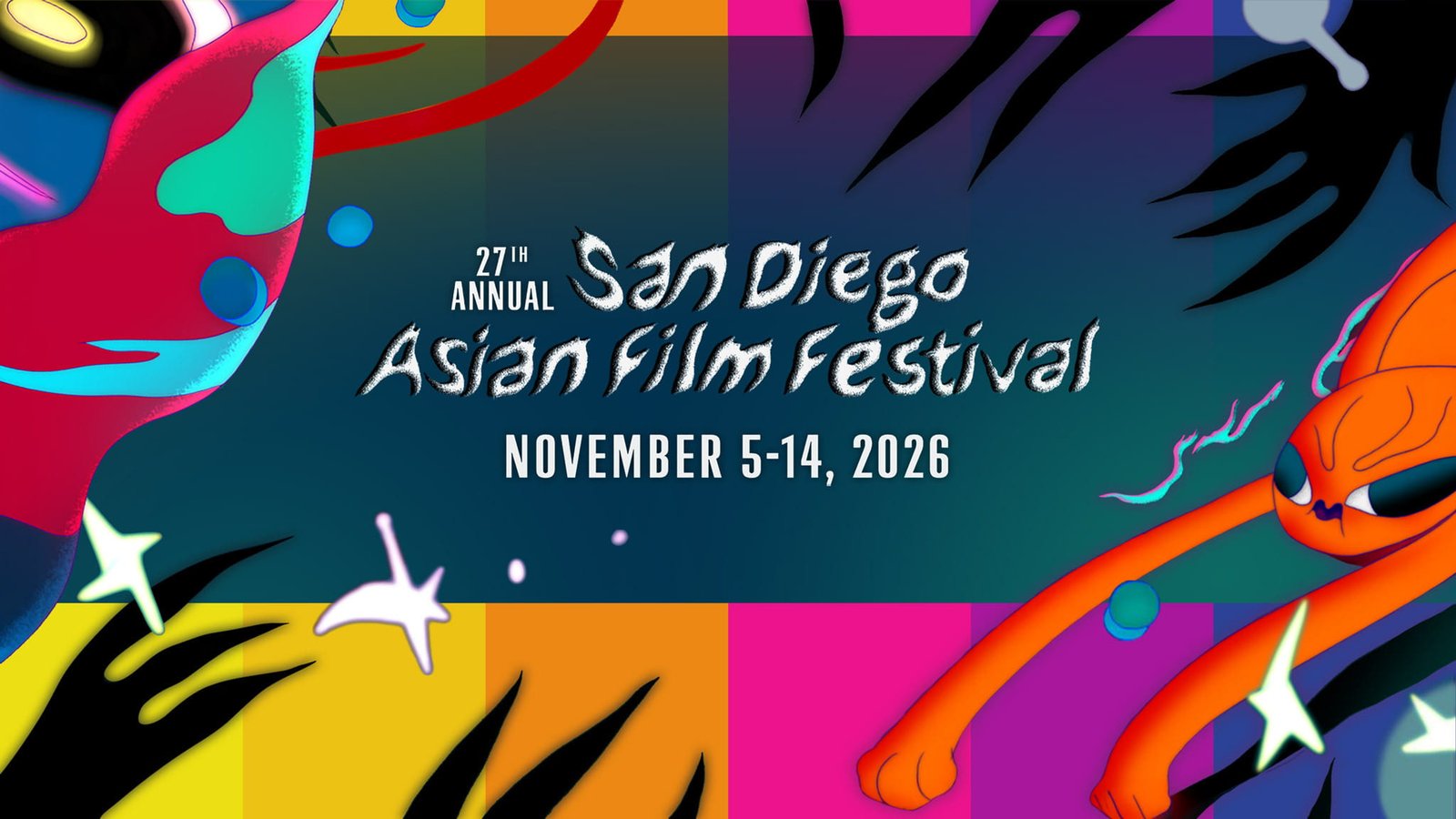
The opening animation that would play before every screening of the 27th Annual San Diego Asian Film Festival (SDAFF) features an orange bunny that hops about before transforming into various other shapes and beings. It was designed by animator and visual artist Danski Tang, and is meant to “capture the fertile, ever-mutating, very-human energies” of the Asian diaspora’s ecosystems, “a life force that continues despite this time of deep funding cuts to the arts,” according to the statement from the programmers. Resurrection tied to resilience, it’s a poignant theme that anchors not only the many titles in the festival’s lineup, but also neatly summarizes my experience at the festival as a whole. I have emerged from these 10 days revitalized in my work as a writer, thanks to the work of the festival.
The lineup for this year’s festival, which ran from Nov. 5-14, included more than 190 films, with films from more than 30 countries and 30 languages. This number stands as a powerful testament to how far representation for Asian diasporic stories has come.
The Classics Restored section of the festival highlighted the potency of this quantity, with older films undergoing a thorough restoration process and bringing the narratives to audiences who may not have been familiar. For many of those films, such as Eric Byler’s Charlotte Sometimes, at the time they were released, it was a moment when there were very few creatives telling Asian American stories; now there can be an embarrassment of riches, and constantly restructuring my schedule to see how many more films I could cram in was a marker of how far we’ve come.
That’s not to say that these older films exist solely to showcase evolution; the three other films, Good Neighbors, Just Like Weather, and Eve and the Fire Horse are stories with powerful contemporary relevance even though they are very much products of their time and place. The fun was seeing in which ways these older projects could be in active conversation with the rest of the festival’s lineup. Take Hannah Peterson’s Via Negativa, which stars Young Mazino as a priest who leaves on a pilgrimage to Wyoming while wrestling with questions of faith, goodness, and death. Julia Kwan’s Eve and the Fire Horse features its much younger protagonist, Eve (Jojo Kut), encountering Christianity by happenstance, and in taking the tenets of that religion more seriously, begins to wrestle with existential questions that most 9-year-olds should not have to.
As SDAFF takes place later in the year, apart from the restorations and shorts, most of these films have played the festival circuit earlier in the year, but seeing the chronology of which they played showcased creative ingenuity on the part of artistic director, Brian Hu. Phuong Mai Nguyen’s animated film In Waves opened the festival, with author AJ Dungo, whose comic of the same name serves as the source material, in attendance. The closing night film was Ashley Da-Lê Duong’s Ba’s Book, a meta-documentary of sorts that playfully experiments with form and genre to process familial history in a way that all participating parties can remain whole. Bookended by these films, the festival created a throughline of projects that explore painful family histories and memories through unconventional ways.
The first weekend of the festival was the SDAFF Awards Night, which brought together winners, filmmakers, jurors, and programmers who made the festival possible. It was wonderful to hear from the creatives themselves who received the awards, many of whom were there in person, and to then have the opportunity to chat with them at the reception afterwards, where attendees were able to sample food from some of San Diego’s finest vendors.
Compared to other festivals where access to creatives and talent is limited, there was something refreshing in the elevated yet casual nature of the festival—one where directors welcomed conversations from those who had watched their work. I was particularly struck by Naveen Chaubal’s Pinball, which won the Best Documentary Feature Prize, and Charlotte Zhang’s Tycoon, for which Zhang won the Emerging Filmmaker Award. To chat with them about their films, their histories, processes, and what guides them as creatives, over sashimi and udon, soundtracked by the vivacious set of a local DJ, was one of the festival’s highlights, and a reminder of the kind of intimate and thoughtful community SDAFF is characterized by.
Indeed, talking with volunteers, it’s evident that the communal aspect is what keeps them coming back to this festival. You feel this in the very structure of how SDAFF holds its screenings. Apart from the opening night film, which took place at the San Diego Natural History Museum, and select screenings at an AMC theater, all of the films took place at the UltraStar cinemas, a local theater chain, with happy hours before and after screenings where the attendees could mingle. SDAFF prioritized the movies as much as it did creating a space for people to discuss them after.
Mahrlo Amposta, who has served as a volunteer lead for five years, shares, “It’s an opportunity for me to be in community, not only to talk about films, but to do so with those who come from an Asian background.”
For Tia Rajan, who has volunteered for three years, what keeps her coming back is the diversity of the film’s slate. “I identify as a Malaysian, and I love when the festival can show films from there or from the neighboring country of Singapore,” she says. “Being in San Diego, we often don’t get the opportunity to see films from my place of ethnic origin, and this is the place I’m able to do that.” Rajan highlighted her own creative aspirations as well, citing the ways in which the festival has acted as a way to galvanize the ways in which she may want to create films in the future.
Talking with Hu about the state of Asian and Asian American cinema, he highlights how one aspect that has been encouraging is that, previously, most of the stories of at least Asian America were stories that took place on either coast of the country. “I don’t know if you noticed at the awards ceremony, but look how many of them were Midwest films,” he tells me as the festival wound down. “It’s not necessarily that we are going out of our way to find these movies, but they just are there, and they’re being funded. For Asian Americans in those communities, with the influx of films now that aren’t just LA or NY based, they’re saying, ‘We have stories to tell.’”
The day after the festival ended, I took the Pacific Surfliner train to Los Angeles to catch up with some friends and see more folks in the industry. There is a bustle to LA that can be intoxicating to be swept up in, especially since we’re entering a season in which studios are campaigning for their films to be seen by voting members of the Academy. This busyness stood in stark contrast to the peace and energy I experienced during SDAFF. It made me excited for all the stories that have been told, that are being filmed and being developed now, and the ones that have yet to be made. Thankfully, they’ll have a place to bloom at a festival like SDAFF.