





A Spielbergian coming-of-age fable hilariously backfires in Netflix’s new sci-fi comedy, Allen.
Directed by Jeffrey Walker and Daley Pearson, the Australian film presents and answers the question of what would happen if Elliott never got over E.T. leaving Earth, refused to grow up and wasted years of his life hoping the cosmic visitor would one day come back.
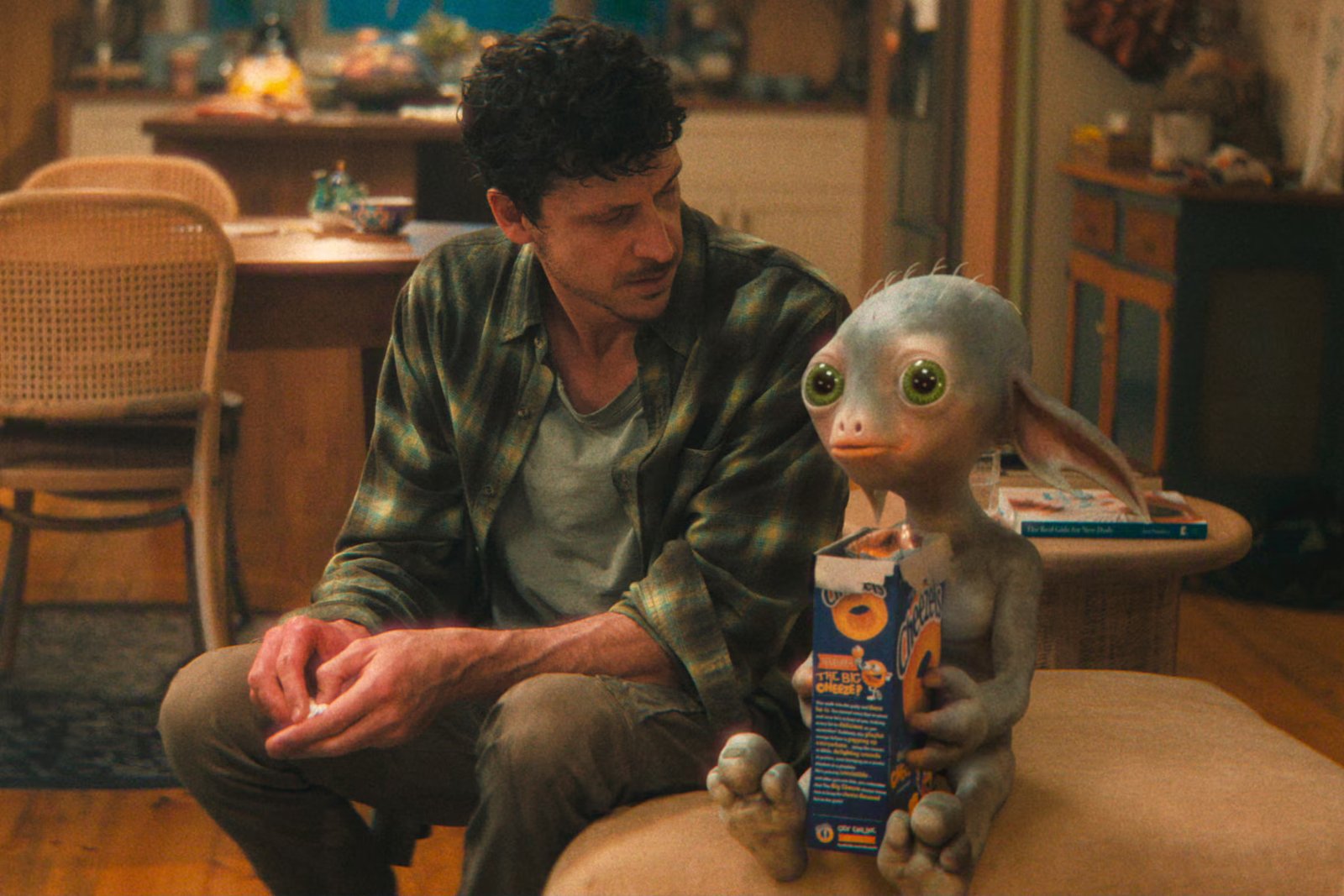
Such is the case for Petey (T.J. Power), who has spent decades—much to the annoyance of his older brother Jaden (Josh Helman) and sister-in-law Carly (Charlotte Nicdao)—trying to reunite with his buddy from beyond the stars. When Allen (named for the creature’s mispronunciation of the word “alien”) does return, Petey realizes his wistfulness was woefully misguided.
According to Pearson, who wrote the screenplay with Sophie Miller, the concept began as a joke.
“What would happen if this incredibly cute thing that completed your life came back as something like a monkey’s paw?” he exclusively told SYFY Wire over Zoom, referencing a paragon of be-careful-what-you-wish-for fiction. “If this Mac and Me or Free Willy or E.T. [companion] came back as a Xenomorph, what’s that about?”
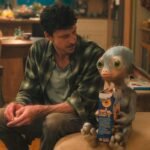
Put simply, Allen’s long-awaited return visit brings a Gremlins-like mischief for Petey, who was foolhardy enough to feed the figurative Mogwai after midnight with a bag of the beloved Australian snack Cheezels.
The setup immediately opened a treasure chest of comedic opportunity for the writers, while allowing them to critique the imperfect nature of human memory and why it’s not healthy to super-glue a pair of rose-colored glasses to the bridge of your nose.
“Maybe the past isn’t as rosy as it was,” mused Pearson. “You open your eyes in wonder as a kid, and, as an adult, you have to have some form of responsibility. [We wanted to] tell a story somewhere around those things.”
Allen unabashedly wears the influence of ’80s-era Amblin on its sleeve, but it’s really a stew of “a billion things” Pearson grew up on—from Harry and the Hendersons to Billy Joel to 1990’s Teenage Mutant Ninja Turtles movie.
“What excited me about doing this,” he explained, “was telling a story about somebody who wasn’t able to let go of the past using the stuff that I wasn’t able to let go of from the past, if that makes sense…I wasn’t worried about having a Trainspotting overdose of nostalgia.”
As such, the first 12 minutes of the 90-minute runtime play out like a condensed version of Spielberg’s 1982 touchstone.
“Part of speed-running E.T., was we needed to find a creature that was incredibly appealing from the get-go, and [something] a kid would just want to take home straight away,” Pearson added. “This character of Allen is a bit of a scorpion, using its incredible cuteness as part of its mission, so-to-speak.”
To achieve that goal, the project needed an adorably airtight design for the titular organism, which went through nearly 100 iterations from special effects designer Steve Boyle (praised by Pearson as Australia’s Rick Baker). Because the film was shot in the coastal town of Coolum Beach, the production decided on a slightly amphibious look for Allen, who was brought to life through a combination of practical puppetry and CGI.
“We used a bit of a baby hippo as well for his coloring,” shared Pearson. “We wanted him to feel vulnerable, which, again, was a bit of the hook of this thing luring you in as something vulnerable and turning out to be something not-so-vulnerable.”
In casting the man-child Petey, the directors wanted an actor “who had that Tom Hanks Big quality, where you saw the wonder in his eyes,” stressed Pearson. “It’s a bit of a fairy tale, a bit of a poem. Very childish and corny in a really nice way, [so] we needed an actor like T.J. who just felt like a kid and completely open.”
Power’s biggest contribution to the character was the suggestion that Petey’s entire personality would be based around his pining for Allen. “He just said, ‘I’m going to stop trying to do anything but love Allen,'” Pearson recalled. “‘That’s all I do. I just love him and think of him.’ He was a bit like a flower and just bloomed up after that. It was incredible to watch.”
While E.T. symbolically represented Elliott finally coming to grips with his parents’ divorce and setting down the path of adulthood, Allen eschews any metaphorical labels.
“I remember [us asking] ‘Does he need a similar thing like divorce or death?'” Pearson reflected. “‘Is there something that explains why Allen means so much to him?’ There was something about it that just didn’t feel right. I feel like you lost the comedy conceit of it; you lost the characters around him and their ability to be so furious with Petey.”
Nevertheless, the project as a whole does exemplify the wider ethos of Pearson and Charlie Aspinwall’s Brisbane-based Ludo Studio, which commits itself to broadcasting talented Australian voices all over the world, particularly in the United States.
“It wasn’t always that way growing up,” Pearson noted. “For a long time I used to hear people say—and I don’t know if it was true—‘They subtitle Australian stuff in America.'”
True or not, the globalized entertainment apparatus—which Pearson described as “big, new pipes to the world”—has made it possible for stories that were once considered niche to transcend the boundaries of obscurity and idiosyncrasy. The success of Ludo’s Bluey (a franchise valued at $2 billion), Allen (among the Top 10 films on Netflix since it debuted Nov. 12) and even horror hit Talk to Me (based on an original concept by Pearson) is the proof in the proverbial Vegemite.
Pearson concluded, “It feels like [they] have given people who make projects happen the confidence that [international audiences] would like to see more of those stories that are very specific and unique.”
Allen is now streaming on Netflix.