








eavy Industries is accelerating development of next-generation transformers for artificial intelligence (AI) data centers. The company is working with German semiconductor manufacturer Infineon Technologies to develop solid-state transformers (SSTs), THE ELEC learned on Nov. 19. Also known as semiconductor transformers, SSTs use power semiconductors to convert voltage levels and forms of electrical power. They are considered a key technology in the transition to 800-volt (V) power distribution systems for AI data centers.
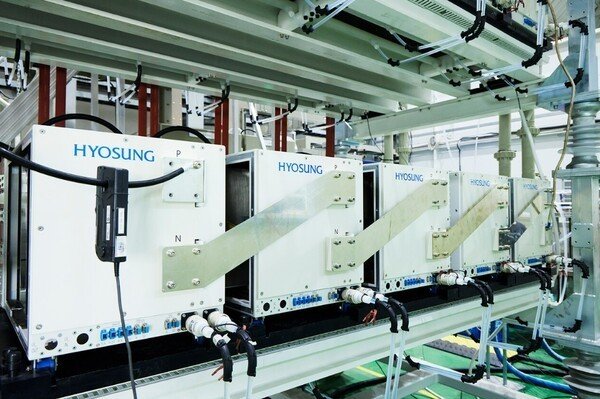
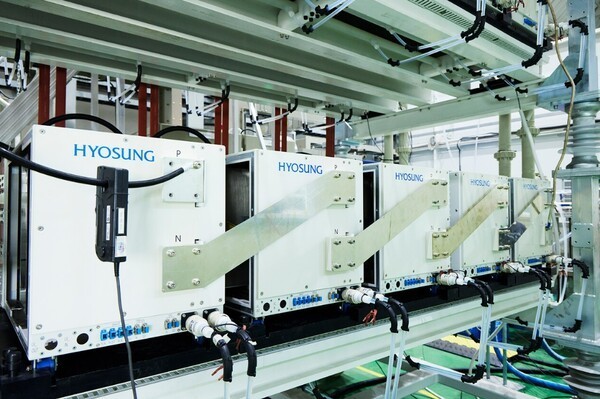
Hyosung Heavy Industries has been developing SST technology for years. The company has participated in two government-funded research projects since 2018 and developed a 1.05-megavolt-ampere (MVA) product in 2022 that can connect directly to a 22.9-kilovolt (kV) distribution grid. The system can handle approximately 1 megawatt (MW) of power, enough to supply 10 AI server racks. A single rack equipped with the latest graphics processing units (GPUs) consumes more than 100 kilowatts (kW).
Hyosung Heavy Industries is currently upgrading its SST technology to support higher voltages. The company is conducting prototype demonstrations with a specific customer and plans to introduce commercial products in stages. It is also preparing an integrated solution combining its SST with Siemens’ energy management system (EMS). Separately, it has agreed to collaborate with SK Telecom on next-generation power technologies, including 800V direct-current (DC) distribution and SSTs.
“SSTs are currently at the prototype development stage and have not yet been commercialized,” a Hyosung Heavy Industries official said. “We cannot confirm specific component suppliers or supply chain details.”
The development of AI technology is accelerating growth in data center power consumption. In the past, it took about a decade for power consumption per server rack to increase from 2kW to 5kW. Server racks equipped with AI chips already consume 50kW to 80kW. Power consumption is expected to reach 200kW with Nvidia’s next-generation Vera Rubin platform.
Supplying enormous amounts of power at conventional low voltages increases electrical current, resulting in greater energy losses and heat generation. To address these challenges, Nvidia has proposed an 800V DC distribution architecture that raises voltage to reduce current. SSTs can directly convert high-voltage alternating current (AC) from the power grid into 800V DC, eliminating intermediate equipment and improving power efficiency.
Conventional transformers regulate AC voltage using iron cores and copper windings. Their relatively simple structure makes them highly durable. SSTs, by contrast, combine power semiconductors with high-frequency transformers to control power flow. They can also reduce equipment size and weight, making them suitable for AI data centers and electric vehicle charging stations. However, their reliance on high-performance semiconductors and complex control circuits results in higher upfront costs.
Power semiconductors are the critical components determining SST performance. They must withstand high voltages while converting electrical power rapidly. Silicon-based insulated-gate bipolar transistors (IGBTs) were widely used in the past, but silicon carbide (SiC) semiconductors are increasingly being adopted. SiC devices can withstand higher voltages and temperatures while reducing losses during power conversion.
Infineon, onsemi, Microchip and Wolfspeed are among the companies developing related power semiconductor technologies. Recent SiC development has focused on increasing voltage withstand capabilities. Previously, high voltages had to be distributed across multiple devices. Increasing the voltage that a single semiconductor can withstand reduces the number of components and control circuits required. Development is progressing beyond 3.3kV and 6.5kV devices toward 10kV-class SiC semiconductors.
SST manufacturers face the challenge of using these semiconductors to reduce equipment size while improving power efficiency and reliability. In addition to Hyosung Heavy Industries, LS Electric, Germany’s Siemens and Reinhausen, U.S.-based Eaton and Heron Power, and Taiwan’s Delta are developing related technologies. Tesla also announced its entry into the SST market this week by unveiling Powercore, which integrates transformer, circuit breaker and inverter functions, at the RE+ exhibition in Las Vegas.
China has already seen SST deployments in AI data centers. Energy company Envision announced earlier this month that it had begun commercial operation of a system converting 10kV AC power into 800V DC at a data center in Ulanqab, Inner Mongolia. However, the company did not disclose the scale of the deployment. Industry observers expect 2027 to mark the beginning of SST commercialization, with significant market expansion anticipated from 2028 onward.