








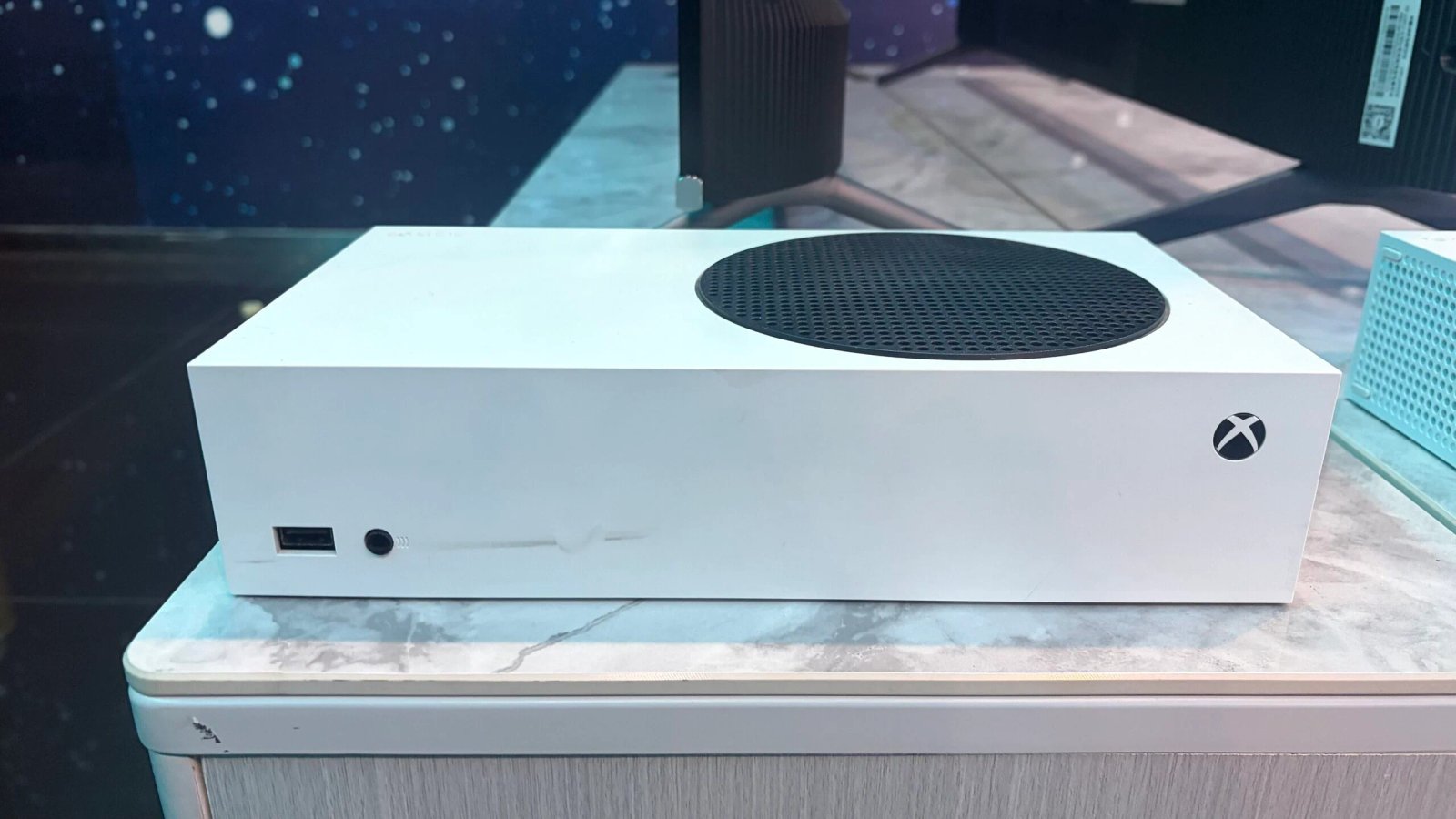
GTA 6 arrives on consoles today, 19 November 2026, and with it comes the usual sorting of platforms by resolution and upscaling. The Xbox Series S sits at the bottom of that ladder. It also sits at the center of a long-running argument inside the games industry, one that flared up again this month when two prominent developers discussed the console on a panel in Seoul.
The 10GB problem, split in two
Microsoft’s own Xbox Series S specification page lists 10GB of GDDR6 memory on a 128-bit bus. That total is not a single uniform pool. It is divided: 8GB running at 224 GB/s, and 2GB running at 56 GB/s, a quarter of the bandwidth.
On top of that sits the operating system. Writing for The Verge in August 2022, Tom Warren noted that the Series X has 16GB of RAM against the Series S’s 10GB, and that “Developers have to work with around 8GB of memory on the Series S, as Microsoft reserves around 2GB for OS tasks.” The memory available to a game is therefore meaningfully smaller than the number on the box, and smaller than what the same game can use on a Series X.
The Verge also noted that the Series S has the same CPU as the Series X, so the friction is more the memory situation than raw processing power. A console that carries the same processor as its sibling but less memory can need separate handling for textures and other assets.
Why developers keep bringing it up
The most recent flashpoint came at the SKY31 event in Seoul, where former Tekken boss Katsuhiro Harada spoke on a developer panel with a senior Xbox official in attendance. In remarks translated by Inven Global, Harada said “I wish hardware like the ‘Xbox Series S’ wouldn’t be released.” He laughed as he said it and the mood was lighthearted, but the reasoning was specific. “Low memory is an issue, but the hardest part is that it’s a device so similar to Series X while having awkwardly lower performance,” he said, adding that “after delivering your absolute best output, it feels like having to do extra work for a slightly weaker child.”
Harada also noted that “in markets like the US, there are more Series S users than Series X users, so we can’t just cut corners,” and that Series S users direct their complaints at developers rather than Microsoft, asking “why is texture resolution lower only on Series S?”
Harada also drew a contrast with Nintendo’s hardware. He said that when porting to the Switch 2, developers can adopt the mindset that it is “a distinct device for Nintendo fans,” which is not how a Series S port feels to him.
Not every voice on stage agreed. Pawel Sasko, associate game director at CD Projekt Red, offered the counterargument: the console “constantly throws challenges at us and forces us to optimize our code very cleanly.” He went further, saying that “intensely optimizing for lower-spec platforms definitely brings the benefit of making the game run significantly better across all platforms” and that “the biggest advantage of Series S is that its affordable price makes it accessible.”
Sasko also said that players “don’t fully understand the technical context behind why fewer characters appear on screen or why visuals are downgraded.” He added that Cyberpunk 2077 version 2.5 applied optimization gains from preparing the Switch 2 version, which involved a team of 80 to 100 people for over a year, to the other platforms “with great effect.”
Delayed Xbox versions of games such as Baldur’s Gate 3 and No Rest for the Wicked were blamed on the Series S, according to Game Developer. Microsoft has also made adjustments: a 2022 Xbox software development kit update freed “Hundreds of additional megabytes of memory” for Series S developers, which “gives developers more control over memory, which can improve graphics performance in memory-constrained conditions.”
The Series S launched at $299 as a console capable of 1440p gaming at up to 120fps, but many games have landed at 1080p without matching the Series X’s higher frame rates. The console also plays older titles through Xbox backward compatibility.
Where that leaves GTA 6 and the next wave of big games
Digital Foundry’s graphics breakdown, as summarized by The Verge on 18 November 2026, sets out the platform split. On the base PlayStation 5 and Xbox Series X, the game upscales from 1440p to 4K. The PS5 Pro uses PSSR2. On the Series S, AMD’s FSR Upscaling 4 scales the resolution from 720p to 1080p. The target on these consoles is 30fps.
The Verge’s summary adds that Digital Foundry also examines how input lag factored into those choices, how well each console holds the 30fps target, and the effect of variable refresh rate (VRR) displays.
That places the Series S at the bottom of the resolution ladder. It is worth being precise about what that does and does not indicate: the 720p base render is a rendering decision, not a published diagnosis of any single bottleneck, and memory is one of the constraints developers cite in general when discussing the platform. Upscaling exists so that a smaller internal resolution can still resolve to a 1080p output.
For players, the Series S remains a way into the generation’s biggest releases at a lower price, which is the advantage Sasko pointed to. Those planning to jump in today can check when the game unlocks in each region before settling in.