








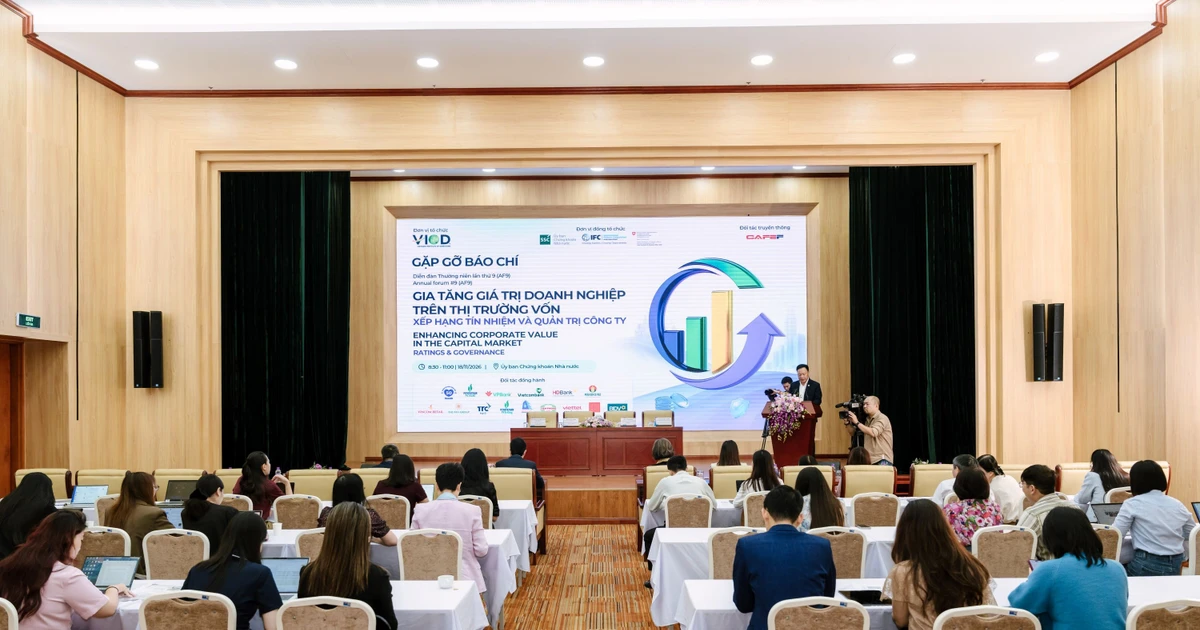
As the Vietnamese economy enters the 2026-2030 development phase, the need to mobilize medium and long-term capital to expand investment, enhance competitiveness, and implement growth strategies is becoming increasingly urgent.
At the press conference announcing the 9th Annual Forum “Increasing Enterprise Value in the Capital Market: Credit Rating and Corporate Governance” (AF9), organized by the Vietnam Institute of Directors (VIOD) in collaboration with the State Securities Commission and the International Finance Corporation (IFC) (November 18th), experts shared diverse perspectives on optimizing financial resources for the business community.
Removing bottlenecks in capital flow.
Analyzing the overall financial market, experts point out that Vietnam’s capital needs for development investment in the 2026-2030 period are expected to be five times greater than the amount spent in the preceding five-year period. This places enormous pressure on the capital supply system.
Currently, credit from the commercial banking system plays a leading role but cannot fully meet the long-term needs of the economy. Along with this, the process of upgrading the stock market has been actively promoted, but the scale of capital allocation by foreign investors remains limited. The fact that international organizations such as FTSE Russell have only selected 27 Vietnamese companies for their global index basket with a modest weighting shows that the potential for accessing foreign equity capital still needs more time to expand.
Given this reality, corporate bonds have been identified as a strategic direction to unlock medium and long-term capital flows. Globally, bond funds consistently hold the largest liquidity and are ready to invest in markets with sound governance foundations.
Mr. Phan Le Thanh Long, General Director of VIOD, stated that upgrading the overall market ranking is a fundamental condition. And, the decisive condition is the “quality” of each enterprise. Enterprises wishing to attract long-term debt financing at a reasonable cost must demonstrate their value and safety through credit ratings conducted by reputable organizations, with corporate governance quality playing a central role.

Sharing the same view, Ms. Ha Thi Thu Thanh, Chairwoman of VIOD, emphasized that while raising capital is difficult, using that capital efficiently to create sustainable debt repayment is even more challenging. Credit ratings not only reflect short-term financial capacity but also interact directly with the quality of corporate governance. The combination of independent credit risk assessment and transparent internal control mechanisms is the basis for investors to make disbursement decisions.
Drawing on practical experience, a representative from Military Commercial Joint Stock Bank (MB) shared that in the credit and investment appraisal process, evaluating corporate governance is a mandatory component. Specifically, businesses with a solid governance structure, an independent board of directors, and proactive risk management will maintain long-term stability.
On the regulatory side, Mr. Vu Chi Dung, Head of the Legal and External Affairs Department of the State Securities Commission, also stated that the mandatory English-language information disclosure roadmap for the period 2025–2028 and additional regulations on ESG information disclosure will help Vietnamese businesses meet the standards of international capital flows.
Standardization according to international criteria
In that spirit, the organizing committee stated that the 9th Annual Forum will focus on clarifying the role of credit ratings and corporate governance in expanding access to medium and long-term capital, building investor confidence, and increasing enterprise value, with transparent and effective governance as the foundation for sustainable development.
The event is expected to bring together approximately 350 senior leaders, including Chairmen, Board Members, CEOs, and Executive Board Members from around 250 listed companies, public companies, and large-scale private enterprises, along with representatives from regulatory agencies, financial institutions, credit rating agencies, and domestic and international investment funds.

The forum will offer in-depth insights from domestic and international experts and organizations, focusing on three key perspectives: The overall Vietnamese economy from 2026-2028, including its impact on the Vietnamese capital market and future economic prospects; Corporate credit ratings and opportunities for increasing medium-term capital through bond issuance; and the role of professional corporate governance institutions in the market, sharing experiences and the role of specialized organizations in supporting the enhancement of board capacity and the quality of corporate governance practices according to international standards and best practices.
Furthermore, the organizers stated that a highlight and outstanding initiative at AF9 is “Positioning the Vietnamese Stock Market in the ASEAN Region – Honoring ACGS20 Enterprises in 2026,” recognizing pioneering enterprises in improving corporate governance quality according to the ASEAN Corporate Governance Scorecard (ACGS), aiming towards the ASEAN Asset Class ranking standard. In addition, the forum continues to honor the VNCG50 group in 2026, recognizing listed companies that are committed to and pioneering in practicing and improving corporate governance quality according to best practices.