








The latest AIDA statistical update provides an update on developments in legislation, policy and practice relating to the implementation of the Dublin III Regulation in 2025, and an overview of case law on the suspension of Dublin transfers.
It includes the following key findings:
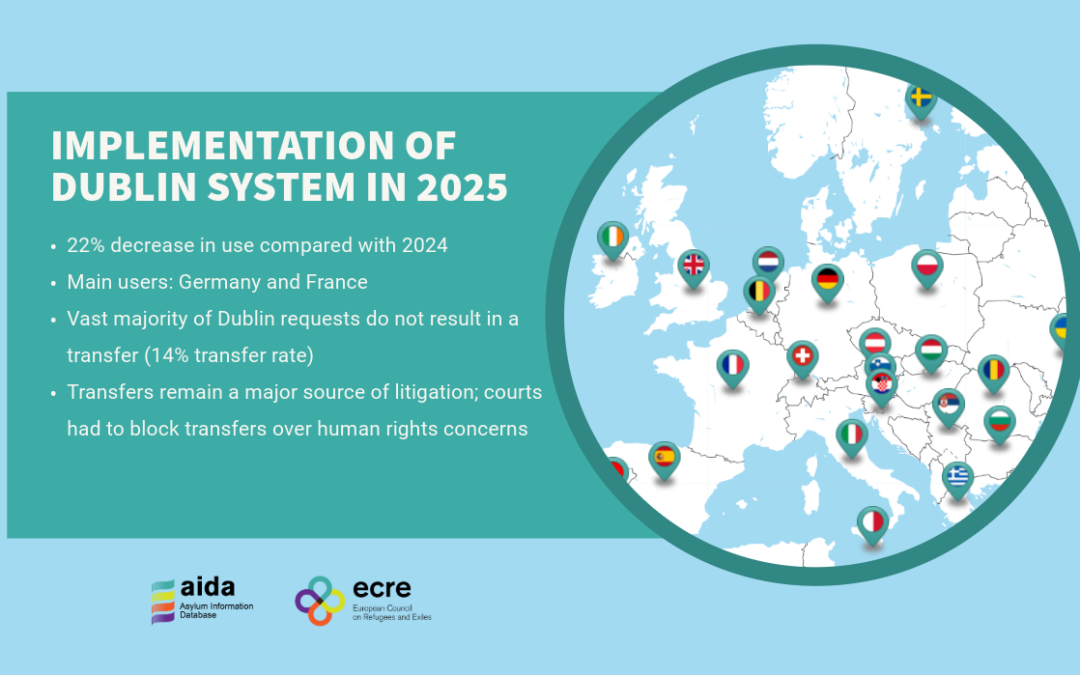
- Slight decrease in use of Dublin: After a record year in 2023, Dublin requests and decisions on requests decreased for the second consecutive year in 2025 when there were 134,454 outgoing Dublin requests. Germany and France were once again the main users of the system by far, jointly accounting for 64% of total outgoing requests.
- Continued low transfer numbers: Despite the high number of requests, the number and rate of actual transfers remained low: 18,415 outgoing transfers (14% transfer rate). The main recipients of incoming Dublin requests were Italy, Germany, Croatia, Spain and Greece. Notably, most of these requests did not result in a transfer of the applicant to Italy (66 incoming transfers) and Greece (33 incoming transfers).
- Continued litigation on respect for fundamental rights: Dublin procedures remained a major source of asylum litigation in Europe. However, jurisprudence continued to be inconsistent between and sometimes within countries regarding blocking transfers to certain countries for reasons related to respect for fundamental rights, including the existence of systemic deficiencies in the reception and/or asylum systems of the state deemed responsible. In 2025, asylum and/or reception systems in Belgium, Bulgaria, Croatia, Greece, Italy, Hungary, Malta and Poland were found by some national authorities and courts to demonstrate systemic deficiencies. In other cases, courts did not find that deficiencies in these countries existed or were systemic. The Court of Justice of the EU notably ruled on, inter alia, Italy’s unilateral suspension of incoming Dublin transfers, the interpretation of the six-month time limit for transfers and the reception conditions to be awarded to people awaiting a Dublin transfer.
- Prevalence of “take-back requests”: The majority (61%) of Dublin requests concerned people who had already lodged an asylum application in another Dublin country.
- Very limited use of family provisions: Only 2.2% of outgoing requests were based on the criteria related to family unity and the best interests of the child. This was despite the fact that these provisions are at the top of the hierarchy of responsibility and should therefore be prioritised. The vast majority (85%) of “take-charge requests” are based on the issuance of a visa or residence document (Article 12) or on the irregular entry criteria (Article 13.1).
- The Dublin Regulation became the Asylum and Migration Management Regulation: The Dublin Regulation has been repealed and replaced by the Asylum and Migration Management Regulation (AMMR), which became applicable on 12 June 2026. Analysis of the AMMR suggests that the changes will not be significant as the new rules on the allocation of responsibility are very similar to the current Dublin system and, as such, the current shortcomings will remain.
The latest statistical update is available here and previous updates can be found on the AIDA website.