



A walk down Wallajah Road, one of the lanes leading to the MA Chidambaram Stadium, offers a curious glimpse into Chennai’s relationship with two of Indian cricket’s biggest names. There is a shop called Sachin Sports and, a little further down, another called Dhoni Sports. A tea shop sits between them. It is an unremarkable stretch of road, especially on a non-match day, but the names on those shopfronts tell a story about the city’s enduring love affair with cricket. Sachin Tendulkar and MS Dhoni may have come from different corners of India, but Chennai has always found room for both in its heart.
Ask the staff at Sachin Sports what sells fastest, and the answer is a Chennai Super Kings shirt with Dhoni’s No. 7 on the back. A store named after Tendulkar sells more shirts bearing the number of a man who never played for Tamil Nadu. On Wallajah Road, nobody seems to find that unusual.
The city had made up its mind about Dhoni before he ever wore yellow. The long-haired batsman from Ranchi who flayed Pakistan at Visakhapatnam in 2005 was adopted in Chennai the way he was adopted everywhere else, from a distance and in a hurry, and the formal papers followed three years later. To understand why that happened, it helps to understand the city he walked into. Chennai has never needed the Indian Premier League to discover its love for cricket.
Idli, Rajinikanth, Ilaiyaraaja, Marina Beach, filter kaapi and cricket have long been the city’s shorthand for itself, and cricket is the only item on that list you can inspect for free on a Sunday. Take a suburban train in the morning and every stretch of open ground beside the track has a pitch or two marked out, sometimes several matches sharing one outfield, nobody asking anybody’s permission.
My mother still tells the story of Kris Srikkanth visiting our school for its annual day function as chief guest in the early 1990s. The auditorium held about 500-600, and by her account a good many more squeezed in, for an opener whose following the social media age has no real means of reproducing. Later in that decade, in 1999, Chepauk watched Pakistan beat India by 12 runs after Tendulkar had batted through a bad back, and the crowd rose to applaud the winners on their lap of the ground. Javed Miandad, then Pakistan’s coach, was moved enough to salute the city for it.
The affection was never in doubt. What it lacked, until 2008, was a face.
When the IPL arrived, franchises were expected to look like their cities, and most of them borrowed a local hero to prove it. Mumbai had Tendulkar, Kolkata had Ganguly, Delhi had Sehwag. Chennai had declined an icon player altogether, which looked like an oversight until they bought a man from Ranchi.
It also suited the city’s habits. Tamil Nadu has a long record of taking in outsiders and then refusing to give them back: MGR was born in Ceylon, Rajinikanth in a Marathi-speaking family in Bengaluru, and both were worshipped with a thoroughness the state has not always shown its own. Dhoni, whose “Nalla irukken” still carries a North Indian lilt, found his place in Chennai without needing an introduction.
Thala, the nickname caught on through the franchise’s music and the first Whistle Podu campaign. In Tamil Nadu, though, Thala was already a title closely associated with actor Ajith Kumar, one of the biggest stars in Tamil cinema. Dhoni gradually came to share it. Asked about the name in 2019, he said that in Tamil Nadu, “they don’t call my name, they call me ‘Thala'”. A year later, he explained that the word “basically means brother.”
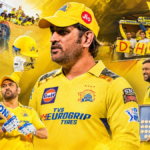
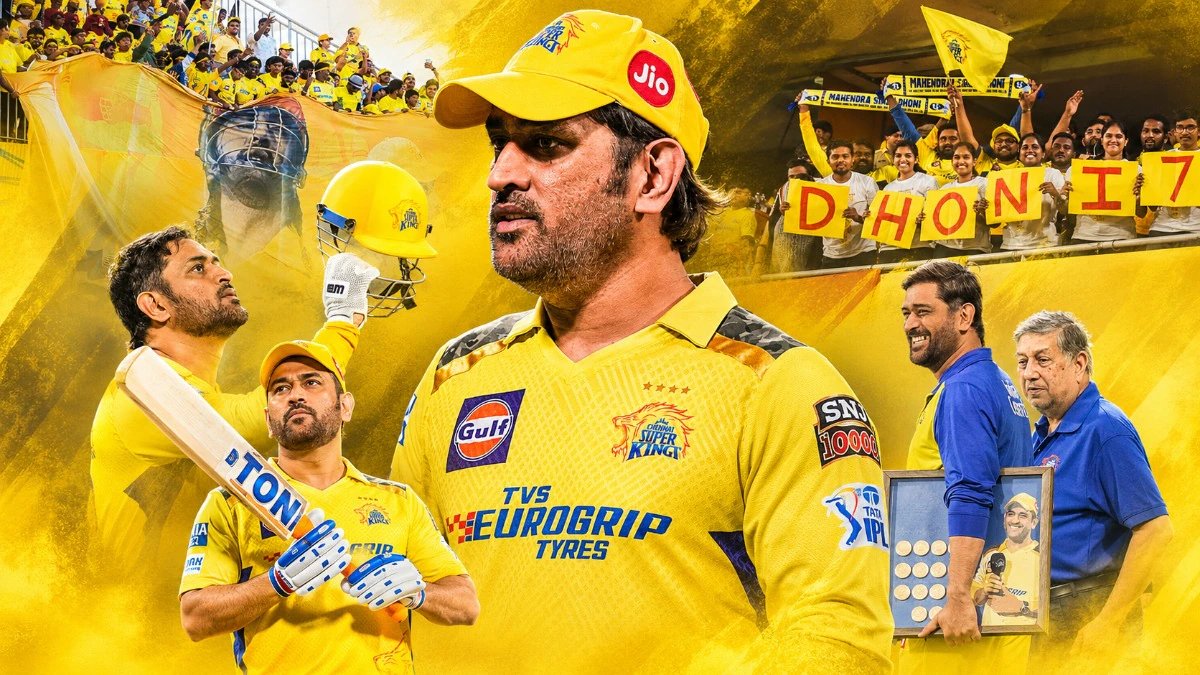
At Chepauk the affection acquired a soundtrack. The stadium DJ plays Rajinikanth’s intro songs as Dhoni walks out to bat, the Padayappa title number among them, a courtesy the city does not extend to just anyone, and a stand full of yellow shirts, a great many with 7 on the back, shakes accordingly. The ritual has a curious side effect. Chennai crowds have been known to cheer a wicket falling for their own side if the man walking in next is Dhoni. Ravindra Jadeja complained about it, half in jest, in 2023, and the DJ answered by playing “Mannipaaya?”, which means Will you forgive me?, as Jadeja came out to bat. The DJ meant it as the city apologising to Jadeja. Most of the stands heard Jadeja apologising for having got in the way.
There was a point in the later years when the relationship became almost entirely about the sight of Dhoni. Even when CSK were struggling, a boundary from him could bring Chepauk to its feet. It did not matter much if the match was slipping away. The supporters had come to see their Thala, and a few overs in the middle were sometimes enough. The phrase that emerged around this ritual was ‘Thala Dharisanam’, a glimpse of the leader. It was an unusual arrangement for a team sport, and not always comfortable for the teammates who had to share the stage. But the supporters had their own understanding of what they wanted from an evening at Chepauk. A CSK victory was the ideal outcome. The sight of Dhoni was sometimes consolation enough.
Perhaps the most telling moment came in 2018, when Chennai Super Kings returned to the IPL after serving a two-year suspension. Fans did not drift off. A group of them started a Save CSK campaign that grew into the Whistle Podu Army, the franchise’s best-known fan club. The two seasons away did little to diminish the attachment. If anything, the absence made the return more anticipated. When the BCCI welcomed the team back in July 2017, Dhoni replied on Instagram with a photograph of himself in the yellow shirt, number 7, with Thala written across it.
When CSK returned in 2018, the welcome was almost like a homecoming. The franchise opened its practice sessions to the public, and fans packed the lower tiers of three stands at Chepauk for a practice match. For many, it remains one of the most iconic moments of Dhoni’s CSK journey. He did not even play in that session, but the moment he stepped out, the ground erupted. A weekday practice session had turned into an event of its own. The sea of yellow and the roar from the stands said all that needed to be said: Chennai had waited two years for its Thala to come home.
At a team event around the return, Dhoni, who had greeted India’s 2011 World Cup triumph with roughly the emotion of a school-going kid pleased about a centum in a mathematics mid-term, tried to talk about the two years and fought back tears.
“We went through a lot. It’s never easy,” he said, before speaking about the importance of going through difficult times with a smile. His voice cracked. Suresh Raina came across with a bottle of water. Harbhajan Singh has since said that Dhoni cried at a team dinner around the same time, a detail the rest of the country would have bet money against. For a man who had spent much of his career making composure look effortless, Chennai had found a way to touch a different chord.
There was something in it for Dhoni, too. He has never pretended that the relationship was a one-way street. In 2020, he spoke about how CSK had helped him grow, not merely as a cricketer but as a person.
“This journey started in 2008. CSK has helped me improve in everything, whether it was being a human being or being a cricketer,” he said.
He spoke about learning to handle difficult situations, remaining humble when things were going well and dealing with challenges both on and off the field. A year later, at the franchise’s title celebration, he offered an even more personal reflection:
“Chennai taught me a lot. Tamil Nadu taught me a lot on how to conduct myself, how to appreciate the game.”
It was an acknowledgement that the city had shaped him as much as he had become part of its sporting identity.
Tamil Nadu has a test for stardom that has little to do with opening-weekend collections. A hero is proven when the whole family turns up, grandparents and grandchildren along one row, and Dhoni passed it without ever appearing on a cinema screen in the state. Sathyam and Kamala were never his theatres. Chepauk was. The political class noticed. At a CSK felicitation in 2021, MK Stalin, then chief minister, said he had come as a fan and that his father, Karunanidhi, had been one too, and told Dhoni the people of Tamil Nadu loved him as one of their own. In 2023 he hoped aloud that “our adopted son of Tamil Nadu” would carry on playing for CSK. Chief ministers in the state do not usually lobby on behalf of a man from Jharkhand.
At that 2021 function, after the fourth title, Dhoni made a promise that sounded almost like an aside. His last one-day game at home had been in Ranchi, he said, and “Hopefully my last T20 will be in Chennai.”
Time then did what it does. Dhoni’s last IPL appearance came in 2025, against Gujarat Titans, and a calf injury kept him out of the whole of the 2026 season, in which CSK finished eighth. In May this year, the team played its last home game at Chepauk, lost to Sunrisers Hyderabad, and went round the ground in a lap of honour. Dhoni, who had not played, went round with them. He stopped to share a moment with Raina, the stands did what stands do, and half the country spent the night asking whether it had just watched the farewell. He did not say.
On Tuesday he retired, by announcement and not on a field. The goodbye his promise had pointed to never came, and the supporters had imagined it for years: a last walk to the middle, one more roar from the stands, a chance to tell their Thala what he meant to them.
It would still be unfair to reduce the relationship to the one evening it left out. Chennai had all the others: the roar that arrives before he has reached the crease, the yellow shirts scattered through opposition stands, the nights when the result was almost beside the point. None of that depends on a fixture list. The speakers at Chepauk will go on playing Rajinikanth, and the Shor Meters should not need much persuading if he turns up in the dugout or joins a strategic timeout next year.
On Wallajah Road, Sachin Sports and Dhoni Sports will open as usual, with the tea shop between them doing what it has always done. Ask a child outside the stadium whose number is on the back of the yellow shirt, and the answer will come in one word, which will not be Dhoni.
– Ends