







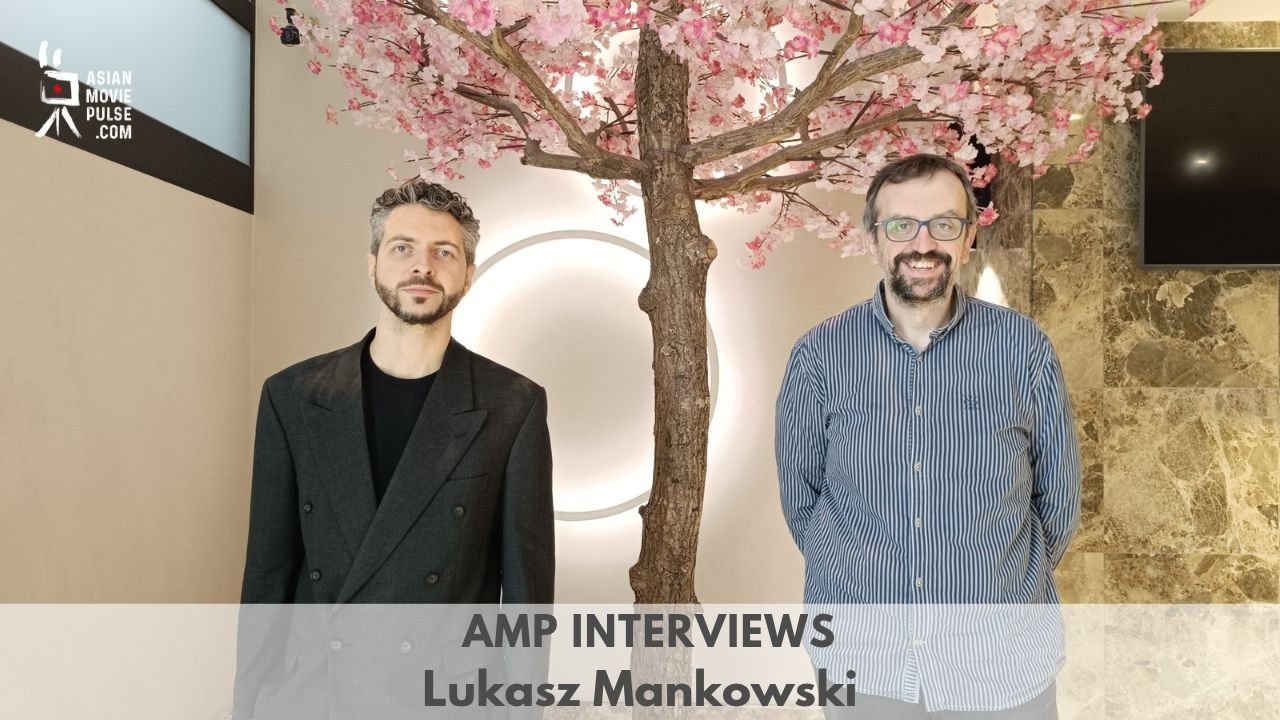
Ten years before becoming artistic director of Five Flavours, Łukasz Mańkowski arrived at the festival as a member of its People’s Jury. He was studying Japanese studies and film studies in Toruń, where opportunities to encounter Asian cinema were limited, and had long wanted to attend the Warsaw event. His successful application in 2016 opened a relationship that would gradually take him from audience member to translator, programmer and, eventually, artistic director.
Speaking during the festival’s anniversary edition, Mańkowski described that progression as a series of collaborations rather than a predetermined career path. After serving on the jury, he applied again unsuccessfully, but remained close to Five Flavours. He covered an edition for his blog, began interpreting for visiting Japanese filmmakers and contributed interviews, Q&As and curatorial writing. What started as a way to see films became an increasingly substantial involvement in presenting them to others.
The pandemic accelerated that involvement. Online conversations with filmmakers, including Miwa Nishikawa, Kiyoshi Kurosawa and Shunji Iwai, created new opportunities for the festival to reach audiences. Mańkowski took on more responsibilities during this period, initially expecting that the team would expand its work together when programmer Jagoda Murczyńska returned after her illness. Her death profoundly affected both the organisation and the people working within it.
For approximately three years, the team ran the festival collectively, without a conventional hierarchy. The subsequent decision to introduce an artistic director came through discussions about how responsibilities could be organised differently. Mańkowski offered to take on the role, but remains clear that the position does not make programming an individual exercise. One of its challenges has been learning to delegate rather than assuming that he should do everything himself.
“You’re a director, but it’s really collective effort that matters,” he said. His responsibilities include coordinating programming, assigning work, finding appropriate people to introduce and discuss films, shaping communication and representing the festival publicly. He also makes tea for the team—a small detail that fits his broader understanding of leadership as something expressed through daily relationships as much as formal decisions.
Mańkowski wants colleagues to feel comfortable making mistakes and acknowledging uncertainty. For him, trust is essential to working well together, and an emphasis on efficiency alone can obscure the person doing the work. Creating an environment in which people can be vulnerable is one of the more demanding parts of the job, but he regards it as inseparable from the kind of festival the team wants to build.
His programming partnership with Marcin Krasnowolski has benefited from their contrasting tastes. Mańkowski’s background in Japanese studies naturally informed his early contributions, but their shared remit extends across East, Southeast and South Asia. His first curated section, Japan Feel Good, emerged during a painful period following Murczyńska’s death. It offered audiences and organisers an opportunity to find some comfort through cinema.
Later sections drew on interests in India, Japanese cinema of the 1980s and Tokyo. Personal enthusiasm provides a starting point, but Mańkowski also considers which films are being restored, what discussions are developing around particular works and how a programme can respond to the wider world. Curating, in his account, involves bringing those elements together rather than simply assembling a list of favourites.
The festival divides its programme between contemporary work and retrospectives or thematic sections. This edition combines retrospectives devoted to Tsui Hark and Na Hong-jin with a focus on Vietnam and a section exploring spirituality. Alongside the New Asian Cinema competition, Asian Cinerama provides space for films that connect with audiences within Asia, broadening the selection beyond titles already prominent on the European festival circuit.
Programming begins in January for the November event. The team follows international festivals while also trying to maintain a presence at Asian events, despite the difficulty of fitting trips to places such as Busan, Tokyo and Singapore around its own preparations. Mańkowski wants the selection to reflect both the international circulation of Asian films and the conversations taking place closer to where they are made.
Audience feedback also matters. The team studies evaluation surveys and discusses requests, sometimes incorporating them into future editions. That exchange does not mean abandoning curatorial judgement. Mańkowski is willing to include a film that is imperfect if it offers a distinctive perspective or introduces something valuable. A programme need not consist entirely of polished works to justify the attention it asks from viewers.
“We want films to circulate alongside knowledge that stands behind those films,” he explained. Every film receives an introduction, either live or recorded, and the team invests in contextual material that can help viewers retain and think about what they have seen. This is also a reason to limit the programme’s size: adding more titles would make it harder to give each one the same care.
His spirituality section began partly with a desire to show “The Great Buddha+,” which he felt deserved a Polish screening, and partly with questions arising from his own life. The resulting eight-film programme approaches spirituality through different genres and everyday experiences. Its concerns extend beyond religious practice to less visible aspects of human life, including the search for meaning after profound disruption.
Shinji Aoyama’s “Eureka” became central to that approach. Mańkowski sees it as a film about finding a way to live after trauma has damaged that possibility. Its rhythm, images and duration also raise another question: whether watching a film can itself become a spiritual experience. Spending nearly four hours in a cinema allows the viewer to enter a particular relationship with time, attention and the people on screen.
The section’s range reflects his wish to examine those questions from different perspectives. “Becoming Human”, for example, concerns a ghost inhabiting a cinema that faces destruction, connecting the fate of a building with the presence it contains. Such premises allow the programme to consider what a cinema holds beyond its physical structure, and what might disappear when the space itself is lost.
For Mańkowski, however, access remains as important as the experience inside the auditorium. He identifies the expansion online as the most consequential change he has witnessed at Five Flavours. Growing up in a small town where local screenings were largely restricted to blockbusters, he relied heavily on pirated films for his early film education. That background makes him particularly aware of what access can mean to someone outside a major cultural centre.
Online screenings brought the festival into contact with viewers who could not necessarily travel to Warsaw. They also generated new responses and helped build a community around shared discoveries. Mańkowski sees this as an extension of the festival’s educational purpose: the encounter with a film should not depend entirely on where someone happens to live.
Within the festival itself, discussions and other events increasingly expand what can happen around a screening. This edition includes conversations about spirituality, feminism in China and Tsui Hark’s work, alongside performative Q&As and lectures. Mańkowski recognises that many viewers are accustomed to a traditional screening format, but wants to explore how the festival can offer other ways of engaging with cinema.
The anniversary programme also involved audiences directly in selecting films for a dedicated section. That participation helped establish a sense of anticipation before the festival began. By the time of the interview, Mańkowski was particularly encouraged by the conversations taking place around introductions, screenings and Q&As. His assessment of the edition’s success rested on those exchanges and the supportive response he could observe.
Asked about the future, he first returned to the team. Maintaining its sense of togetherness matters more to him than presenting the event as flawless. “We don’t want to do a perfect festival,” he said. “We want to make mistakes and learn from it.” He hopes to explore less represented regions of Asia, continue supporting marginalised voices and make room for work that challenges familiar viewing habits.
One memory from the edition captures what he wants to preserve. Introducing Hirokazu Koreeda’s “After Life,” Mańkowski found himself smiling and crying at the same time. He spoke to the audience about how an empty screening room need not signify absence or failure: after a film, it can also be a space in which something meaningful has just happened. He hopes Five Flavours will continue filling those rooms with people, while retaining an appreciation for what remains after they leave.