







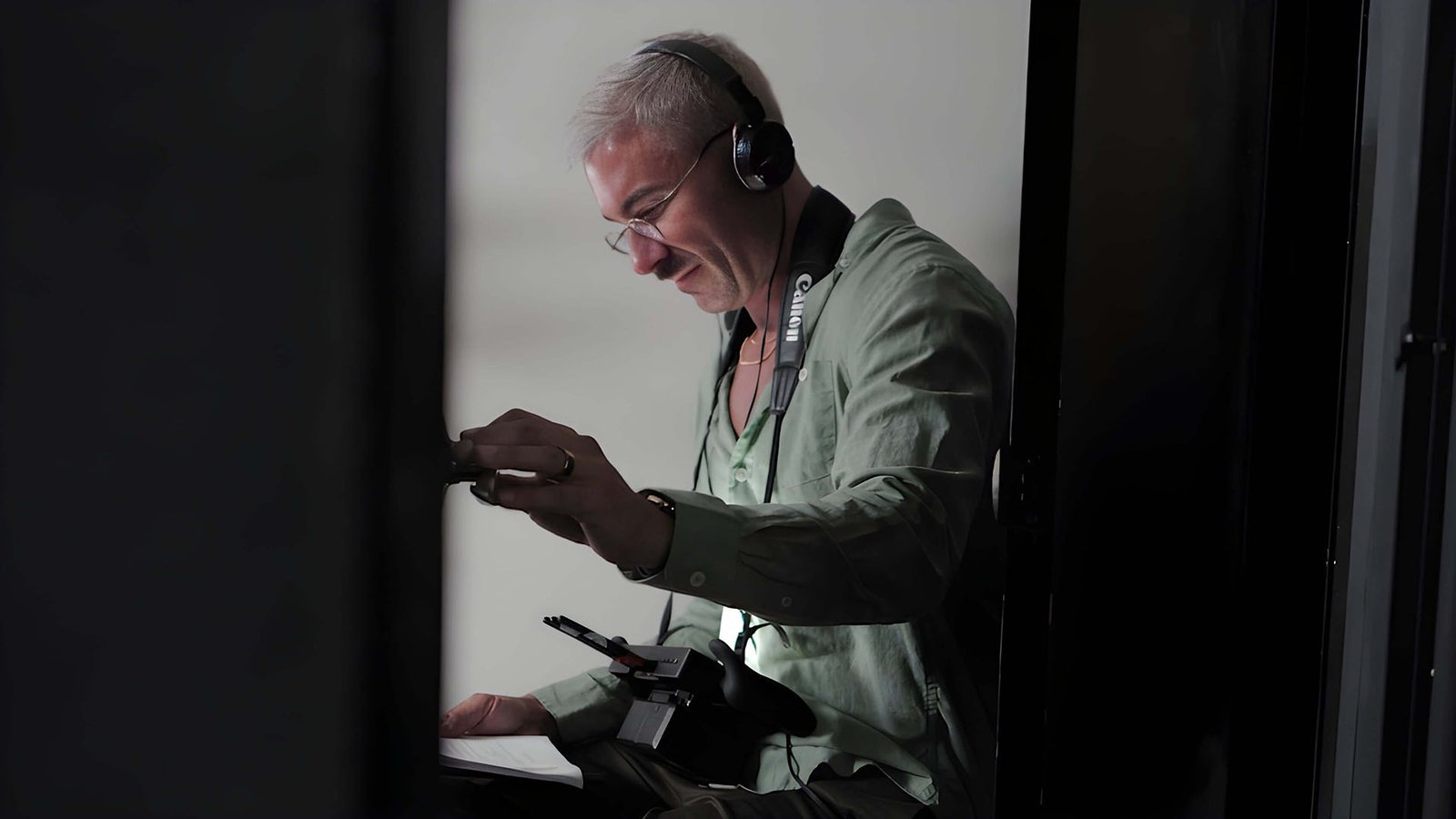
In Infection, the pursuit of a promotion becomes a disturbing test of ambition, loyalty and the price of staying productive. Written by Chelsea Franklin, Faleb Lindo, Fanny Gallegos, Matthew Miller and Tyler Ohaya through Kids in the Spotlight, the short marks James Kicklighter’s fourth collaboration with the programme, which pairs young people from the foster care system with professional filmmakers. As director, producer and editor, Kicklighter helped bring their corporate horror story to the screen while keeping the writers involved in its creative decisions. In this conversation with Indie Shorts Mag, he discusses mentorship, shooting the film in a single day, and the performances, visual details, and sound that shape its corporate nightmare.
Indie Shorts Mag: What drew you to the way Chelsea Franklin, Faleb Lindo, Fanny Gallegos, Matthew Miller and Tyler Ohaya approached ambition and loyalty in the screenplay for Infection?
James Kicklighter: What drew me in was how clear-eyed they were. Chelsea, Faleb, Fanny, Matthew and Tyler didn’t write ambition as a villain or loyalty as a virtue. They wrote both as hungers, and they let Jane feel each one honestly. She wants the promotion. She has earned it. She needs it. And the only thing standing between her and that chair is a man who is coming apart at his desk.
A lot of writers would make that choice easy. They didn’t. They understood that the work itself is the infection, that what’s happening to the Boss is what the job has been doing to him all along, and that Jane’s competence makes her the perfect host. That’s a sophisticated idea, and it came from young people who already know what it costs to keep going when the system around you isn’t built to take care of you.
Where I come from in Georgia, loyalty is close to sacred. You show up for your people. What this script asks is harder: what happens when showing up for the job means not showing up for the person in front of you? The writers never answered that for the audience, and I respected that. My job as director was to protect that ambiguity and let it get under your skin.
Indie Shorts Mag: What did collaboration with the five writers look like once production began, and how did you make space for their input into decisions on set?
James Kicklighter: The collaboration didn’t start on set. It started months earlier in the writers room, where Chelsea, Faleb, Fanny, Matthew and Tyler built this script with Hakim Hill guiding them. By the time we got to production, I knew the script the way they knew it, because I had watched them argue for every scene. That gave me a kind of shorthand with them that most directors never get with their writers.
On set, my job was to treat them like what they are: the authors of the film. Kids in the Spotlight is built on the idea that young people make their own work with mentors walking alongside them, not running ahead. So when a scene wasn’t landing, the first question wasn’t what I wanted. It was what they meant, and how we could further clarify the idea. One of those suggestions was trimming expositional dialogue, and letting those ideas speak for themselves visually. This is often a lesson with young writers, something I try to impart; if the camera can tell the story, we don’t have to announce the theme.
Making space for that input is less about a process and more about a posture. You have to decide in advance to take people seriously, before they’ve “earned” it by industry standards. Many people did that for me in my early career. I owe it forward. And the film is better for it. Their instincts about Jane, about what ambition costs and who pays for it, were sharper than mine more than once.
Indie Shorts Mag: With Infection marking your fourth film with Kids in the Spotlight, how do you balance the demands of delivering a finished film with giving young writers room to learn and develop their own creative judgment?
James Kicklighter: I don’t think those two things are actually in tension. The fastest way to shortchange young writers is to protect them from the real thing. If you hand them a small, safe film because it’s easier to finish, they learn how to make small, safe films. So the standard on Infection was the same standard I’d hold on any professional set: a real shot list, a real production design package, a real conversation about what we could afford and what we couldn’t.
That standard is where the learning happens. When you’re shooting a body horror short in a single day, every choice costs something. A scene that runs long in the script means a setup that doesn’t happen on the day. The writers got to see that math in real time, and I think it sharpened their judgment more than any notes session could. They learned which moments were essential to the plot, and which ones they loved but could live without. That’s a skill working screenwriters spend years developing.
My part of the balance is knowing when to step in and when to stay quiet. I’m responsible for delivering a finished film, so some calls are mine to make. But I try to explain the why every time, because the point isn’t for them to agree with me. The point is for them to understand the decision well enough to make a better one on their own film someday.
Each film with Kids in the Spotlight is a chance to give it back, and Infection was the most ambitious version of that yet.
Indie Shorts Mag: From Emily Peters’s sterile office design to the custom display font you created, how did you use visual detail to express the values of Infection’s corporate world?
James Kicklighter: Infection is about a workplace that gets inside you, so the world had to feel that way before anyone said a word. Every visual choice started from one question: what does this company value, and what does it cost the people inside it?
Emily Peters gave us the answer in the walls. She designed an office of sculpted white paneling, clean and expensive, the kind of space that tells you everything here is under control. But the longer you look at it, the more the surface starts to feel organic, almost alive. That’s the corporate promise in one image. It looks like order, and it’s actually an organism.
The custom display font came from the same idea. I didn’t want a logo. I wanted a language. The typeface is an invented script with no recognizable letters, so every document, screen and sign in Jane’s world is written in something you can’t quite read. Companies speak to their people in a language that sounds official and means nothing. I wanted the audience to feel that without having to think about it. It runs through the title cards, the on-set graphics and a 50-page corporate report we built for Jane to work on, because a world only feels true when every surface belongs to it.
Jonathan Pope and I carried that into the frame. We shot in a boxy 4:3, kept the office cold and framed Jane between hard vertical lines, so the architecture is pressing on her before the plot does. Adam Fishbein and Kasha Faye dressed the corporate world as a uniform.
None of it calls attention to itself. It just keeps telling you, quietly, that this place has rules, and the rules are winning.
Indie Shorts Mag: With so much of Infection unfolding without dialogue, how did you work with Isabel Adele Brown to convey Jane’s need for the promotion alongside her growing fear of the illness?
James Kicklighter: The first note I gave Isabel was that Jane’s trap is her competence. That’s the virus. Most actors would play the fear as a breakdown, and I asked her to do the opposite. Every time something gets hard, Jane narrows. She focuses. The rash spreads and she gets more productive, not less. She isn’t ignoring it. She’s filing it. That gave Isabel a way to play both things at once without saying a word. The need for the promotion lives in her hands, in how fast she recovers when someone interrupts her, in the way the headphones read as optimization instead of escape. The fear lives underneath that, in the small things she can’t quite stop: scratching her arm, glancing at the clock, her fingers still moving on the keyboard while her mother is talking to her in the hospital. She cares, and she still can’t stop working. That’s the whole film in one gesture. The moment I’m proudest of is the arm. When it happens, Isabel doesn’t play revulsion. She plays assessment. Is this a problem? How big? Can I still type? Yes. Move on. Someone walks by disgusted and Jane doesn’t even register it, and that’s more frightening than any scream would have been. Isabel understood that the horror isn’t Jane losing control. It’s Jane gaining a very particular kind of control, and paying for it with her body. She carried that with almost nothing but her face and her hands, and I think it’s one of the bravest performances I’ve had the chance to direct.
Indie Shorts Mag: Adam Fishbein developed a full costume arc for Jane. What did you want her changing wardrobe to reveal about her relationship with ambition?
James Kicklighter: Jane’s wardrobe tells the story the dialogue never says out loud. She starts as a worker bee: shapeless blouses, pencil skirts, flats, a copy-paste uniform in a sea of corporate sameness. As the infection takes hold, her silhouette moves toward her boss’s. Tailored. Structured. That masculine 1980s power line. By the end she’s dressed like the man she was afraid of becoming.
What I wanted that arc to reveal is that ambition doesn’t announce itself. Nobody wakes up and decides to become their boss. It happens a shoulder seam at a time. So Adam and I agreed the change had to be subtle. If the audience notices Jane’s clothes transforming while it’s happening, we’ve lost. They should only feel it at the end, when they realize she already looks like him.
Adam’s thesis for the whole film was that the clothes shouldn’t belong to any specific era. Infection isn’t set in 1985 or 2025. It lives in the timeless gray of cubicles and fluorescent light, where the job has worn away everyone’s individuality. That made Jane’s arc sharper. She isn’t finding herself. She’s trading one uniform for a more expensive one.
And then there are the gloves. The Boss hands Jane his gloves at the end, so they had to match his exactly. That’s the final piece of the costume, and the final question of the film. Does she put them on?
Indie Shorts Mag: How did you decide how far to push the illness’s practical makeup effects to achieve the balance you wanted between corporate satire and horror?
James Kicklighter: The rule I kept coming back to was that the effects could be as gross as they needed to be, as long as nobody in the office treated them that way. That’s where the satire lives. The horror is on the skin. The comedy is in how little anyone reacts.
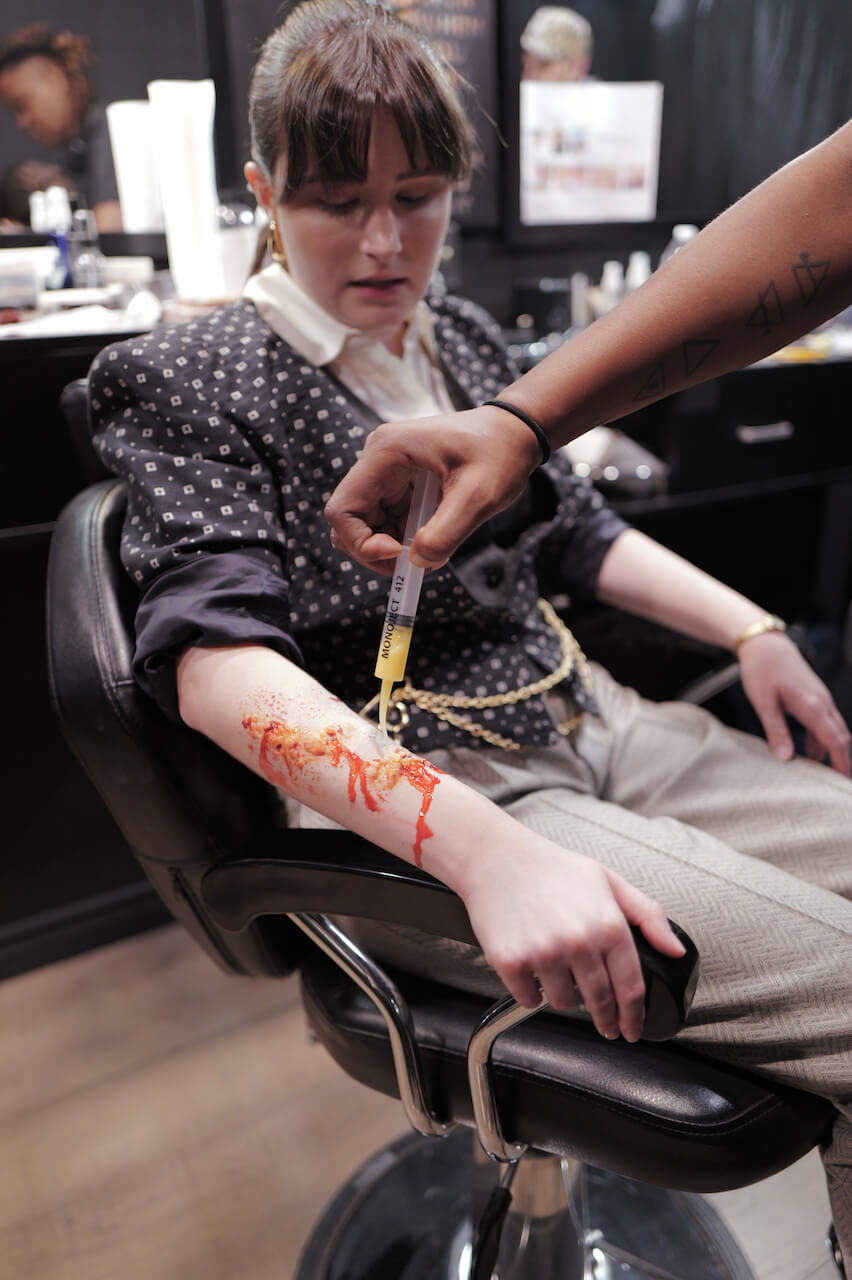
So we went practical. The prosthetics, blood and makeup were all applied on set, in the room, so Isabel and Daniel were reacting to something real across the desk. I wanted the illness to have weight and texture, because if it looked fake, the audience would have permission to laugh it off. It had to be real enough to make you flinch.
Then the performances did the rest. Daniel plays the Boss as thorough, not sick. The cough isn’t a symptom to him. It’s punctuation. When Jane’s arm finally gives way, she doesn’t scream. She checks whether she can still type. When someone walks by disgusted, she doesn’t even notice. The line “Will this affect my typing speed?” only works because the thing on her arm is genuinely horrifying. If we’d pulled back on the makeup, that line would just be a joke. Because we pushed it, it’s a joke and a tragedy at the same time.
That’s the balance. Push the body as far as it can go, and keep the corporate world completely unbothered. The further apart those two things get, the funnier and scarier the film becomes.
Indie Shorts Mag: What did you want Nicolas Repetto’s score to make audiences feel about Jane’s world that the images alone could not communicate?
James Kicklighter: The images can show you the office. They can’t make you feel it humming inside you. That was Nicolas’s job.
I wanted the score to sound like the building itself. Nicolas took that literally. He recorded real office supplies, staplers and the like, and then distorted them in the mix until they became part of the music. You don’t hear a stapler. You hear something mechanical and relentless, a system running in the background that never shuts off. Most people won’t consciously recognize where those sounds came from, and that’s the point. The office is in the score the same way it’s in Jane. She stopped noticing it a long time ago.
The most important thing the score does is follow her. The film leaves the office for the hospital and for home, and visually those are different worlds. But the sound doesn’t let her leave. When the staplers are still in the music at her mother’s bedside, the office has come with her. The images tell you where Jane is. The score tells you she never actually left work.
It also had to hold the line between satire and horror. The performances are deadpan, and the effects are grotesque. The music sits between them and refuses to tell you whether to laugh or flinch. It doesn’t wink and it doesn’t scream. It just keeps going, the way the job does.
Nicolas and I have worked together on a bunch of films for over ten years, and scoring is my favorite part of post. On Infection, he understood that the scariest thing about Jane’s world isn’t any single moment. It’s that it never stops.
Indie Shorts Mag: As both director and editor, how did you judge the length of the film’s pauses so that viewers could inhabit Jane’s uncertainty while the story continued to move forward?
James Kicklighter: Editing your own film is dangerous, because you remember every take you loved. The only way I know to fight that is to stop watching the film as the person who made it and start watching it as Jane.
Jane almost never pauses. That was the key. She’s a person running at full speed, and her recoveries are immediate. When someone interrupts her, she’s back on task in a beat. So the rhythm of most of the film is tight and efficient, the way she is. That made the few real pauses hit harder. When the film finally slows down, it’s because Jane has slowed down, and that means something has gotten through to her.
The final scene is where I let it breathe most. When the Boss tells her he doesn’t remember what made him qualified, she has to take that in slowly, the way you realize the door you thought was there isn’t. And when she asks if he ever considered not doing it, that’s the only moment in the film where she reaches for herself. I held on that longer than felt comfortable in the edit, because it needed to be uncomfortable. It’s the one place where the machine stops running, and it was the scene I shot first, because I knew structurally, every performance choice would lead to that.
The test I used was simple. If I was waiting for the next cut, the pause was too long. If I was waiting for Jane, it was right. The audience should never feel the story stall. They should feel Jane stall, and wonder whether she’ll start back up.
The ending had to hold that same tension. She’s looking at the gloves, and I didn’t want to decide for the audience. The film ends while she’s still deciding, so the uncertainty walks out of the theater with you.
Indie Shorts Mag: With Infection premiering in November 2026, what do you hope audiences recognise in the work of its five writers, and what opportunities would you like the film to open up for them?
James Kicklighter: I hope audiences recognize that this is a sharp, grown-up genre script, and that it would be one no matter who wrote it. Chelsea, Faleb, Fanny, Matthew and Tyler wrote a film about ambition, loyalty and what work takes from the body. They didn’t write a small, polite film about their own lives. They wrote a horror film with real ideas in it, and it holds up next to anything else in that space. Critics have already noticed the writing, not just the effects or the performances. That means a lot to me, because the script is where all of it started.
There’s a quiet bias in our industry that mentorship programs should produce “issue” films, the kind of safe short that gets applause at a panel and is never watched again. These five writers proved that young people from the foster system can write genre, satire and body horror with as much command as anyone. I want the film to put that bias to rest, at least for anyone who sees it.
As for opportunities, I want people to read their names in the credits and go looking for them. I hope the film opens doors to writers rooms, fellowships, development meetings, and people in this business who will take a meeting because they saw what these five did with ten minutes. They spent months in a room with Hakim Hill building this script. They’ve already done the hard part. Now they need the industry to show up for them the way they showed up for the work.
Being this is my fourth film with Kids in the Spotlight, I learn from at least as much from them as I taught. If Infection does one thing, I hope it’s this: the next time someone in a position to hire reads a script from one of these writers, they’ll open it expecting to be surprised.
Throughout the conversation, Kicklighter returns to the screenplay’s strength and the importance of treating its writers as collaborators with creative authority. That commitment runs through his account of Infection’s costumes, practical effects, music and editing: each choice serves a story about what work asks of people and what they surrender to it. His hope for the film extends to its five writers’ futures, opening doors to writers’ rooms, fellowships, and development meetings where their next stories can take shape.
Loading…
Loading…
Loading…