









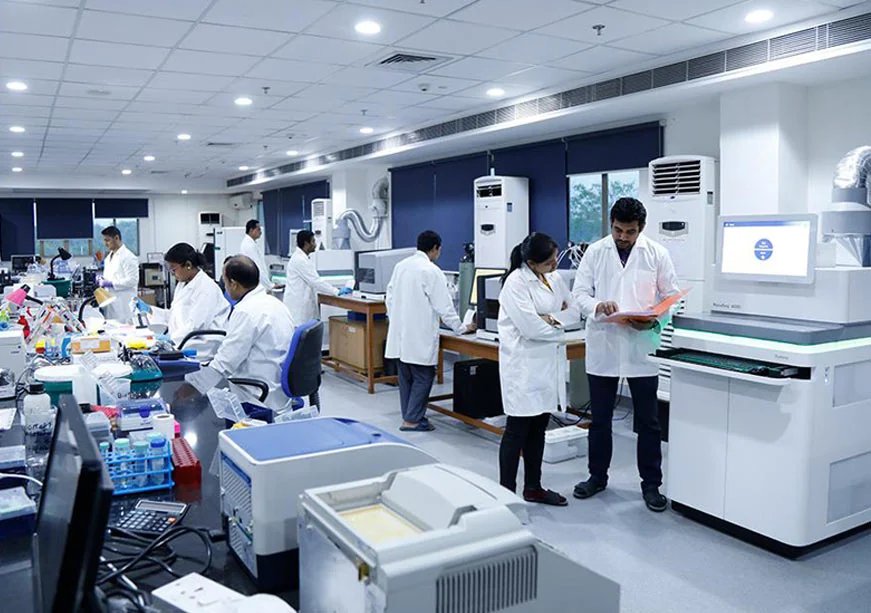

In 2014, India’s bioeconomy was worth less than US$10 billion and the country had less than 50 biotechnology startups. Today the bioeconomy is closer to US$200 billion, and India counts nearly 12,000 biotech startups. Growth of this kind is rarely the work of markets alone. In India’s case it was set in motion by a series of institutional decisions spanning decades: from creating a dedicated government department for biotechnology in 1986, to building an independent agency a quarter of a century later that could put public money directly into the hands of scientists and first-time founders.
This essay tells that story. It is a story about how institutions, and the changes made to them, can shape a market economy. It traces the path from the National Biotechnology Board of 1982 to the Department of Biotechnology (DBT), and from DBT to the Biotechnology Industry Research Assistance Council (BIRAC), and it ends by asking what the next institutional change ought to be. The account draws on an interview with Dr. Renu Swarup, former Secretary of DBT, and on the author’s own research and observations of this sector over the past decade.
Building the Foundations, 1982–2006
India began to take biotechnology seriously in the early 1980s, when the field itself was only just becoming real. Advances in recombinant DNA technology through the 1970s had shown that living cells could be engineered to make useful products, and in 1982 the first genetically engineered human insulin was approved for use. For a country that had spent earlier decades focused on food security and building its pharmaceutical base, this looked like the next frontier.
In 1982, the government set up the National Biotechnology Board, a coordinating body that brought together the Department of Science and Technology (DST), the Indian Council of Medical Research (ICMR), the University Grants Commission (UGC), and the Council of Scientific and Industrial Research (CSIR). Its task was to identify priority areas for a field that had barely begun in India. Within four years, the field had outgrown this arrangement. In February 1986 the Board became a full department of its own, the Department of Biotechnology, under the Ministry of Science and Technology.
For its first two decades, DBT looked inward. India at the time was a receiver of technology, rather than a developer. It depended on overseas expertise, and international sanctions limited its access to some technologies. The department’s early priorities were therefore basic: build research institutes, train scientists, and create laboratory infrastructure capable of producing world-class science at home.
One institution shows how this approach worked. Before the DBT existed, the National Institute of Immunology (NII) was established in New Delhi in 1981 by the Science and Engineering Research Council wing of DST. It began with research on leprosy and grew into a broad centre for immunology and vaccine research. When DBT was created in 1986, NII became one of its founding autonomous institutions. Rather than build everything anew, DBT absorbed and strengthened what already existed. The scientific base that grew at NII and similar institutions helped seed India’s vaccine and pharmaceutical industry, including companies such as Bharat Biotech and Shantha Biotech.
By the early 2000s this groundwork produced its clearest result: an Indian rotavirus vaccine. Rotavirus is a leading cause of severe diarrhoea in young children. The vaccine grew out of research by Dr. M.K. Bhan at the All India Institute of Medical Sciences (AIIMS), and then by DBT once Dr Bhan became the Secretary. DBT carried the work forward in partnership with Bharat Biotech, receiving support from the Ind0–US Vaccine Action Program. The vaccine was licensed in 2014 and entered India’s national immunization programme in 2016.
What stood out was the full arc of the journey: a discovery made in an Indian laboratory had travelled all the way to a product delivered to Indian children, with public research and private manufacturing working together at every stage.
What stood out was the full arc of the journey: a discovery made in an Indian laboratory had travelled all the way to a product delivered to Indian children, with public research and private manufacturing working together at every stage. The vaccine’s reach has since extended beyond India. In 2018, it received WHO pre-qualification, making it eligible for procurement by United Nations agencies and Gavi, the Vaccine Alliance, for use in other low-resource countries.
A New Kind of Gap
The rotavirus journey proved that public–private partnerships could turn laboratory research into a real product. It also showed how long and hard that road could be. And while it was under way, a new kind of actor was appearing in India and around the world: young scientists and researchers with novel ideas. These ideas were too small or too untested for large companies to fund, and too early for DBT’s existing grant schemes, which were built for established laboratories and institutions. This was a different gap from the one the rotavirus partnership had bridged. It was not a gap between a finished discovery and a manufacturer, but one between an idea and its first proof.
Closing it became one of DBT’s mandates. Around 2006, under the then Secretary Dr. Bhan, the department designed its first public–private partnership scheme for exactly this purpose. The template was the US Small Business Innovation Research (SBIR) programme, which since 1982 has directed a share of federal research funding to small firms and is one of the most established initiatives of its kind. It was adapted to Indian conditions, and the Small Business Innovation Research Initiative (SBIRI) was launched.
SBIRI was a genuine first step, but it exposed a structural problem. A government department dealing directly with private companies could not offer the speed and flexibility that industry needed; decisions moved at the pace of government. The scheme was also cautious by design. Support went to companies as loans rather than grants, and only to established companies that could offer collateral. It could not reach the young researcher or first-time founder with nothing but an idea and a laboratory result.
Designing an Institution
The conclusion DBT drew was that the problem could not be solved with just another scheme. It needed an institution outside the department’s formal structure. To work out what such an institution should look like, DBT studied how other countries had done it. The United States’ Defense Advanced Research Projects Agency (DARPA) showed how a public agency could fund high-risk, high-reward research. Canada’s Industrial Research Assistance Program (IRAP) showed how a government body could work directly with small and medium enterprises. Israel offered a model of strong government backing for medical device innovation. The United Kingdom had built clusters of research and innovation that operated at arm’s length from government departments. Each model taught a different lesson: how much risk a public funder should take, how closely it should work with industry, and how much independence it needed to do so.
The UK idea of an arm’s-length body had the greatest influence on DBT’s thinking. However, the lesson of SBIRI was that copying a single country’s programme was not enough. The new institution had to be built for where India’s ecosystem stood in 2007, with its own instruments, its own approach to risk, and its own legal identity, separate from the department.
The timing helped. DBT was in the process of finalizing its first National Biotechnology Development Strategy, a follow-up to its Vision document of 2000. Wide consultation with researchers, universities, startups, and industry produced one clear conclusion: DBT could not remain only a granting authority. It had to become a partner in the products it funded, sharing the risk and staying engaged from research through to market. This was close to the “product development partnership” model then gaining ground internationally, in which public and philanthropic funders worked alongside companies to develop vaccines and drugs for diseases the market alone would not serve. A partnership of that kind could not be run from within the government system as it stood. It needed a vehicle of its own.
The Origin of BIRAC
That vehicle was the Biotechnology Industry Research Assistance Council (BIRAC). Its name says what it was meant to do: bring biotechnology, industry, and research together, and assist research towards the market rather than simply fund it. Even the word “council” was a deliberate choice. The institution had to be government-owned, not privately held, yet it had to operate with the independence of an industry partner rather than a ministry department.
Three choices set BIRAC apart from anything DBT had built before.
First, it was a separate legal entity registered as a public sector enterprise with government backing its own operating framework, not a departmental scheme.
Second, it could fund individuals and early-stage entrepreneurs directly, not only established companies. This was the real shift from SBIRI, which had lent only to companies and only against collateral. Until then, government money had never gone straight to a founder with nothing but an idea. It was the biggest risk in setting BIRAC up.
Third, it could offer grants, loans or equity depending on what a company or a stage of research needed, years before such flexibility became common in Indian public financing.
Getting this approved took nearly five years. The proposal moved through DBT’s own processes and then through roughly 20 ministries and departments, from the Ministry of Finance to the then Planning Commission. The Cabinet cleared it on 11 December 2011. BIRAC was registered as a public sector enterprise on 20 March 2012, five years after the 2007 strategy had first called for it.
BIRAC and its Partners
BIRAC began in 2012 in a small ecosystem with around 50 biotech startups and a bioeconomy worth less than US$10 billion. The gaps were basic. Researchers with promising ideas had nowhere to work on them outside their academic laboratories, because India had hardly any incubators. The vocabulary of translation, incubation, and entrepreneurship was unfamiliar in research institutions, where the job was to publish, not to build products.
BIRAC’s first task was to fill these gaps, and it chose to do so by staying small. It kept a single office in Delhi and did not grow into a large bureaucracy. Instead, it built what came to be called the “BIRAC family”—a network of partner institutions across the country that would carry its programmes into their regions, rather than BIRAC running everything from the centre.
That network started with five incubators and grew alongside BIRAC’s own schemes, beginning with the Biotechnology Ignition Grant (BIG), its early-stage grant for individuals and young startups. Regional partners such as the Centre for Cellular and Molecular Platforms (C-CAMP) in Bengaluru and IKP Knowledge Park in Hyderabad did more than host startups. They ran components of national schemes, co-managed funds, and studied the innovation ecosystem in their regions on BIRAC’s behalf. DBT’s own biotechnology clusters, including the one built around the Translational Health Science and Technology Institute (THSTI) near Delhi and others in Bengaluru and Pune, were given a mandate to work closely with industry and startups to move technologies through the translational stages. The cluster approach worked because it put research institutions, incubators, startups and funding in one place, so that a technology could move from laboratory to company without leaving the campus. And every scheme BIRAC introduced grew out of direct conversations with the people who would use it, rather than being designed from the top down.
Where there was a gap in policy, it shaped policy. Where there was a gap in skilled people, it built training pathways. Responding to identified gaps rather than following a fixed blueprint is what allowed BIRAC to keep evolving as India’s biotech ecosystem grew more complex.
BIRAC’s method, then, was simple. Where there was a gap in infrastructure, it built infrastructure. Where there was a gap in policy, it shaped policy. Where there was a gap in skilled people, it built training pathways. Responding to identified gaps rather than following a fixed blueprint is what allowed BIRAC to keep evolving as India’s biotech ecosystem grew more complex.
What the Numbers Show, and What They Do Not
The results, a decade on, are striking. The bioeconomy that stood below US$10 billion when BIRAC was set up is now closer to US$200 billion. India has nearly 12,000 biotech startups and ranks among the top 12 biotech economies in the world. BIRAC alone has provided over INR 42 billion in direct funding and helped catalyse roughly INR 70 billion in total investment, which has translated into more than 900 products reaching the market and over 35,000 high-skilled jobs.
COVID-19 became an unplanned stress test. Through the National Biopharma Mission, BIRAC funded vaccine and diagnostic work at Bharat Biotech, Cadila Healthcare, Serum Institute of India, and Gennova Biopharmaceuticals, support that reached across the pandemic response, from vaccine candidates to testing capacity. The pandemic showed that the ecosystem built over the previous decade could deliver at speed and at scale. BIRAC has since been named a second-level fund manager under the government’s new Research, Development, and Innovation framework, with INR 20 billion earmarked over five years for high-risk, high-impact biotech ventures from early translational research to growth stage.
But the institutions mattered because they did what markets would not do on their own. They took the first risk on unproven ideas, built the incubators and clusters where those ideas could be tested, and made public research a working partner of private manufacturing.
It would be too simple to credit this growth to DBT and BIRAC alone. India’s established pharmaceutical industry, its large pool of trained scientists and a growing private capital market all played their part. But the institutions mattered because they did what markets would not do on their own. They took the first risk on unproven ideas, built the incubators and clusters where those ideas could be tested, and made public research a working partner of private manufacturing.
The Next Institutional Change
Yet these numbers do not answer the harder question: what happens to a startup after it is funded? Does the ecosystem carry it to a sustainable, scaled business, or only to the next milestone? That distinction is the crucial one, and it is where the real work now lies.
Building a pipeline of startups was the visible, and in hindsight the easier, part of the last decade. Sustaining what comes out of that pipeline is harder. Helping startups survive and scale well beyond their first grant is a problem the ecosystem is only beginning to confront. Venture capital remains hesitant to back biotech, and where it does invest it tends to chase safer, “low-hanging” opportunities rather than the harder, higher-value ones.
The story told here is one of two institutional changes: a department created in 1986 to build a scientific base, and a council created in 2012 to fund the first mile from idea to product. The next change must address the last mile: patient, risk-bearing capital and the market access that turn a funded startup into a lasting company. Whether that calls for a new instrument within BIRAC or a new institution alongside it is the question the ecosystem now must answer. BIRAC’s own history offers the method. Keep identifying what the ecosystem needs next, and make sure the framework built to fund India’s scientists as entrepreneurs evolves quickly enough to keep pace with them. An institution that stops questioning its own relevance risks becoming irrelevant.
Table: A Timeline of India’s Biotechnology Journey

Source: Author’s own
Shruti Sharma is an associate director and fellow at the Observer Research Foundation.
The author acknowledges the use of Claude Fable for language refinements and grammatical corrections.
The views expressed above belong to the author(s). ORF research and analyses now available on Telegram! Click here to access our curated content — blogs, longforms and interviews.