







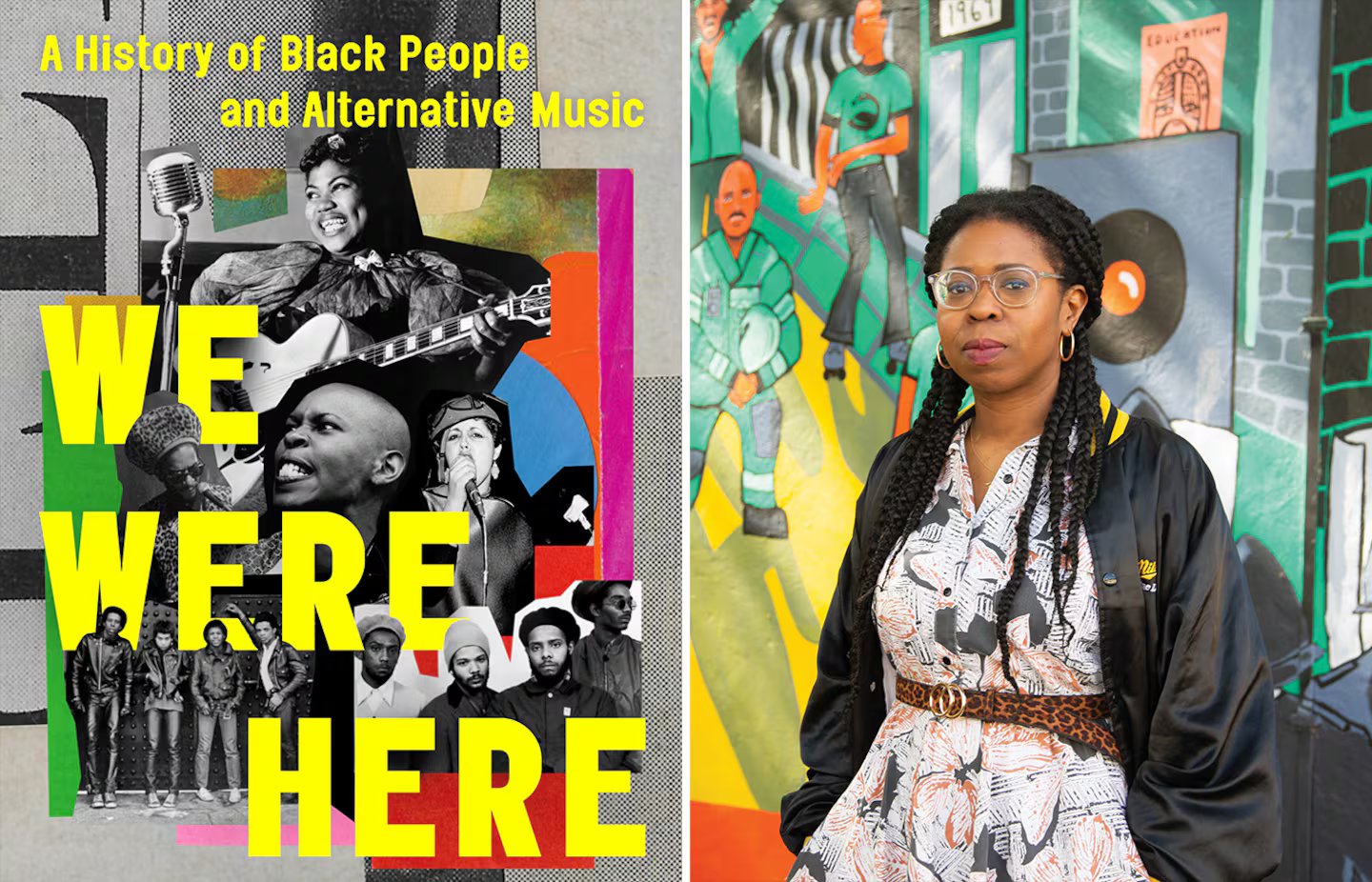
Voices like Phillips are vital in speaking out against this pattern.
“We Were Here” celebrates the impact of renowned figures like “Godmother of Rock and Roll” Sister Rosetta Tharpe, Little Richard, Fats Domino, and Chuck Berry. In addition, Phillips calls out a parasitic industry that “deliberately buried” Black alternative musicians while elevating white singers instead as a money grab.
She tells the Globe that her latest work praises the Black creatives that made rock music as prominent as it is today, while simultaneously educating the masses about the weight of their contributions.
“I wanted the book to be a reference point because unless history is documented, people say it didn’t exist,” she said. “If you’re documenting almost a century’s worth of music history and pointing out the various moments where Black artists have been incredibly pivotal to the development in alternative music, then you can’t deny it.”
“I also highlight a few artists that have been a bit more forgotten about or their stories that have been misremembered. Hopefully that adds to a better remembering of their legacy. I want people to learn a bit more about this period in Black history.”
For instance, though many people credit the birth of rock ‘n’ roll to Elvis Presley’s 1954 release “That’s All Right,” the song was actually a cover of Arthur “Big Boy” Crudup’s 1946 single.

Some of the artists Phillips pays homage to include infamous queer performer Vaginal Davis, who drew inspiration from Black Panther revolutionaries to explore race, class, and sexuality through drag; Washington, D.C. band Bad Brains, who redefined the concept of hardcore punk; and British band Skunk Anansie, who crafted their own racialized version of shock rock.
Phillips notes that Skunk Anansie vocalist Skin–as well as other Black women like Grace Jones and Bam Bam’s Tina Bell–have had their appearance scrutinized over the years in an attempt to minimize their cultural influence. She explains that it was mostly white people who perpetuated racist narratives.
“When I went back in the archives and looked at what people were writing about Skin in the UK music press, it was overwhelmingly white journalists critiquing her,” she said. “They were fixated on her race and on her sexuality and her beauty. There was this mixed kind of reaction of being almost horny for her and also kind of terrified of her. I do think that it was like a uniquely, you know, misogynistic and racist–a kind of misogynoir–reaction to Black women in these spaces that people deem to be white.”
Phillips knows this experience firsthand as the frontwoman of Big Joanie. In “We Were Here,” she shared that even though her band has been together for over a decade and received support from riot grrrl acts like Bikini Kill and Sleater-Kinney, the skepticism around Big Joanie’s place in the alternative music spaces remained.
“From a UK perspective, it doesn’t feel like you can prove yourself in a logical, reasonable way in the same way your white counterparts can and the industry will reward you,” she explained. “Our music industry is very aligned to this very narrow-minded idea of what is indie, or what is rock, or what is punk. Black women in their late 30s don’t fit that kind of theme for them.
“We can get good reviews, we can get some festival slots,” Phillips added. “But reaching that next level and excelling would mean we’d need to be able to kind of find a space for ourselves in that world–and I don’t know if there is a space.”

Despite Phillips struggling to find a space for her own Black feminist punk in the United Kingdom, “We Were Here” ends on a positive note about Black punk artists in the US charting their own path. She commends acts like Meet Me @ The Altar, Willow Smith, KennyHoopla, and Soul Glo for the authenticity found in their art and the courage it took to make it. These acts didn’t just expand the representation of Black pop-punkers in the scene, but they also received critical acclaim and praise from industry peers.
Despite a music industry that is ripe with a history of racism and exclusion, Phillips insists that she is hopeful about the future of punk rock.
“It feels like things have kind of moved on from when I was kind of writing that book,” she concluded. “In the past, it was seen as a weird thing to be alternative and Black. Whereas now it feels like it’s just one of the number of things that you’re into and it doesn’t necessarily define you or mean that you’re less of a Black person.”
“The most interesting music that’s coming out in alternative spaces is from young Black people and young people of color, and I don’t think it’s ever gonna die.”
WE WERE HERE: A HISTORY OF BLACK PEOPLE AND ALTERNATIVE MUSIC
By Stephanie Phillips
Da Capo, 368 pages, $30