








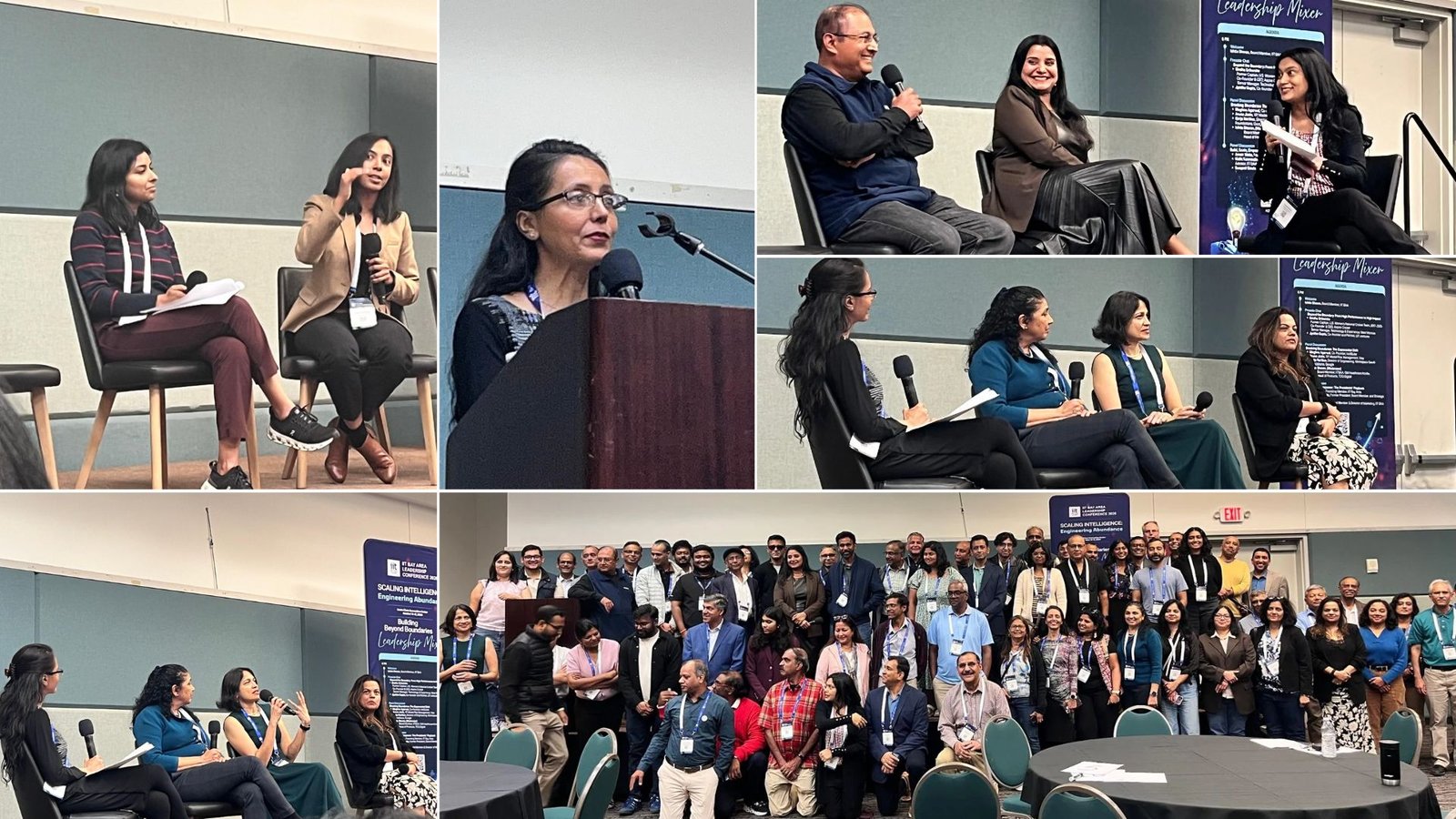
By Ritu Jha-
The IIT Bay Area Leadership Conference opened its flagship program, “Building Beyond Boundaries,” on Oct. 16 at the Santa Clara Convention Center in the heart of Silicon Valley. Widely recognized as the largest IIT networking event on the West Coast, the opening evening focused on women’s leadership, bringing together industry veterans, company founders, investors and business leaders to discuss the challenges of leadership, breaking traditional barriers and redefining success.
Among the key organizers behind the gathering was Aman Walia, a founding member of the IIT Bay Area organization, which was established in 2016. In an exclusive interview with indica on the sidelines of the “Building Beyond Boundaries” leadership mixer, Walia discussed the impact of artificial intelligence on the technology workforce, changing gender representation at the Indian Institutes of Technology and the challenges facing Indian professionals navigating the U.S. immigration system.
As agentic AI increasingly automates traditional entry- and mid-level technology roles, including quality assurance and project management, and major corporations continue to restructure their workforces, Walia compared the current disruption to the technology industry’s transformation during the dot-com downturn of 2000-01.
He said artificial intelligence should not necessarily be viewed as a permanent threat to employment but as a fundamental rebuilding of the technology landscape that will require workers to develop new skills.
“Whenever there is a change in baseline technology, the systems need to be changed fundamentally, from the ground up. Then there is a lot of disruption, not in the net employment, but in the way you are employed,” Walia said. “If you get laid off, it is just because your skills are redundant, which does not mean that the requirement for new skills is not coming. People move from one bucket to the other, and the people who move faster find themselves stable faster.”
“What is worrying is the current state and how you manage the transition,” he said. “Humans will eventually find a way to beat the machines. It’ll just take a few years and some new inventions. If I needed data two years back, I would go to a database. Now I don’t need to go to a database; I need to go to some prompt. So, it’s fundamentally changing how I’m looking for information.”
With approximately 15,000 IIT alumni living in the Bay Area, Walia said the organization’s annual gathering provides an important opportunity for professionals to exchange ideas, understand industry changes and plan their careers.
Nearly 800 people attended the organization’s first conference in 2016, he said.
“People who have to transition have to know where they are and where they have to go,” Walia said. “That was the focus of this conference because they met their colleagues, listened to speakers, and figured out where the world is going. To be able to intelligently plan how they have to reach that point. If they don’t come to such meetings, they won’t get an idea of what’s going on in the world. These conferences exchange ideas, exchange securities, and insecurities.”
Reflecting on the conference’s emphasis on women’s leadership, Walia pointed to significant changes in female enrollment at India’s premier engineering institutions since his student days at IIT Bombay.
“The number of women has increased in recent years, whereas the past years were terrible,” he said. “In my batch at IIT Bombay, we were a class of 269 or 270 people, out of which we had only 12 women. Now, every class entering IIT Bombay has at least about 80 to 100 women. In our time, not even 5% were women. Now, it’s in the range of 20 to 25%, which is very good.”
Walia also addressed U.S. immigration policies, green card backlogs and proposed changes to the H-1B visa program, saying younger IIT graduates have been particularly affected by delays in permanent residency processing.
He noted that some major technology companies have recently paused corporate green card processing, adding to uncertainty among Indian professionals who have spent years working in the United States.
“The people who have graduated in the last 10 to 15 years are in serious trouble,” Walia said. “Immigration is a very touchy issue, so typically corporate heads don’t really make an issue of this. They employ all kinds of people. They employ non-Indians at large, so you can’t expect the CEO of Microsoft saying, ‘I want more Indians.’”
Walia said the current scrutiny of employment-based immigration was not entirely unexpected, given longstanding concerns about the H-1B program and its use by companies to reduce labor costs.
“We’ve been expecting this for the past 10 years,” he said. “Immigration has two parts to it: one is people who come here to study and join the mainstream, and the second set of people is the H-1s who come in. H-1s have been abused by companies across the spectrum. It is labor arbitrage that has been driving this abuse, and at some point, people had to wake up and say enough is enough.”
He said the H-1B program could return in a revised form with stricter requirements because U.S. companies continue to need skilled international workers.
“Whether the H-1 will survive or whether it will come in some other format, we will have to see,” Walia said. “I think it will come back in some other format with stricter rules because the talent is required, but the abuse has to be cut down.”
The conference also featured a discussion with Sindhu Sriharsha, an Indian-born American cricketer and captain of the United States women’s national cricket team. During an audience question-and-answer session, Sriharsha drew parallels between leading a national team and managing corporate organizations, discussing vulnerability, team culture, handling pressure and the development of cricket in the United States ahead of its return to the Olympic program at the 2028 Los Angeles Games.
For Sriharsha, leadership extends beyond performance on the cricket field. She said one of the most rewarding aspects of her role is hearing from players and mentees about their progress, whether in sports or their professional lives.
“It’s not just cricket. I want to continue to make impacts in their lives,” Sriharsha said.
Responding to a question about changing the culture of an inherited team, a challenge familiar to corporate managers taking over established organizations, Sriharsha described how she addressed inadequate fitness levels when she assumed leadership.
Rather than immediately imposing demanding standards, she said she worked with the team to establish a common benchmark that every player could realistically achieve and gradually build upon.
“When I did take over, our fitness levels weren’t too great,” Sriharsha said. “We got together as a team and decided on a common objective and a benchmark that we were all going to hit. We came up with something that everybody could meet, which everybody could strive for. It was an inclusive approach to make everybody work towards one common goal.”
“As a leader, you want to make sure that your team is buying into your culture and buying into your objectives,” she said. “It meant that I was going down on my status a little bit, but I was able to get more people to follow it because I was going into what they could do.”
With cricket scheduled to return to the Olympics at the 2028 Los Angeles Games, Sriharsha said the United States has an opportunity to expand the sport’s appeal beyond established immigrant communities.
She emphasized the importance of introducing cricket in schools and encouraging participation at the grassroots level rather than relying solely on the Olympics to generate interest.
“There’s definitely a lot of work that needs to be done from the ground up to be able to make the sport a little bit more seen throughout,” Sriharsha said. “One way to do that is going into schools. This is the right time for cricket to be introduced in the Olympics. Maybe that will be the catalyst to move the sport a little bit in the country.”
She said the United States had not done enough to capitalize on the opportunity presented by cricket’s Olympic return but that significant work could still be accomplished before the Games.
“I feel like we haven’t done enough work leading into the Olympics, that we haven’t actually used that platform to grow the sport for many obvious reasons, but I think we still can do plenty of work there to grow the sport with the Olympics in our backyard,” she said.
Bringing the conference’s themes of leadership and technological transformation into the corporate world was a panel discussion titled “Breaking Boundaries: The Exponential Shift,” moderated by IIT Bay Area board member Ishita Sharan.
The panel featured Meghna Agarwal, co-founder of flexible workspace company IndiQube; Girija Narlikar, Google’s director of engineering overseeing Workspace Trust & Safety; and Aruna Joshi, Visa’s vice president of model risk management.
The discussion examined how business leaders are adapting to rapid changes in workplace models, cybersecurity, artificial intelligence and financial risk management.
Agarwal, who is not an IIT graduate, came from a small town before co-founding IndiQube, a Bengaluru-based flexible workspace company that expanded to 17 cities and went public last year. She said the company was built around the expectation that businesses would increasingly move away from long-term commitments to traditional office spaces.
“One of the biggest exponential shifts we saw was the way people are going to consume real estate and office spaces, because there’s already disruption happening in other parts like the way we shop, travel, and commute,” Agarwal said. “We believe that flexibility, agility, and experience are going to be the core drivers, and people are not going to spend on any fixed real estate or commitments with a landlord for the longer term.”
She said businesses must recognize that changing consumer and workplace expectations will continue to reshape traditional industries.
“We do not say that we know what the future is going to look like, but what we know is that the future is changing,” Agarwal said.
Narlikar, who earned a bachelor’s degree in computer science from IIT Bombay in 1993 and a doctorate from Carnegie Mellon University, spent a decade as a research scientist before launching a startup in Mumbai. She later held leadership positions at Meta, Instacart and Google.
At Google, she oversees efforts to protect Workspace users from spam, abuse and emerging AI-driven threats. She said the rapid availability of generative AI has fundamentally changed the cybersecurity landscape, forcing defensive teams to adapt at an unprecedented pace.
“Initially, we were very happy that we were the first team that was able to use large language models not to make you more productive, not to help you write better emails or take notes, but to fight abuse,” Narlikar said. “We thought that we had a trump card, that we could stay ahead of the bad guys.”
However, she said, that advantage quickly diminished as malicious actors gained access to the same technology.
“But very soon we found out that all the bad guys also have AI at their disposal, and the attacks got very sophisticated very quickly and kept changing,” she said. “We are trying to stay ahead of these kinds of behaviors in agents and use as much of agentic protections as we can. The velocity with which we have to adapt has increased tremendously.”
Joshi, a 1985 IIT Bombay graduate with a doctorate in mechanical engineering, took a different career path into financial services. She joked that her transition into the industry meant she had “switched over to the dark side.”
As Visa’s vice president of model risk management, Joshi leads a discipline that gained prominence following the 2008-09 financial crisis. The field focuses on identifying weaknesses in statistical and analytical models before they contribute to financial losses or broader systemic problems.
Her team had traditionally evaluated models used in areas such as fraud detection and credit risk. However, the arrival of generative AI in late 2022 dramatically expanded the number and complexity of models requiring oversight.
“Generative AI gave access to many. People who didn’t even know how to code are now writing code; they’re constantly deploying things,” Joshi said. “Suddenly, our model inventory grew from 200 to 500 in just one year because of generative AI. We had to rethink how we define a model and how we validate it.”
She said traditional validation methods were no longer sufficient as companies began deploying generative AI applications.
“Traditional validation included accuracy and sensibility testing, but now suddenly we have to do prompt engineering tests, context awareness, and hallucination checks,” Joshi said. “Our program has evolved so much more in the last 12 months compared to what happened in the six years before that.”
In a separate exclusive interview with indica, Joshi discussed her career transition, the continuing gender gap in U.S. science, technology, engineering and mathematics fields, and the skills women will need to succeed in an increasingly AI-driven economy.
Although both of her daughters pursued STEM degrees, Joshi said attending their college graduations reminded her that women remain underrepresented in many technical disciplines.
“I don’t know why there are still fewer women in STEM, because both our daughters went into STEM and I was really happy,” she said. “But when I went to their graduation, I saw that they were still in the minority.”
Joshi said cultural expectations and longstanding stereotypes about women’s abilities in mathematics and science may contribute to the disparity.
“I think it’s very cultural, and maybe they get intimidated, or maybe there are stereotypical ideas that people have that girls are not good at math,” she said. “So many things have been tried, and they’re not succeeding as much. It’s a long journey.”
Although she eventually moved away from mechanical engineering into software and financial modeling, Joshi credited her education at IIT Bombay with developing the critical thinking skills and confidence that helped her navigate unfamiliar industries.
“IIT education was a huge help,” Joshi said. “Being in IIT helped me with critical thinking, and it just taught me how not to be afraid of any situation.”
Looking ahead to the next five years, Joshi said artificial intelligence would fundamentally change employment patterns across the technology and financial services industries. While routine tasks are likely to require fewer workers, she expects the nature of professional responsibilities to change significantly.
“I cannot predict. All I know is the number of people doing the work will be reduced, and the type of work that people will do will completely change,” she said.
Her advice to women entering technical fields or considering a midcareer transition was to prioritize foundational education and analytical abilities rather than focus exclusively on specific technologies.
“Focus on basic sciences, get your foundation well, and then you’ll be able to do anything,” Joshi said. “Have critical thinking, build your critical thinking skills, have a good basic education in the physical sciences, and you can do a lot.”
In a separate interview with indica, Narlikar discussed the implications of artificial intelligence for women in technology, the continuing importance of human judgment and the challenges facing recent graduates entering an increasingly competitive job market.
Asked whether AI poses a disproportionate threat to women working in fields such as quality assurance and project management, Narlikar said the technology’s impact would depend more on an individual’s ability to adapt than on gender.
“I don’t think it’s impacting women more than men,” Narlikar said. “It will empower people who can adapt quickly and who can use it in a creative way, men or women who can do jobs they would not have otherwise been able to do as quickly.”
She said AI tools could allow professionals to expand beyond their traditional responsibilities, giving them opportunities to develop prototypes, test ideas and take on work that previously required specialized teams.
“For example, product managers can build prototypes or designs,” she said. “More people can do jobs that are adjacent to their current job as a prototype so they can get their ideas taken forward and be more creative and entrepreneurial.”
Narlikar emphasized that workers across industries must continuously update their skills and learn to use AI tools effectively.
“Everyone has to keep upskilling themselves,” she said. “Even as a project manager, you can do 10x the work you could do before if you learn the AI tools to your advantage, and you will then become a power user and a power employee for the company.”
Her advice was to experiment with emerging tools while recognizing the limits of automated systems.
“My advice is to start using the tools as much as possible, but use your human judgment because it’s going to be needed,” she said.
Addressing concerns about the rapid development of generative and agentic AI, Narlikar said the technology should not be viewed as inherently threatening, provided companies establish appropriate safeguards and maintain human oversight.
“It’s not scary, but I think we just have to be careful about the safety and security of these systems,” she said. “As long as we think that through properly, put the right guardrails, and bring the human in the loop whenever there is something potentially risky, we will provide a lot more value.”
Narlikar also acknowledged growing anxiety among recent computer science graduates, including those from prestigious universities, who are finding it increasingly difficult to secure entry-level positions.
She said more experienced professionals may be better positioned in the current market, while hiring growth for entry-level roles could slow as companies increasingly automate routine tasks.
“I think the more senior jobs are going to be very safe,” Narlikar said. “It’s the entry-level jobs that may not grow as much as they were growing before. They’ll still be there, but they won’t be growing.”
For students still pursuing their degrees, she recommended gaining practical experience through internships and establishing professional relationships with potential employers before graduation.
“What I would advise students to do is do internships as much as possible during their degrees so that they develop relationships with companies, the companies get to know them, and it becomes a lower-risk hire for the company to bring them in when they’re graduating,” she said.
Across the conference’s discussions, a common theme emerged: As artificial intelligence transforms industries and traditional career paths, adaptability, continuous learning and effective leadership will become increasingly important.
From Walia’s assessment of workforce disruption and immigration challenges to Sriharsha’s emphasis on inclusive leadership, and the panelists’ perspectives on business transformation, cybersecurity and financial risk, the gathering underscored the importance of preparing people and organizations for an increasingly unpredictable future.