








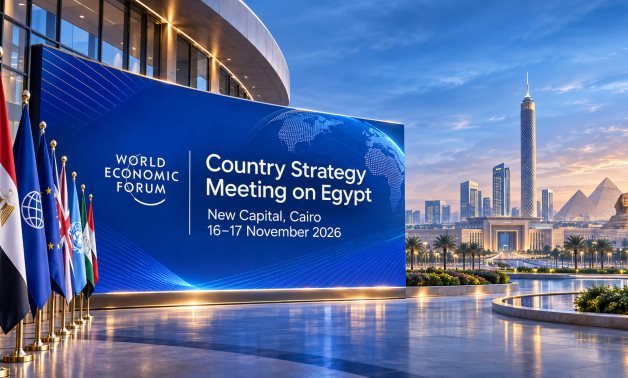
WORLD ECONOMIC FORUM / INVESTMENT DIALOGUE
From infrastructure and logistics to renewable energy and artificial intelligence, Egypt highlights its economic potential at a World Economic Forum business meeting

THREE FIGURES FROM THE DISCUSSION
$600bn+
Infrastructure investment cited by Abdelatty
€17bn
EBRD investment in Egypt since 2012
~13%
Worldwide internet traffic share cited by Hidary
Egypt is seeking to strengthen its position as a regional investment and business hub, drawing on its strategic geographical location, expanding infrastructure, growing private sector, and potential in emerging industries. The country’s economic prospects and investment opportunities took center stage during a high-level dialogue at the Grand Egyptian Museum, ahead of the World Economic Forum’s (WEF) dedicated business meeting in Cairo.
The session, moderated by Maroun Kairouz, Managing Director of the World Economic Forum, brought together Egyptian Foreign Minister, International Cooperation and Egyptians Abroad Badr Abdelatty; Investment and Foreign Trade Minister Mohamed Farid; European Bank for Reconstruction and Development (EBRD) President Odile Renaud-Basso; and Sandbox CEO Jack Hidary, alongside senior representatives of the international business community.
The meeting marked the first of its kind under the WEF’s strategy for Africa and the Middle East, and the fourth globally, bringing international business leaders together to explore investment opportunities, strengthen economic partnerships, and discuss the future of growth across the two regions.
At the heart of the discussions was Egypt’s ambition to translate its economic and geographical advantages into greater investment flows, stronger industrial capabilities, and a more prominent role in regional and global supply chains.

STRATEGIC ADVANTAGE
Infrastructure and strategic location underpin Egypt’s investment appeal
Egypt’s geographical position, connecting Africa, Asia, and Europe, emerged as one of the country’s major competitive advantages.

Foreign Minister Badr Abdelatty highlighted the extensive infrastructure development undertaken over the past decade, saying investments in the sector had exceeded $600 billion. He pointed to improvements in roads, ports, energy networks, and transportation infrastructure as foundations for strengthening the country’s economic competitiveness.
Abdelatty stressed that these investments are increasingly important amid disruptions to international shipping routes and supply chains, arguing that changing geopolitical conditions also create opportunities for countries capable of providing alternative trade and logistics corridors.
He highlighted Egypt’s efforts to develop railway connections between the Red Sea and Mediterranean, link ports, and strengthen transportation networks connecting regional markets. These projects, he said, reinforce Egypt’s potential as a major logistics center serving trade between the Middle East, Africa, Europe, and Asia.
The minister also underscored the importance of the country’s industrial and productive sectors, identifying chemicals, pharmaceuticals, agriculture, and food industries as areas offering considerable investment opportunities.
Egypt’s economic resilience, Abdelatty added, is supported by a diversified economic structure encompassing traditional industries as well as emerging sectors, including artificial intelligence, digitalization, and the green transition.
THE INTERNATIONAL INVESTOR
EBRD highlights Egypt’s market potential and investment opportunities
The international perspective on Egypt’s economic prospects was reinforced by EBRD President Odile Renaud-Basso, who described the country as having significant potential for private investment.

The bank has invested approximately €17 billion in Egypt since beginning operations in the country in 2012, reflecting its longstanding engagement across several economic sectors.
Renaud-Basso identified Egypt’s large domestic market, growing population, and substantial human capital as important advantages for international investors. She also highlighted its geographical position between Europe, Africa, and the Middle East, alongside its relative stability and capacity to withstand external economic shocks.
Drawing on the bank’s experience in emerging markets, she emphasized the importance of macroeconomic stability and consistent economic policies in sustaining investment and supporting long-term growth.
The EBRD president also pointed to the diversity of investment opportunities in Egypt, particularly in agriculture, logistics, financial services, manufacturing, and energy.
More than four-fifths of the bank’s investments in Egypt are directed toward the private sector, according to Renaud-Basso, highlighting the importance of private businesses in driving economic activity and development.
However, she stressed that unlocking the sector’s full potential requires a supportive business environment, including a stable legal framework, fair competition, and greater opportunities for private companies to operate alongside state-owned enterprises.
Her remarks underscored the importance of continued structural reforms in strengthening investor confidence and expanding the private sector’s contribution to economic growth.
Private sector expansion and reforms at the heart of Egypt’s strategy
Investment and Foreign Trade Minister Mohamed Farid highlighted policy consistency, regulatory clarity, and administrative reform as essential factors in attracting long-term investment.

He stressed that investors need predictable economic policies and a clear understanding of the direction of government decisions, particularly in monetary and fiscal matters.
Farid also emphasized the importance of reducing bureaucratic obstacles through digitalization and standardizing government procedures, enabling businesses to complete transactions more efficiently and operate within a clearer regulatory framework.
He outlined upcoming amendments to the executive regulations of Egypt’s Companies Law, aimed at facilitating mergers and acquisitions, preferred shares, golden shares, and convertible financing arrangements.
The minister also highlighted Egypt’s network of trade agreements with regional and international markets, describing it as an important advantage for companies seeking to use the country as a production and export base.
He pointed to the expansion of non-oil exports and the government’s efforts to integrate technology and artificial intelligence into export procedures, including helping businesses navigate rules of origin and market-access requirements.
These measures form part of a broader strategy to improve the business environment, expand productive capacity, and strengthen the competitiveness of Egyptian exports.
Renewable energy and digital sovereignty offer new growth frontiers
Beyond traditional infrastructure and manufacturing, the discussions highlighted Egypt’s potential in renewable energy, digital connectivity, and artificial intelligence.

Sandbox CEO Jack Hidary identified four interconnected areas shaping the country’s economic transformation: energy, connectivity, investment and finance, and artificial intelligence.
He praised Egypt’s investments in energy infrastructure, citing the Benban Solar Park as an example of the country’s expanding renewable energy capabilities.
Hidary also highlighted the importance of battery storage in making solar power more reliable, pointing to a $127 million financing commitment by the EBRD and Germany’s DEG for battery storage at Benban as an important contribution to Egypt’s energy resilience.
On digital connectivity, Hidary highlighted Egypt’s strategic position in global telecommunications infrastructure, saying approximately 13% of worldwide internet traffic passes through cables located in the country.
He argued that Egypt’s geographical position makes it a vital connection between Europe, Asia, and Africa, while investments in fiber-optic and undersea cables could further strengthen its role in global digital networks.
Artificial intelligence, however, represents an opportunity extending beyond technological development itself.
Hidary emphasized the importance of developing domestic AI capabilities and applications, describing digital sovereignty as an increasingly important component of economic independence and national development.
He pointed to opportunities for applying AI across energy, biomedicine, and materials science, stressing that its economic value lies not only in improving administrative efficiency but also in transforming core productive sectors.
His remarks complemented Abdelatty’s emphasis on AI governance and the need to place people at the center of technological development, while identifying practical applications in agriculture, water management, and other civilian sectors.
Turning economic potential into sustainable investment
Taken together, the discussions presented Egypt’s investment appeal as the product of several interconnected advantages: its strategic location, large domestic market, expanding infrastructure, diversified production base, and emerging capabilities in renewable energy and digital technology.
The perspectives of the EBRD and Sandbox executives also added an international business dimension to the Egyptian government’s investment priorities, highlighting the country’s potential across traditional and emerging sectors.
For Egypt, the challenge is to turn these advantages into sustainable investment, stronger private-sector participation, greater export capacity, and employment opportunities.
The dialogue at the Grand Egyptian Museum therefore went beyond promoting individual projects or investment incentives. It highlighted a broader economic proposition: positioning Egypt as a regional platform for production, logistics, energy, and technology, with stronger links to international markets and global business networks.
The country’s ability to advance this ambition will depend on maintaining a predictable investment environment, supporting private enterprise, and converting its infrastructure and geographical advantages into long-term economic value.