









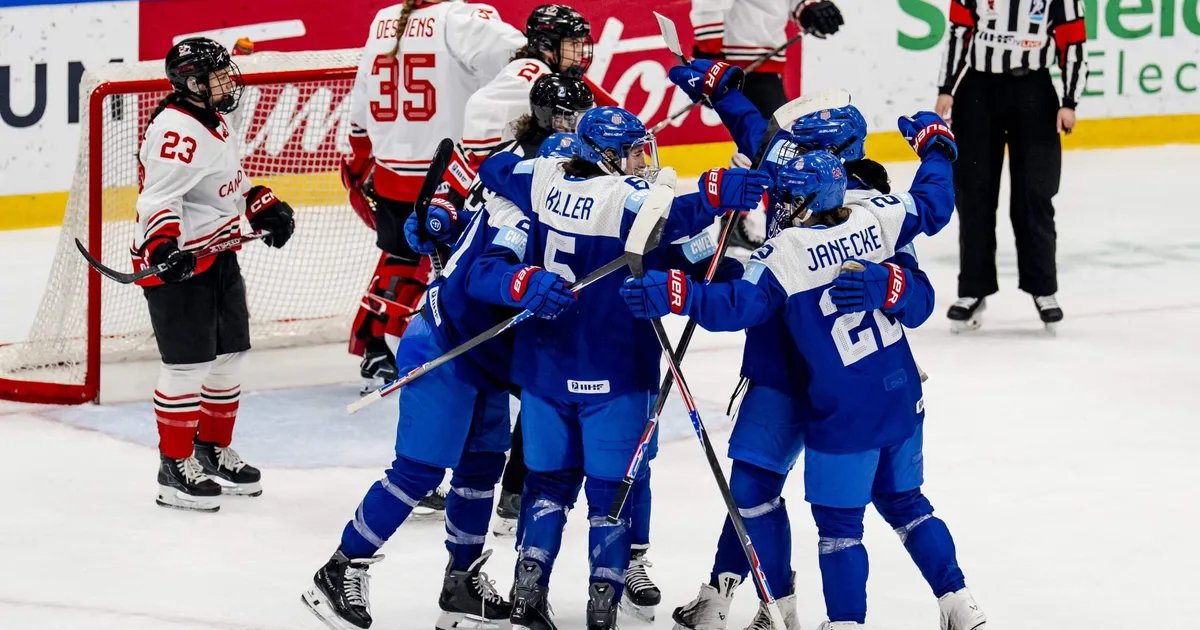
HERNING, Denmark – The United States women’s hockey team continued its unprecedented run of dominance with a 6-2 win against Canada in the IIHF Women’s World Championship gold medal game.
Heading into Monday’s tournament finale, the Americans had won 20 consecutive games at major international tournaments and looked like the powerhouse of the two programs. Still, in the opening frame, it seemed like the gold medal game might be yet another tight contest between the top two teams in the world.
The underdog Canadians came out with some of their best hockey of the tournament, playing tight defensively and holding the dangerous American offense — which averaged 8.3 goals per game through its first six games — to just two shots on Ann-Renée Desbiens midway through the first period.
Canadian star winger Sarah Fillier opened the scoring, with a diving backhand to beat American goalie and PWHL MVP Aerin Frankel. It was the first time the U.S. trailed all tournament, but it wasn’t for long. Five minutes later, American captain Hilary Knight, playing in her 16th Women’s World Championship, buried a rebound on the doorstep to tie the game 1-1.
The second period became a special teams battle with six minor penalties called, including one against U.S. coach John Wroblewski for “abuse of officials.” The Canadians squandered an early power play chance — their fourth consecutive of the game — to pull ahead after Keller was called for high-sticking.
Not long after, Kelly Pannek finished off a stunning Hayley Scamurra saucer pass over Canadian defender Sophie Jaques to make it 2-1.
Before the end of the period, Knight made sure to capitalize on an American power-play chance, scoring her second of the game to pull ahead 3-1. With the primary set-up, Taylor Fox (née Heise) broke Hockey Hall of Fame forward Cindy Curley’s longstanding record for assists at a single tournament.
Both Pannek and Lacey Eden scored less than three minutes into the third period to push the American lead up to 5-1. Fillier stopped the bleeding with her second goal of the game – and sixth of the tournament – but the game was already out of reach.
By the final buzzer, after a Scamurra empty-netter, it was 6-2 Team USA.
The victory caps a banner year for the U.S. program — pairing the world championship gold with the Olympic title the Americans won in Milan in February — and continues a run unlike any we’ve seen in women’s hockey. The Americans haven’t lost a game in international competition since the 2024 women’s worlds gold medal game, more than two years ago.
They went undefeated at the 2025 worlds in Czechia, the Milan Winter Olympics and at this year’s world championship, giving Team USA three consecutive major international gold medals and 21 straight tournament wins. Over the last 19 months, the Americans have dismantled opponents 140-19, including 56-4 in Denmark.
“This is the best team I’ve ever been on,” said Fox after Sunday’s semifinal. “This whole year has been amazing.”
The U.S. team brought back 20 of the 23 players who beat Canada in overtime for Olympic gold nine months ago — led by tournament MVP Caroline Harvey, overtime hero Megan Keller and captain Hilary Knight. The team picked up where it left off in Milan.
No team scored more goals than Team USA or allowed fewer against. Their penalty kill was perfect, and came up huge on Monday, stopping each one of Canada’s power-play opportunities. Fox broke a nearly 40-year-old tournament record. Harvey broke her own record for points by a defender at a single world championship, with 15 in seven games.
On the other hand, after losing in the Olympic gold medal game — and the 2025 world championship — Team Canada got noticeably younger and assembled a new-look roster.
“I do believe there is a new era of women’s hockey in Canada,” coach Kori Cheverie told The Athletic last month. “We’re doing our best to keep trying to win gold medals now and to keep pushing the needle forward.”
Canada’s new-look roster was perfect through the preliminary round, with every skater recording at least one point for the first time since 2011. Still, a gold medal game against the powerhouse Americans was the team’s first true test — and outside the first period, it didn’t go particularly well. If nothing else, Monday night was a critical learning experience for a team aimed at building for 2030.
This story will be updated.