








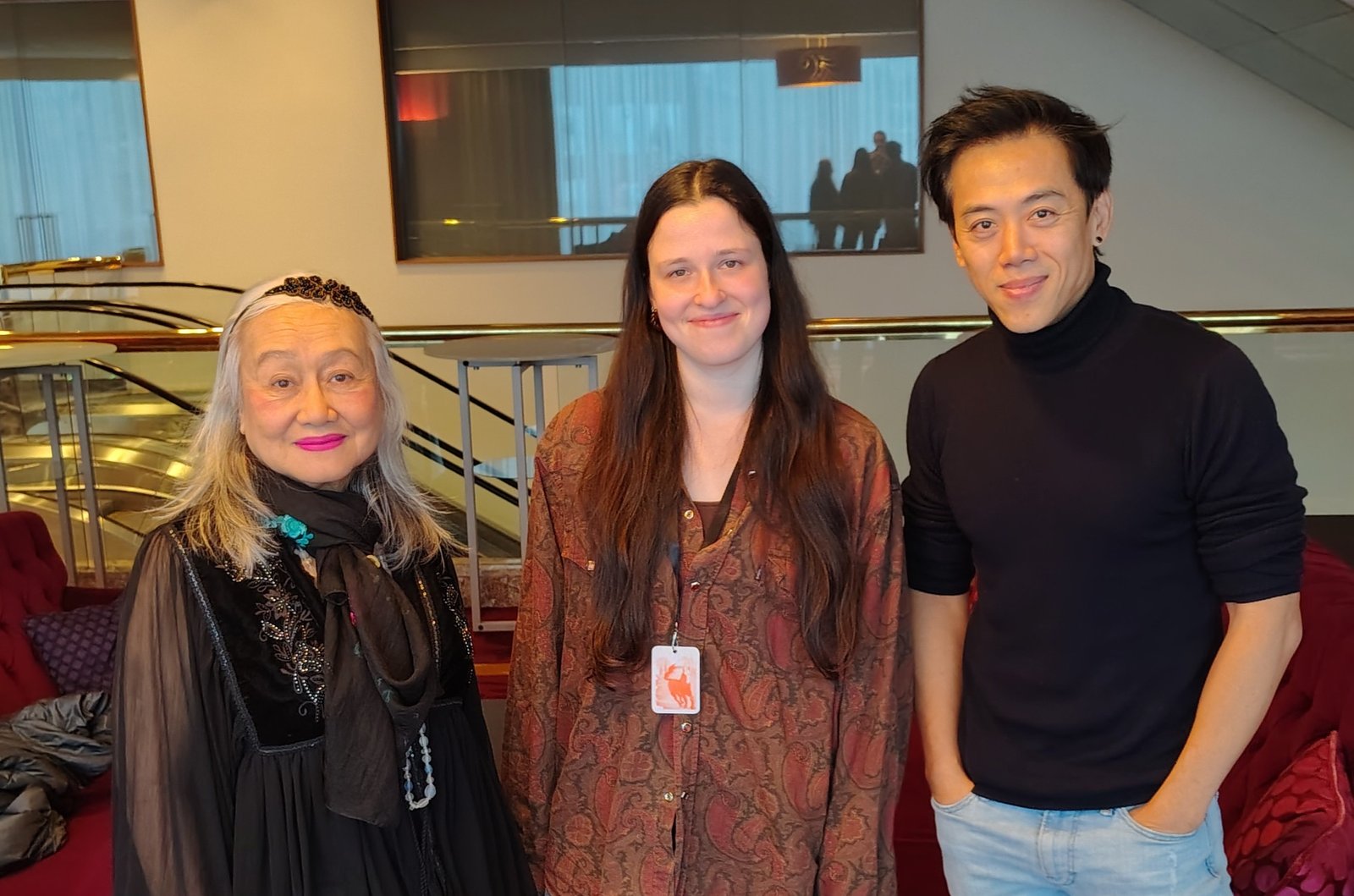
Leon Le’s second feature, “Ky Nam Inn”, had its world premiere at the 20th Toronto International Film Festival. Since then, it has been released theatrically in Vietnam and screened at numerous film festivals around the world. The story follows Khang (Lien Binh Phat), a translator from northern Vietnam who moves to Saigon to work on the new version of “The Little Prince”, and Ky Nam (Do Thi Hai Yen), a widowed cook from the South. Now, the film has arrived in Poland, where it is screened for Polish audiences as part of the Focus: Vietnam section at 20th Five Flavours Asian Film Festival in Warsaw.
We spoke with director Leon Le and co-screenwriter Nguyen Thi Minh Ngoc about the film, how they came to work together in the first place, and the difference in how it has been received by Vietnamese and international audiences.
You set both of your films in 1980s Saigon. What attracts you so much to this particular period?
Leon Le: First of all, it is connected to my childhood. I grew up in Vietnam in the 1980s, and when I left the country at the age of thirteen, my image and experience of Saigon froze in time.
When I first returned to Vietnam in 2007, I found myself just wandering around, searching for all of those places and people I remembered. Naively I thought everything would still be there. But to my surprise, to my shock, the city has changed so much. Buildings, streets, and places that had been an important part of my childhood started to disappear.
All my friends had all grown up, too, even though in my mind I still expected them to look the way they had when we were thirteen. I think that’s when I realised that, whenever I thought about Vietnam, I was drawn almost exclusively to the period of 1980s. There are also many reasons why I don’t feel particularly attracted to Vietnam as it is today.
Therefore, when it comes to making films, I find myself wanting to recreate that period, racing against time to capture as much as possible of what remains before it disappears completely.
This is your second collaboration on a screenplay. Could you tell me a little more about how your collaboration works? How did you first come to work together?
Leon Le: We met at Viet Film Fest in California in 2007. Ngoc had written a film that was featured at the festival, and I approached her because I knew she had once taught acting at the Vietnamese Traditional Opera School, which I was fascinated by.
I told her I loved Vietnamese opera and wanted to make a film about it. I asked whether we could talk. That’s how our conversation began, and eventually we became friends.
Ngyuen Thi Minh Ngoc: I studied cinema shortly before the events of 1975. When I lost a teacher whom I regarded as a symbol of the lost South, I made it my mission to work hard and create films that would take me to international film festivals. I hoped that one day I might find him there. And twenty-seven years later, in 2007, I finally found him at a film festival. I was able to stand next to him again. He has since passed away.
But in return, I met a younger filmmaker who helped make another of my dreams come true: creating works that would take me to international film festivals. Before collaborating on films, we already worked together in theatre as actors, and there were even times that we played husband and wife in an off-Broadway show in New York. It was a cultural collaboration between Vietnam and the United States, performed bilingually in Vietnamese and English so that both Western and Vietnamese audiences could enjoy it.
There is one thing I would particularly like to thank Leon for. After graduating from film school, I received a scholarship to study in Poland. However, the school was afraid that I might not return to Vietnam, so they replaced me with another person from my class who was a member of the Communist Party. Ironically, he was the one who eventually left Vietnam and stayed in Poland.
I had always dreamed of visiting this coutry. I often wondered how my life might have turned out if I had been able to come here back then. Would I have stayed? Would I have returned to my country? Would I have been able to make films? It was one of those sliding-door moments: if I had come to Poland at that time, the entire course of my life might have been different.
I am very grateful to Leon for eventually helping me realise my dream of being able to live in the capital of Poland. The second time I came to Poland, he made it possible for me to fulfil something I had wanted for so many years. I would like to thank this young man for that opportunity.
Where did you draw your inspiration for creating this “Ky Nam Inn”?
Leon Le: The inspiration actually came from my living situation when I was in Vietnam in 2017, making my first film. I rented a unit in an old apartment building, very similar to the one in the film.
The woman living downstairs ran a catering business. She had even written a sign on the wall with her name and the services she offered. And the only difference between her and Ky Nam was that she was always angry. She was always fighting with the neighbours practically every single day. I found that contradiction very interesting, because to me, cooking is an act that requires a great deal of care. You have to put a lot of love into what you do, especially when you’re cooking for other people, right? And yet here was this woman who seemed constantly angry at the world.
Check the review of the film
That was the initial inspiration – an artist living above and below is a lady who I thought must be very unhappy to always feel so frustrated and angry at the world surrounding her. I started wondering what could make someone so unhappy. Perhaps she had an unhappy childhood? Perhaps she had lost everything because of the change of regime. Maybe it had something to do with her children, terrible divorce, abuse, loss, or unfilled dreams.
I began imagining all these possible scenarios. It was also a way of dealing with the negative energy surrounding me in my everyday life. Instead of simply being annoyed by the situation, I started imagining what might lie behind this woman’s behaviour. That’s how the whole idea began.
And where did the idea for using “The Little Prince” come from? Is there any deeper meaning to that?
Leon Le: “The Little Prince” came into the picture later, after we decided that Khang would be a writer. We knew that he had to be a French translator, given the time and place in which we wanted to set the story.
It was Ngoc who suggested “The Little Prince”. Initially, we had considered “Les Miserables” or another novel called “Nobody’s Boy”, which I also mention in the film. The latter was actually the first French novel my mother introduced me to.
But both of those books tell such enormous stories that it would have been difficult to fit them into Khang’s narrative and this whole arc of his time he’s spending in the apartment building. That’s when Ngoc suggested “The Little Prince”.
Once we had made that decision, we realised how many parallels there were between the book and our film. Khang is, in a way, the Little Prince, and the people he encounters along the way resemble the characters the Little Prince meets on his journey. Khang and the other characters have to learn to understand and accept one another in order to survive in post-war Vietnam.
There are also some fascinating coincidences connecting the book to Vietnamese history. Saint-Exupery was inspired to write “The Little Prince” after his plane crashed in the Sahara Desert. At the time, he was travelling from Paris to Vietnam. Had his plane not crashed on that journey, we might never have had “The Little Prince”. And there are also many little connections to Vietnamese culture. The book was very familiar to my parents’ generation, particularly those who attended French schools in Vietnam during the 1950s and 1960s. It was part of their education.
Since the film touches on a number of political and social issues in post-war Vietnam, did you have to compromise your original vision in any way? Were there things you wanted to say but felt you couldn’t?
Leon Le: Looking back, I don’t think of it as a compromise. Of course, censorship forces us to find different ways of telling the story we want to tell while hopefully still getting the film approved. But that challenge also pushes us to be more creative.
Without those limitations, we might end up with a rather clumsy execution, simply explaining everything too explicitly and spelling out all our ideas. The restrictions force us to find more nuanced ways of communicating with the audience. I don’t mind that at all.
Of course, the film requires viewers to have some background knowledge of Vietnamese history, particularly the period in which the story takes place, in order to understand it fully. But that was a decision we had to make from the beginning: did we want to create the most authentic film possible for Vietnamese audiences, or did we want to cater to international audiences by explaining everything?
I’ve seen many films, not just Vietnamese but also Chinese and other Asian films, that clearly try to appeal to Western audiences by overexplaining their cultural and historical context. I find that uncomfortable. When those films return to their own countries, the result can feel rather awkward to local audiences.
For me, it was impossible to do both. So I had to make a choice. I wanted the film to feel as authentic as possible, so that Vietnamese viewers wouldn’t feel alienated or annoyed by the way their culture and history were being explained to them. And if international audiences miss some of the reference or don’t understand certain aspects of the film, that’s a compromise I’m willing to accept. If they are interested, they can always do more research.
So have you noticed any differences in how Vietnamese and international audiences respond to your films? How do you feel about that?
Leon Le: Yes, absolutely. I think that’s one of the reasons why international audiences, most of them, tend to see the film primarily as a love story. That’s also why so many people describe it as a Vietnamese version of “In the Mood for Love”. They pick out the romantic storyline, but that’s only one part of a much bigger picture.
If you understand all of the nuances, particularly all the political ones, I don’t think you can see it simply as a love story anymore. Of course, the romance is there, but the film is not fundamentally about the love between Khang and Ky Nam.
To me, the real subject is the private lives of Vietnamese people and their struggle to reconnect with themselves and with one another, and to find a way to move forward together in the aftermath of war. After the French had left, and then the Americans, Vietnamese people from all over the country – from the North, the South and the Centre, from both the winning and the losing side – had to figure out how to live together again. They had to find a way to move beyond pain, loss, hatred and disappointment. That’s the story of the film, and that could not be more different than “In the Mood for Love”.
Nguyen Thi Minh Ngoc: I felt that the Polish audience’s response was very different from the reactions we had encountered elsewhere, including among the Vietnamese community in the United States. And I particularly enjoyed the silence in the cinema while people were watching the film. Because I felt there was a similarity between the Polish audience’s experience and the story of Vietnam, especially in terms of the political experiences shared by Polish and Vietnamese people.
I can only describe the audience’s attention and concentration as the quietness of the ocean. The sea has waves and a roar, yet at the same time it can be calming and frightening. It is the silence of the ocean.
Leon has often mentioned that, based on his experience at various festivals, most audiences cannot understand or fully comprehend what it means for a country to be divided in two. That’s one of the reasons why international viewers tend to see only the love story and compare the film to “In the Mood for Love”.
Perhaps the only similarity between the two films is Wong Kar-wai’s love for Hong Kong, which was about to be returned to China. And that’s probably why audiences in Poland, in particular, can understand the feeling of having lived through a similar historical experience under communism. I was very pleased and touched by that. It also made me wonder: how were we able to create such a film while still living under the communist regime?
One visual device that seems to be becoming increasingly popular in contemporary cinema is portraying the present in black and white while showing the past in colour. Was there a particular reason behind your decision to use this approach?
Leon Le: Actually, those sequences were shot a year and a half apart. We returned to film them because I wasn’t happy with the original opening and ending of the film.
So the new ending takes place in Hanoi, a year after the main events, when Khang has already left. I wasn’t happy with the colours of the set we had built for him, so my cinematographer and I started discussing what we could do. We eventually decided to shoot those scenes in black and white to solve the problem with the set.
Then I realised that it was actually an interesting way to frame the film, giving it a visual bookend and allowing the audience to understand more clearly that time had passed.
You shot the film on 35mm. I’ve read that it is the first Vietnamese feature film in two decades to have been shot entirely in this format. Was working with 35mm challenging in any particular way?
Leon Le: Absolutely. For one thing, none of the film laboratories in Southeast Asia were still operating. They had closed because hardly any projects had been shot on film for years.
We therefore had to learn how to develop the film ourselves. Sending it back to Los Angeles would have been too risky. We would have had to wait weeks for the footage to be shipped, developed, scanned and sent back to Vietnam. That means we wouldn’t know whether everything had worked, or whether anything had been damaged, until a week or two later.
We also couldn’t rent equipment from Panavision and have it shopped to Vietnam because nobody was willing to insure the equipment there. So we had to purchase the cameras ourselves and arrange for them to be shipped to Vietnam. We also had to purchase the film stock in the United States and send it over. Customs procedures and all the associated paperwork in Vietnam made the whole process extremely difficult and challenging.
Was there a specific reason you decided to shoot it this way then?
Leon Le: I’ve always wanted to shoot on film, even with my first film. I used to work in fashion photography, so I’ve always loved the look of film.
I think we all have certain apps on our phones that make digital photographs look more photogenic or more like film. Even people who don’t know much about the medium seem to understand that film has a certain soul and depth to it.
But it’s not just about the image. The process of shooting on film is also incredibly exciting for me. There’s the anxiety and stress of not knowing exactly what you’ve captured until days later, and the fact that it’s so expensive. It makes you treat every scene, every moment on set with a different kind of respect, and it makes everyone a little bit on edge in a good way.
When you’re shooting digitally, you can simply press record and keep filming until you get it right. There’s a mentality you can always do another take, and somehow that can make you take things for granted. With film, everyone knows exactly how much stock we have left and that changes the atmosphere on set. The process itself is a big part of what I find so exciting about shooting on film.
Both “Song Lang” and “Ky Nam Inn”, you seem to treat elements of Vietnamese culture almost as characters in their own right. In “Song Lang”, it was Vietnamese opera (cai luong), while in “Ky Nam Inn”, it was Vietnamese cuisine. Are there any other aspects of Vietnamese culture that you would like to explore in your future films?
Leon Le: You know, it was never my intention to showcase Vietnamese culture. With my first film, I simply loved cai luong. That’s what got me into filmmaking in the first place. It wasn’t that I wanted to make a film about Vietnamese opera because I thought it was something interesting or exotic to show. The same applies to the cuisine in “Ky Nam Inn”. The real-life woman who inspired Ky Nam was a cook. The fact that she cooked for a living while being constantly angry at the world was the contradiction that interested me and made me want to create the film.
I actually get very frustrated with Vietnamese films that use Vietnamese culture as a bait or exoticize it for a Western gaze. That drives me crazy. I find it very distasteful, because to me culture shouldn’t be something you put on display for other people’s pleasure.
I can see a lot of filmmakers falling into that trap, because they want to please festivals. And it becomes a cycle, a loop: festivals keep rewarding those films, and international audiences start believing that what they see on screen represents Vietnamese culture.
I would say that 80 percent of what you can see in some of those films is not really Vietnamese culture. It’s an exaggerated version created for a Western gaze. I don’t like the way Vietnamese culture is presented in that way. I feel that it’s often viewed from above, as though someone were looking down and saying, “Look at this strange, fascinating Asian culture.”
And yet filmmakers keep feeding that perception, while festivals continue rewarding it. That’s why making films that feel authentic to Vietnamese audiences is so important to me. I don’t care if the rest of the world doesn’t understand everything. I need to earn the approval of my own people first.
There’s nothing more disappointing than having a film recognised internationally, only to bring it back to Vietnam and discover that local audiences don’t recognise themselves in it. They might say: “This is not Vietnamese culture. Vietnamese women don’t behave like that. That’s not our history. We don’t eat like that. We don’t express our feelings that way.”
I’m very conscious of this whenever I present Vietnamese culture on screen. For me, the most important thing is that audiences recognise themselves in the film. That was always my intention with “Song Lang” and “Ky Nam Inn”. Both films contain a great deal of Vietnamese culture, but I never wanted it to become something displayed for the audience to admire. I didn’t want it to be the reason people came to watch the film.
These are simply Vietnamese people living their lives. Their culture is part of their everyday existence; it’s not something being put on display. If there’s one thing I feel I got right, it’s that. I’m very proud of the way the films have been received in that respect.
Nguyen Thi Minh Ngoc: I’d just like to add that I think this is where Poland and Vietnam have something in common. Both Polish and Vietnamese filmmakers have found a way to develop a distinctive voice and remain true to themselves.
I have read a lot of Polish literature, including “The Elephant” by Sławomir Mrożek, one of my favourite books, as well as works by other Polish writers, including the latest female Nobel Prize winner, Olga Tokarczuk.
I’ve noticed that in Vietnam, from early on, people tend to look at the judges’ reactions whenever there is a competition. They try to figure out what the judges want and then do whatever they can to please them. So there’s a tendency to follow the jury and adapt to its expectations. We are among the few who are going against that.