





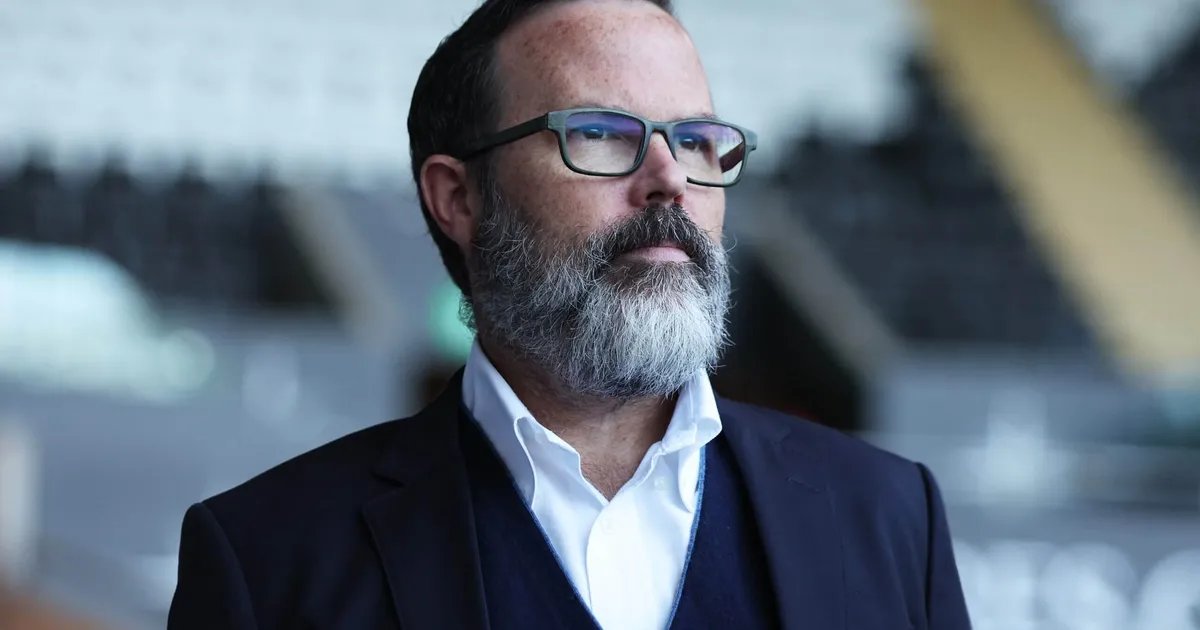
Michael Williamson, Wrexham’s chief executive officer, is a busy man.
On Tuesday, he was a guest on a panel at the European Football Clubs’ 33rd General Assembly in Copenhagen, Denmark, the annual gathering of a body that represents 850 teams across 55 countries and territories.
An insight into life at Wrexham under celebrity owners Rob Mac and Ryan Reynolds was his contribution, just as it had been a week earlier when addressing around 60 business leaders at a breakfast networking event at the famed Savoy hotel in central London.
In between these two prestigious speaking engagements, there was all manner of business to stay across at the Racecourse Ground, including the ongoing development of the Kop Stand, which should be a game-changer for the Welsh club once opened, which is expected to happen next year.
Family time, as a result, has been limited, even though, to the outside world, the Championship is effectively midway through a three-week shutdown due to this extended international break.
There will, though, be a chance to make up for that come Saturday, when Williamson celebrates his 50th birthday before returning to a role he admits is like no other.
“There is no road map for this,” the American tells The Athletic. “No playbook that says, ‘Do this next’. It’s never been done before. Not like this, with the rapid rise through the pyramid, plus having the opportunity to invest in so many areas, so quickly.”
Williamson’s arrival in north Wales followed the second of the three consecutive promotions under manager Phil Parkinson that hurtled Wrexham from non-League to the Championship, one rung short of the Premier League.
Having previously worked at D.C. United in MLS, Italian giants Inter and Miami FC in America’s second-tier United Soccer League, his task on that first day, in July 2024, was to ensure off-field operations started to catch up with the team’s rapid success.
The new Kop is the most tangible proof of the progress made since then, with the £69.1million structure already dominating the local skyline. But there are plenty of other important infrastructure projects already completed, including the new first-team training pavilion erected at Colliers Park over the summer and the purchase of The Rock stadium as a base for the club’s women’s side.
Then there’s the academy, now based at Darland High School in nearby Rossett following a multi-million-pound refit and home to five pitches, including one that is a state-of-the-art combination of natural grass and artificial fibres.
Plans are also in the pipeline for an under-21s team to be reintroduced as a bridge from the youth set-up to the first team, while the appointment of Steve Nickson earlier this month as sporting director, after many years as chief scout for Newcastle United of the Premier League, is designed to upgrade Wrexham’s recruitment and scouting operations.
Full-time staff numbers across the club have also gone from 40 to around 150 on Williamson’s watch, while total revenue in the 2025-26 season is expected to be in the £46million to £50m bracket ($60.8m-$66m) when the next set of accounts are published in the spring.
“I’m proud of what we have done,” says the former accountant. “And that’s just the tip of the iceberg, when you start to look from a commercial standpoint and the evolution of our sponsors to Firefox, Nex Playground, Royal Bank of Canada — which was a funny one in that I got a message from Ryan (one day) to say, ‘I’ve got us a back-of-shirt sponsor’. We’d been out in the market, working for a few months, and he does it literally over a week!”

The new Kop Stand is taking shape at Wrexham’s Racecourse Ground (Jan Kruger/Getty Images)
There’s no doubt what the low point of Wrexham’s early season has been, with the 6-0 drubbing at newly-relegated West Ham United a couple of weeks ago shocking everyone.
“I was numb,” Williamson says of that Friday night in east London. “Just like everyone else, right? There were no words that could be said after. I think everyone realised what it was, and understood it. And then I think everyone understood that, while it was painful and really hurt, what was more important was how we responded.
“West Ham was not going to define us.”
As we all now know, Parkinson did, indeed, inspire a response, via a 2-1 home defeat of Southampton eight days on from that London Stadium debacle. He did so by falling back on tried and trusted methods honed over more than two decades as a manager, while also knowing he retained the backing of the club’s key figures.
“I have a great relationship with Phil,” adds the club’s CEO. “I was at the training facility on the Tuesday (after West Ham), just to have a chat and show presence and support.
“There’s also the advantage of having Steve Nickson around. Him and Phil went out for a pint together on the Sunday. Just to get it all out — two football people having that camaraderie. Having a moment to put that 6-0 defeat in the past and transition into a week leading up to the next match.
“Parky is always able to get the right response out of the squad. And I expected that. We saw it on the pitch, which was fantastic. If we’d drawn 1-1 (against Southampton), I was still proud of how we played and how we performed.
“But, obviously, getting the winner (in the 89th minute) was brilliant. That’s when you feel the magic is still there. Such a Wrexham ending.”

Wrexham’s win against Southampton was the perfect response to the 6-0 defeat at West Ham a week earlier (Charlotte Tattersall/Getty Images)
Nickson’s appointment to the newly-created role of sporting director is seen as a key building block towards realising the Hollywood-star owners’ long-stated ambition of reaching the Premier League with Wrexham.
After 15 years at Newcastle — and a decade before that in charge of youth recruitment at Blackburn Rovers at a time when they were a Premier League club — he arrived on September 2 with a wealth of experience and knowledge.
“Bringing in a sporting director and building out a scouting department is the right thing for the football club,” says Williamson. “Not just for now, but the next 10, 15, 20 years. Again, building something better.
“The challenge was to make sure we found the right person. You can bring in a lot of modern-day sporting directors who base everything on analytics and then create conflict. That would not be good for us. It’s not who we are. I worked really hard, and met a lot of people during the process, to find someone who I felt understood Wrexham values — who would work well alongside Parky, to support him.
“Steve, with 15 years of experience at Newcastle, is someone who balances data with actually making sure we have eyes on the players and (that) we have watched them. As well as character references to understand their mentality and who they are.
“He has access to people around the world. He has a rolodex of all the people and names we need to get access to players that are Premier League-ready and better players. We are talking about eastern and northern Europe, South America, Central America. He gives us that little bit more credibility when we are having that conversation with some of those players.”
Nickson’s arrival also allowed Williamson to focus on the primary task of driving the club’s off-field operations after a summer in which he also led all transfer negotiations as the incoming sporting director served his notice period at St James’ Park.
Seven new faces arrived during a window that also saw talks held over multiple other targets. These included Lyon playmaker Pavel Sulc, who recently suggested he’d been the subject of a £35million bid by Wrexham, though they say it got no further than registering interest in the 25-year-old Czech Republic international.
“I’m not a sporting director,” adds Williamson. “I don’t pretend to be one. That’s why we brought one in. What I did was bridge the need for negotiations with the agents and the clubs. It’s exhausting and very time-consuming. Everyone is trying to play a little game: we value the player at this, they value the player at that, and you have to go back and forth.
“Listen, I was just there to deliver the final commercial terms and then turn it over to the administrative side to process and be papered. That was something I was very happy to turn over to Steve once he’d come in.”

The roof of the new £69.1million Kop is now in place (Richard Sutcliffe/The Athletic)
“The Kop is on time, it’s on budget. Now, we have to transition to the next stage. We’ve had a sprint to get it built; the next sprint, once the Kop is built, is the need to operate it. We’re talking about almost doubling the size of the stadium. And the amenities serving that.”
If further proof were needed that the grass is rarely allowed to grow under the feet of those running Wrexham, then Williamson’s comment concerning the new Kop is surely it.
The 7,750-capacity structure is a long way from being completed, with the start of next season being its scheduled opening date. There’s also an important planning hurdle still to negotiate, with Wrexham Borough Council needing to approve the increase in seats from the 5,500 stipulated in the original 2022 application.
Yet for Williamson and the rest of the senior management team, attention has already turned to how things will run inside The Racecourse’s first permanent addition since the turn of the century.
“First impressions matter,” he adds. “Even if you’ve been to every game at The Racecourse for the past 10 years, this will still be a first impression. We need to make sure we put our best foot forward. That means building out staffing, as we can’t do it with the same matchday staff we have. And we can’t look for that staff in July for an August opening! Everything from the bars to the restaurants, the hospitality, the GA (general admission) services, we very quickly need to know how to double our operations on matchday.
“Yes, we will have test runs. But it’s going to be a significant thing to make sure everything works. That’s the next stress everyone will have.”
Those extensive preparations include piecing together what happens in the areas of the ground where more space will be created, such as how the dressing rooms and medical facilities will move into the new Kop from their current location in the main stand, along with the club shop.
Then there’s the current unknown as to how many existing season-ticket holders will want to move to what has traditionally been known as the ‘Town End’, in the process freeing up seats in the other three stands.
The thorny topic of where to house away fans also has to be tackled, with the increase in capacity meaning visiting clubs will see their allocation rise from the 1,293 tickets today to around 1,800 if Wrexham are still in the EFL then.
All the while, due attention must be paid to how any decisions taken don’t hamper the long-term masterplan drawn up by Populous, the architects behind the new Kop, to turn the Racecourse into a venue befitting the Premier League ambitions of Mac and Reynolds.
Williamson says: “Whatever we do, there cannot be something so permanent that it becomes prohibitive to do a next stage. You have to future-proof a little bit of everything.”
As for those wider plans for Wrexham’s historic home since 1864, the CEO adds: “Once we get to 18,000, we will take a breath in the sense of, ‘Let’s see what we need to do around the other stands to improve them in the short term?’, then start developing plans for the long-term.
“Anything we want to do for the next stage of the Racecourse development is going to take years of planning, design, approvals, and it will go through a lot of different renditions before you are able to put a spade in the ground.
“That pause of breath doesn’t mean we stop working. It just means we pause on the expansion so we can then start to look at, ‘What is it we do next?’ and start to develop the framework and the designs for that.”
Those long-term plans include The Turf, the pub recently bought by the club’s parent company that has become a beacon for overseas fans wanting to see where Welcome To Wrexham is often filmed and meet its popular landlord Wayne Jones.
“Long-term, it allows us to ask, ‘How can we incorporate the uniqueness of The Turf into the future planning of the Racecourse experience on a matchday?’” says Williamson about a deal struck between Wrexham Holdings and Admiral Taverns, the pub’s previous owner.

The club’s parent company have purchased The Turf pub so it can be incorporated into future developments (Jess Hornby/Getty Images)
“And non-matchdays as well. The best example of this is at Fulham. They have the Cottage in the corner (of their Craven Cottage home ground in west London). It’s a lovely throwback that feels part of the stadium but also makes sure that history is not lost, while the rest is developed.
“You have this beautiful (new) Riverside Stand (at Fulham) that, honestly, probably has to be lined with gold in certain places! But you still have this traditional, true-to-your-values part of the stadium as well.
“I look at this as an example where you can build in something similar to Craven Cottage here with The Turf. Where we don’t change what it is but you embrace it into the experience.”
Striking a balance between progress and tradition isn’t always easy, and there have been missteps along the way.
Earlier this month, the chair of the local council’s planning committee, Mike Morris, criticised the club for submitting plans for their new training ground’s pavilion only after the building was almost complete, prompting an apology from chief strategy officer Aidan Miller.
Charging an admission fee to the fanzone that was behind the temporary Kop stand had also previously caused an outcry among supporters, as did the summer unveiling of new leisurewear featuring a white dragon crest, rather than the red traditionally associated with Wales.
“Listen, mistakes will be made along the way,” adds Williamson. “That is going to happen when you’re moving this quickly with no road map ahead of you. You’re trying to make the best decisions in the moment and rely on the people throughout the organisation to carry them forward.
“But the key is, as long as we are doing more good and moving the club forward, you can dust yourself down and get back up when you do have a stumble. Fortunately, if you look back to where we’ve come from and where we are now, we have built a lot of foundations very quickly.
“That was important and critical to do. Wherever this momentum takes us, whatever foundations we have in place at that moment, is going to be the basis for the future.”