







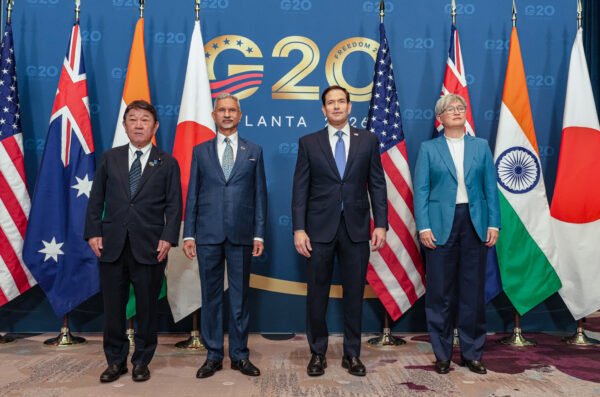
The leaders of Australia, India, Japan, and the United States didn’t hold a 2025 Quad meeting, so this week’s meeting will be the first between the group’s heads of government since 2024. Whether the summit produces a substantive new outcome is less of an issue than the political signal they send to the region and above all China by coming together.
The Quad partners share a basic unity of purpose: to support Indo-Pacific nations strengthening their sovereignty and to constrain China’s attempts to undermine it. With China seeking to take advantage of U.S. focus on Iran, this Quad summit will likely make clear that all four members treat Indo-Pacific stability as their top priority. The summit will also debunk several false claims and comparisons.
Yes, China itself has minilateral groupings such as BRICS, but those are not unified forces for regional capacity building. They center on China’s dominance and their members’ interests do not align. India, for example, sees BRICS membership as a way to keep an eye on other members, particularly China.
The reported upcoming meeting between presidents Donald Trump, Xi Jinping, and Vladimir Putin also isn’t comparable. Major power leaders have always come together in attempts to prevent the worst outcomes for global security. The Quad nations meet to ensure the best outcomes.
The location of this Quad meeting is yet another important signal. Manila was the city where the Quad made a comeback in November 2017, when senior officials from Australia, India, Japan, and the United States met on the sidelines of the Association of Southeast Asian Nations (ASEAN) and East Asia summits. For 10 years after 2007, the Quad had been inactive, partly because of China’s objections. That the Quad’s initial demise had only incentivized China to step up malicious activity was a core reason for the group’s resurrection.
Since 2017, the Quad has become a formal part of its four members’ foreign policy. The lack of leaders’ meetings since 2024 has signaled no second demise of the Quad, despite some assessments that it has. The Quad has matured enough that it continues to progress whether leaders meet or not. There is now a habit of security cooperation among these four different democracies. The Quad continued to build on its substantive agenda in 2025 even without a summit, including through regular foreign ministers’ meetings. Annual military engagements, too, continued without interruption.
But there is no doubt this leaders’ meeting is about political signaling. China’s dismissive attitude reveals the meeting’s importance. An opinion piece in the Global Times, a Chinese state-run newspaper, said that the Quad summit was “more of a photo-op diplomatic event” and that the Quad offered an “invisible crutch” to countries like the Philippines. Yet Beijing fears the Quad, because it makes China’s aggression visible and shows that the U.S. and three regional powers will consistently back the region’s smaller powers.
Beijing must have hoped that political difficulties between the U.S. and its partners, including over tariffs, would kill off the Quad again. So this year’s summit will be more than a small disappointment to China.
The practical nature of the group means that the meeting will probably produce concrete outcomes, even though doing so is actually secondary to the signaling. A Reuters report quoting officials familiar with the meeting said, “The leaders are likely to take up the issue of free and unimpeded commercial shipping lanes in order to secure energy supplies from across the world.”
In addition, the United States will want to focus on critical minerals, critical technologies, and supply chains, as Secretary of State Marco Rubio said in an interview in May this year. As part of this, the leaders should be expected to discuss how the Quad can collaborate on AI to counter China. They will likely also discuss, in private, the smuggling of advanced Nvidia chips into China.
Another misleading claim about the Quad is that it doesn’t deal with security issues. At the May 2026 foreign ministers’ meeting, the Quad launched the Indo-Pacific Maritime Surveillance Collaboration initiative to enhance maritime surveillance in the Indo-Pacific and to boost information sharing and maritime domain awareness capacity in the region. Quad members’ armed forces will exercise together for the first time next year in Sea Dragon 2027, a U.S.-led anti-submarine warfare drill in Guam that is expected to take place around March.
Yet another false claim is that the Quad is incompatible with ASEAN. Meeting in the Philippines on the sidelines of an ASEAN summit highlights the complementarities between the Quad and ASEAN. In the absence of an overarching security architecture for the region, a thicket of overlapping minilateral groupings is the best that can be achieved. As U.N. disarmament chief Izumi Nakamitsu said in Delhi in 2023, networked minilateralism is a practical, feasible way forward at a time when developing consensus via multilateral institutions has proven to be challenging.
Debunking all of these Quad criticisms through a leaders’ summit is all the more important because Trump will meet with Xi, and potentially Putin, just a few days later in Shenzhen.
Of course, should Trump make any compromises with either Xi or Putin, particularly on Taiwan and Ukraine, it would be alarming to all democracies. But meeting Trump beforehand allows the other Quad leaders an opportunity to coordinate a consistent message and signal unity of purpose. Japanese Prime Minister Takaichi Sanae reportedly used discussions with Trump just before and after Trump’s meeting with Xi in Washington in September to great effect. It will be even more powerful when Trump hears a collective message on priorities for Indo-Pacific security, and the Quad’s important role in it, from Australian, Indian, and Japanese leaders.
This article was originally published in ASPI’s The Strategist.